Who or what inspired you to take up conducting and pursue a career in music?
Music was simply the air I breathed growing up. My grandmother, Tatyana Hayrapetyan, was a violin teacher, and she gave me my very first lessons of violin, long before I understood what conducting was. I found my way toward the podium not through a single dramatic moment of inspiration, but through years of study at the Komitas State Conservatory in Yerevan and later the Moscow Tchaikovsky Conservatory as a violinist and then Royal Academy of Music in London as a conductor, where I began to sense that my real voice as a musician was in shaping an orchestra’s sound rather than playing a single instrument.
Who or what are the most significant influences on your musical life?
My teachers, certainly – above all Yuri Davtyan in Yerevan conservatory and Colin Davis in Royal Academy of music in London who guided my conducting studies. But I would also say Armenia itself has shaped me as much as any individual mentor: growing up surrounded by the music of Komitas and Khachaturian, and by a culture that treats music as something essential rather than decorative, gave me a sense of purpose that has never left me. Founding the Armenian State Symphony Orchestra at eighteen was as much an act shaped by that inheritance as by any single person’s guidance.
What, for you, is the most challenging part of being a conductor? And the most fulfilling?
The most challenging part is patience – building an orchestra’s sound, its trust in you and in itself, takes years, not concerts. There are no shortcuts. The most fulfilling part is the opposite side of that same coin: watching musicians grow into an ensemble that can carry Armenian music to stages like the Musikverein, the Berliner Philharmonie or Carnegie Hall, and watching an audience hearing Armenian repertoire for the first time be moved by it.
As a conductor, how do you communicate your ideas about a work to the orchestra?
Mostly through the score itself and through rehearsal – I try to arrive with a very clear idea of the architecture of a piece, but to leave room for the orchestra’s own voice within it. Words matter less to me than gesture and preparation; if I have done my homework, much of what I want can be communicated with a look or a breath rather than a lecture.
How exactly do you see your role? Inspiring the players/singers? Conveying the vision of the composer?
Both, and I don’t think they can be separated. My first responsibility is to the composer – to understand as deeply as I can what Khachaturian, or any composer I’m conducting was trying to say, and to serve that honestly. But a score only becomes music through the players in front of me, so my other responsibility is to give them the conditions – clarity, trust, the most important – energy – in which they can bring that vision to life as their own.
Is there one work which you would love to conduct?
I return to this question often because the answer keeps expanding rather than narrowing. If I had to name one, I would say Mahler’s 9th Symphony and Khachaturian’s music with the scale and production values it deserve. Armenian music, in general, still has so much room to be discovered by international audiences, and that is the “one work” I keep returning to in spirit and our orchestra’s main aim.
Do you have a favourite concert venue to perform in?
The Aram Khachaturian Concert Hall in Yerevan will always be home, and there is nothing quite like conducting Armenian music there, for an Armenian audience. Internationally, the Musikverein in Vienna and the Berliner Philharmonie marked breakthroughs for our orchestra – their acoustics are extraordinary.
What do you do off stage that provides inspiration on stage?
Time with my family, and simply being in Armenia between tours, keeps me grounded. I also find that education work – working with young people through our DasA educational programme or the Music for Future Foundation and Yerevan Youth Orchestra – feeds back into my own musicianship. Watching a student hear a live orchestra for the first time reminds me why any of this matters.
What do you feel needs to be done to grow classical music audiences?
We have to meet audiences where they are rather than waiting for them to come to us. That has meant taking the orchestra into schools – our DasA educational programme has brought live orchestral music to tens of thousands of students across Armenia – and it has also meant being unafraid to build programmes that place classical masterpieces alongside new commissions, film scores, or crossover repertoire. Classical music grows its audience by proving it is alive, in today’s life I find many attractive new ways to engage new audience through social media and media content itself.
As a musician, what is your definition of success?
Success is an orchestra that outlasts any one person’s tenure – an institution, not a vanity project. When me and my friends were founding the Armenian State Symphony Orchestra, the goal was never my own career; it was to believe in music and emotion between us to create music together. Everything I measure as success comes back to that.
What advice would you give to young or aspiring conductors/musicians?
Learn the score before you learn the gesture – technique in front of an orchestra means nothing without total command of the music itself. And be patient with yourself: an orchestra will only trust you as much as you have earned, and that takes years of honest, unglamorous work before it takes any stage at all.
What’s the one thing we’re not talking about in the music industry which you feel we should be?
How fragile institutional memory is for orchestras outside the traditional Western centres. It is one thing to build an orchestra; it is another to build the infrastructure – governance, funding, education pipelines – that lets it survive and keep improving over decades. I think the industry talks a great deal about individual artists and not nearly enough about that structural work.
Where would you like to be in 10 years’ time?
Still in Yerevan, still with this orchestra, though I hope by then it runs on structures that don’t depend on me personally – proper endowment funding, a strong touring calendar, and a generation of musicians who came through our own education programmes now sitting in its ranks or even leading it. I’d like to look back and see that the orchestra had become bigger than any one conductor, including me. Working as much as possible to promote our culture worldwide.
What is your idea of perfect happiness?
Hearing Armenian music performed at the highest level with our orchestra, for an audience that includes young people encountering it for the first time. There is a particular kind of happiness in watching that moment of discovery happen in a teenager who didn’t expect to be moved by an orchestra, and I try to build a season that creates as many of those moments as possible.
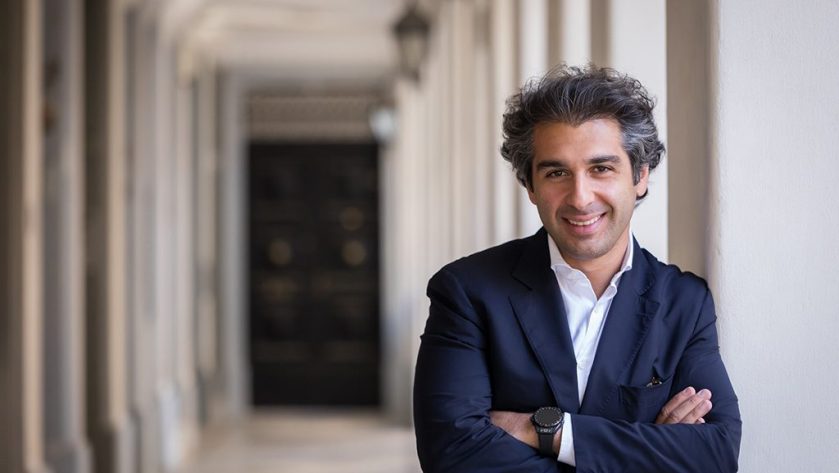
Sergey Smbatyan is Artistic Director and Principal Conductor of the Armenian State Symphony Orchestra
Artist image: DARREN AGIUS
Discover more from MEET THE ARTIST
Subscribe to get the latest posts sent to your email.

