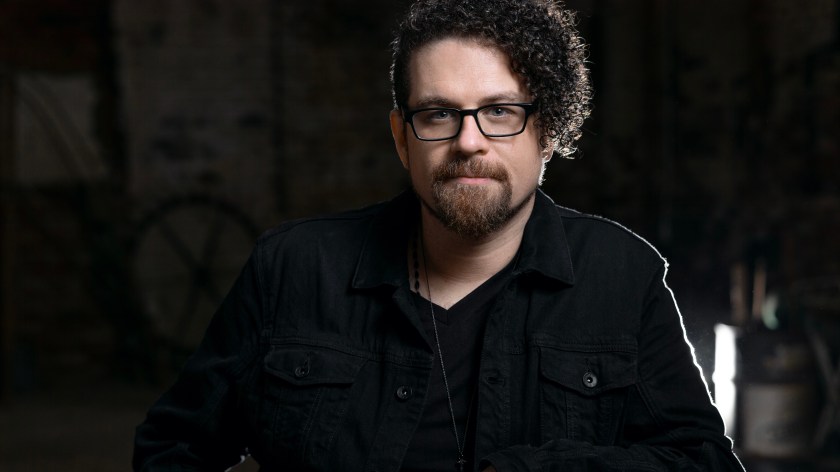
Who or what are the most significant influences on your musical life and career as a composer?
Wow that’s a tough one, in part because I have such a wide range of influences: The Cure, Megadeth, Ministry, Danny Elfman, John Williams, Igor Stravinsky, Pantera, Nine Inch Nails, Charles Ives, Gloria Coates, Aaron Copland, Philip Glass, Ani Difranco, Utah Philips, Messiaen, Mozart, Peter, Paul, & Mary, Bach, Beethoven, Ustvolskaya, Bang on a Can, Bob Dylan, Living Colour, SunnO))), Public Enemy, Giovanni Valentini, Dave Brubeck, Tony Williams, Rage Against the Machine, Dar Williams, Oingo Boingo, Reich, Berg, Andriessen, Mahler, Glass. And in terms of how to have a life in music, I’ve taken a lot from Louis Andriessen and Phillip Glass. And of course my teachers, colleagues and family have been hugely influential.
What have been the greatest challenges of your career so far?
I feel like the biggest challenge is to stay true to your vision, even during periods when that vision might not necessarily be trending in the mainstream. I was lucky to be on the ground floor of the indie-classical thing, and it brought a lot of attention to many of us that we might not have gotten otherwise. But I always felt somewhat on the fringes of that movement, even as I was deeply involved. I was grateful that it offered a spotlight on the work I was doing with my ensemble Newspeak, even if we always felt a bit edgier than some of the other work in that scene. But just at the moment that Newspeak was doing its thing–playing sweet light crude all over–my work was also starting to expand into a fuller realization of my vision, which was presented in Dog Days and Soldier Songs. By the time these pieces ultimately came to NY, people knew my work already–or thought they did. And because people thought they knew my work already, I was able to surprise them with this larger, more complex, and clearer vision through the operas and the big chamber pieces that followed, like Haunt of Last Nightfall, etc. It created a bit of a shock to the system, especially in the press, which felt scary at the time, but actually really helped me. But none of that would have happened if I had tried to shave the edges off my work to match the more prevalent indie- vibes, which (to me) seemed a lot more mellow…
What are the special challenges/pleasures of working on a commissioned piece?
Well, it is really wonderful to be able to do something you love, and then pay your bills from it. And to have a contract that says someone will perform the piece you write. These are far nicer things than the alternative. But sometimes there are also limits or frameworks that aren’t especially helpful to the creative process. I’ve been lucky to have mostly dodged these in my day, though every now and then they slip through and you have to advocate strongly for the piece you believe in, seeing it through to the premiere. But it’s still the best job imaginable.
What are the special challenges/pleasures of working with particular musicians, singers, ensembles or orchestras?
I’ve been fortunate to work with the same musicians on a lot of different projects – including one I’m also married to, the amazing clarinetist Eileen Mack – and there’s a shorthand that develops which is really magical. The same is true with Newspeak, the ensemble that Eileen and I run together — full of terrific players who really get what I’m going for. And though I’m not married to conductor Alan Pierson I may as well be for how much he gets my music on an intuitive level.
I’ve also been blessed to work with and compose for some really remarkable singers: Karim Sulayman (What Belongs to You), Timur (Black Lodge), Daniela Mack, Daniel Okulich, Matthew Worth, Sean Panikkar, Talise Trevigne, Cree Carrico, Katharine Goeldner (JFK), Lauren Worsham, Marnie Breckenridge, Peter Tansits, Jim Bobick (Dog Days), David Adam Moore, Christopher Burchett, Johnathan McCullough, Michael Mayes, Timothy Jones, (Soldier Songs). Each of these singers brought something new to the role they were singing, making brilliant suggestions on how things could sit better in their voices. I’ve learned a ton from them. Each opportunity to work with them is a gift, and it allows us to go deeper into the work, and into our collaborations.
Of which works are you most proud?
I’m proud of them all, but it’s the operas and large scale works that occupy a special place in terms of what they accomplish dramatically and musically, and for what the process of writing them revealed to me about my own artistic principles. There are a lot of them at this point: What Belongs to You, Dog Days, JFK, Soldier Songs, Black Lodge, SIN-EATER, and Vinkensport. I’d also add Haunt of Last Nightfall, AGENCY, and sweet light crude to this list–they’re like mini-operas, in their way. My friend, the composer Oscar Bettison once noted that some composers are like novelists, while others are more like short story writers. And just like with authors, there’s a place for both. I think I’m definitely a novelist – I want to go deep into a project and work on it for a year or more. These works almost all fall into that category.
How would you characterise your compositional language?
Well, according to my bio, my work “probes the deep corners of human psychology, invoking political, historical, spiritual, and social themes as pathways for exploring the human condition…and speaks to the mix of light and dark that we experience in life, unafraid to invoke the mythical, bewitching, disturbing, surreal, or comedic.” Which is to say, my work tends to be eclectic: I take in everything I hear and reframe it in my own voice, based on the story I’m telling or idea I’m exploring. There’s almost always a story or idea being communicated. But even in this eclecticism, I feel averse to the idea of pastiche as a form. I’m interested in what different stylistic reference points can do both for the storytelling, as well as its impact on the audience’s perception of the passing of time (a major obsession of mine.) So if I’m using a stylistic frame, it is absorbed into my own musical DNA, and it’s all done for a very specific dramatic purpose, seeking an outcome that wouldn’t be possible another way.
How do you work?
My first thought was “very hard, and all the time”, but I think that’s not what you meant. My process has evolved over the years, mostly getting more formalized in terms of schedule. In my 20s I used to work all day, stay up really late and write all night with a bottle of whisky next to me. Unsurprisingly this proved to not be the best approach long-term. Now I’m really strict about my schedule. I took a lot from the example of both Louis Andriessen and Philip Glass, who work on a schedule and stick to it. For me: I compose from 8 or 9 am to 2 pm or so, with a little break for lunch. After that, I deal with email and other stuff. I do this Monday through Thursday. Friday I teach all day, and the weekend is a wild card, aside from cleaning the house. If I need to catch up to stay on schedule with a piece, I can do more writing. Otherwise I just try to recover from the week. If you’d told me when I was 20 that this would be the way of working that would make me the most productive, I would have said you were out of your mind. It feels like it’s just not enough time! But it’s amazing how well it works for me. I’ve written so much music this way – way more than when Jack Daniels and I were trying to write for 10 hours straight until 4 am. (Shocking, I know!)
As a musician, what is your definition of success?
Writing music exactly as you believe it should be, and having performers who perform it just as you dreamt it for an audience that understands it. I have been fortunate to have that experience a number of times in my life–with pieces like Dog Days, and most recently, What Belongs to You. It is deeply meaningful.
What advice would you give to young/aspiring composers?
I will paraphrase the advice that my teacher William Bolcom told me on my first day of grad school: master your basics. Right now you’re young and inspired and you can wait for inspiration to strike in the middle of the night. (See above.) Someday, you won’t be as young, you may not be so inspired, but you’re still going to have to meet your deadlines. Having solid craft will get you through. I’m not quite as old yet as he was when he said this, but I can already tell you it is true.
What do you feel needs to be done to grow classical music’s audiences?
I think the classical music industry has done a pretty bad job using modern technology to find its audience. I’m not especially high tech myself. I’m vehemently anti-AI, and sort of loathe the algorithm. But…well I’ll say this: if there is an audience for mukbang there is an audience for new classical music. The mukbang crowd just uses today’s communication tools better than nearly anyone in classical music, and good for them! But as a classical composer, it’s all a bit frustrating.
What’s the one thing in the music industry we’re not talking about but you think we should be?
I was heartened to see Robert Ames’ recent op-ed in The Guardian about class in the classical music industry. I think this is a major topic in our world that we don’t discuss nearly enough. In the arts specifically, we tend not to discuss the fact that a lot of successful artists secretly come from money. (And I don’t mean that they come from middle class families, I mean that they come from real money.) I don’t fault them for that – I’d happily be one of them! And it doesn’t necessarily make them less talented or less worthy of success: the nice thing about being a classical musician is that, for the most part, you still have to be good at it to have a career and be taken seriously by the legit classical world. But it’s just a fact that–all difficulties about actually writing music aside–things are just going to be easier if someone has a lot of money. They won’t need to work a day job or worry about paying rent. They can roll out projects sooner, and on a bigger scale, because they have those resources, (to say nothing of connections). As a young composer coming up it can be hard to understand why some people just seemed to have an easier time of it. You can sometimes start to worry that you’re the problem–that you’re just not talented enough, or that you just need to work harder–but often, that’s not it: they may just have greater resources. In the end–when it comes to the work–things do eventually seem to level out, at least in the ways that matter. But, especially for young artists, it can do a job on your mental health. If things were even a little bit more transparent with regard to wealth and income, I think things would be a lot better for everyone.
What Belongs to You is the new opera by GRAMMY-nominated composer David T. Little
Discover more from MEET THE ARTIST
Subscribe to get the latest posts sent to your email.

