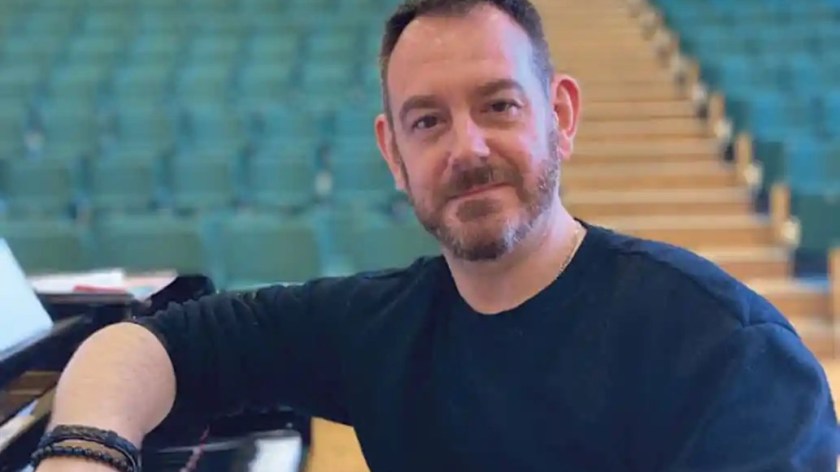
Who or what inspired you to pursue a career in music and who or what have been the most important influences on your musical life and career?
I don’t know if anything inspired me as such. As a child, I started messing around on a piano at school during break times, playing by ear and improvising, and around the same time a friend of my mother’s handed down a grubby old electronic organ, which I adored making a huge row on. I’m sure it sounded utterly horrific – I’m still amazed the neighbours didn’t move! Eventually the school music teacher, who kindly gave me some tips to get me started, suggested to my parents that I have lessons. I don’t honestly remember the exact time-frame – this must have been when I was maybe 8 or 9 years old. I wasn’t keen on the idea of lessons at all, but it was my parents’ condition for their investing in a real piano, so I grudgingly took the trade. I do remember that my exam pieces books for grades 1, 2, and 3, which had grim burgundy covers, were from 1988, so I would’ve been 11 by then. When I was 14, I started playing for classes at a local ballet school, then accompanying a couple of local amateur choirs. Especially around Christmas concert season, it was quite a challenge juggling everything around school, which I suppose by comparison already felt slightly superfluous and definitely far less interesting. By that stage a musical career seemed rather more an inevitability than a choice.
In terms of influences, at various stages so many different pianists, teachers, writers, have all given me something to think about, or aspire to. My high school form teacher, Mike Frost, shared so much time and wisdom – and his entire record collection. By the time I left school I knew literally hundreds of pieces, symphonies, overtures, concertos, lieder, opera, chamber music, by Beethoven, Brahms, Haydn, Schubert, Schumann, Tchaikovsky, Stravinsky, Bartok, Mahler, Schoenberg, so much music.… I’m immeasurably grateful for that.
My first piano teacher, Margaret Fisher, shared her passion for Mozart, which is a gift that still enriches my life thirty-odd years later, and taught me that high standards are the only standards worth having. The marvellous Christopher Elton exemplified the highest dedication to teaching and playing, and frequently showed me how brutal honesty can be just as effective accompanied with a smile and a sense of humour, and much less devastating than when it’s served neat. Outside of music, Alison Sutton taught me how to learn languages, and I have appreciated that every single day of my life. Mary Ashmore taught me that there are some books worth reading that aren’t chemistry textbooks.
What have been the greatest challenges of your career so far?
If we’re thinking of external challenges, I suppose it would have to be the pandemic lockdown. That was the first time in thirty years that I wasn’t travelling, rehearsing, teaching, researching. All sorts of projects were shelved, so much planning was wasted, and with so much uncertainty about the future, not to mention the financial implications, it was very difficult to come to terms with.
Other than that, I think most musicians like to challenge themselves – it’s how we grow, avoid stagnation and boredom. In some ways, each encounter with a new work or a new composer is a challenge, either to my technique or to my musical imagination. That’s absolutely my favourite part of a musician’s life. Certainly, preparing to record the album of Bernard Hughes’s [piano] music was a big project, lots of works, and lots of notes. Just in terms of covering the material, even though I already knew some of it reasonably well, that was probably the biggest single ‘project’ since my first ever post-graduation gig, which was a weekend-long series of lecture-recitals on the complete Mozart piano sonatas. Generally, though, I don’t enjoy this kind of ‘marathon’ project. Big and ambitious projects, sure, but it’s a matter of time, as well. Too much playing without sufficient variety, and time for reflection, doesn’t give me much pleasure. I don’t really believe that music should be about endurance, you know?
Which performances/recordings are you most proud of?
I honestly can’t say – I don’t like to listen to myself, I’m rarely satisfied, and probably less understanding of my own shortcomings than I am of those of others. I do periodically record my practice sessions, but it’s different when things are destined to remain private, isn’t it?!
That said, I am very pleased to have done Bernard’s piano album [Bagatelles]. It’s a substantial milestone in a musical relationship that now goes back probably twenty years or so, to our days as doctoral students. It really captures all facets of Bernard’s kaleidoscopic musical personality, and having a close knowledge of the composer as well as the music, I think gives it a special resonance. Despite a difficult start thanks to a perfect storm of travel problems, it was a good experience. The engineer, John Croft, was wonderful to work with, the piano was biddable, and Bernard generously provided much chocolate… it was all very happy.
Which particular works/composers do you think you perform best?
For some reason, I’ve always felt a close affinity with Schumann. One of my high-school music teachers gave me a few big old volumes of hers. They were falling apart, and the pages were disintegrating! I remember spending hours battling my way through the op. 12 Fantasiestücke, Études symphoniques, Bunte Blätter, and Waldszenen, and loving it -although, again, the neighbours probably didn’t!
Scarlatti is never-endingly wonderful. I’m always astonished at his sheer creativity and the utter joyfulness in his music. I always find Ravel hits the spot. Whether I play any of it well… who knows? That’s a different matter!
What do you do off stage that provides inspiration on stage?
Day to day, most of my time is spent either researching or coaching. Of course, it’s always great to work with people at the top of their game, but it’s an entirely different thing to explore concepts with people who aren’t there yet. Aside from the obvious pleasure in seeing them progress, it forces you to think clearly and to communicate verbally meaningfully – it’s not enough just to be able to do it yourself, you have to be able to put it into words, you know? Especially now, post-lockdown, when so much of my work is online – of course it’s always possible to demonstrate things, but there’s still no excuse for dithering! Finding just the right image saves so much time.
How do you make your repertoire choices from season to season?
In this sense, I’m lucky because I don’t perform so often that this is really an issue. I never have to live with any work or programme for longer than it holds interest for me! I imagine that aspect of a full-time concert pianist’s life must be quite onerous, always having to plan months or years in advance. Even when I was a student and I was having to announce programmes for the following term, it felt terribly oppressive. Now, I always have so much repertoire in various stages of preparation, some of it new, some of it I have been coming back to on and off for decades, so playing never feels like a chore or an obligation. I’m not quite at the stage where I can draw a crowd without telling them in advance what I’ll play, but that is definitely the ideal!
Do you have a favourite concert venue to perform in and why?
Not a specific venue, as there are so many factors that contribute to the experience of a performance. In general I prefer smaller halls – as an audience-member, as well. So much of the solo piano repertoire was written before very large public venues were a thing, and that sense of intimacy is an aspect of the music that often gets lost now. For me, the most exciting sounds are those pianissimos that just breathe on the edge of silence, you know? You can really draw the listener in, create that very special atmosphere of concentration.… You just can’t play like that in a large hall, it would just get lost. No matter how good the instrument or the acoustic – it’s only ever at best a stage whisper, and the need for projection is always a barrier to achieving that really sort of almost confessional atmosphere.
What is your most memorable concert experience?
It’s strange, but I don’t often think about the past. Once it’s done, it’s gone. While I don’t remember the performance at all, I still have a very distinct impression of the emotion as I was taking the applause after what I suppose you’d call my concerto debut, playing the Rhapsody in Blue in Dudley Town Hall – I’m sure very badly. I think I was perhaps 17, and it was the biggest crowd I’d played to, around 800 people. Aside from feeling, inevitably, a certain amount of relief that it was over, I do remember gazing up at the balcony and thinking ‘yeah, this wouldn’t be a bad thing to get used to…’
On the other hand, I once spent the entire orchestral opening of the slow movement of the Grieg concerto trying and failing to remember my entry. My mind was completely, utterly blank for what was both the longest and shortest 28 bars of music in my life. They’d reached my upbeat by the time I thought ‘erm, well, we’re in D-flat—oh yes! D-flats! That’s it!’ Things like that only tend to happen once. The brain is a weird and wonderful thing…. That’s an experience I’d quite happily forget, but try as I might, I can’t!
As a musician, what is your definition of success?
Being able to pay the bills! More seriously, when someone takes the time to speak to me after a performance. When I was young I found it difficult to accept: I was so concerned with everything I’d done badly, and so disappointed, I didn’t really know why anyone would tell me they’d enjoyed it. Now, of course, I’m just grateful to hear that something got across to someone, you know. That’s why we do it, isn’t it?
What do you feel needs to be done to grow classical music’s audiences?
Hmm. This is a difficult issue, as there are lots of different factors, and I have many thoughts. I am essentially an optimist – I’ve been hearing that Classical music is dying ever since I first started studying the piano, but I don’t see signs of that. Look at live-streams of concerts from Germany, Italy, France, and further afield, South and Central America, the Far East… audiences are there, and they seem to be getting younger. Or maybe it’s just me who’s getting older!
The risk, it seems to me, about growing audiences is two-fold. Firstly, in trying to attract a newer, wider audience, there is a danger of compromising the art-form itself. I’m a traditionalist, but I can see why many people find the traditional concert experience uncomfortable. The public concert evolved before recordings, and it was a comparatively rare treat. Now music is so readily accessible – can you imagine only having heard Beethoven’s symphonies in a piano-duet arrangement? But economists tell us that more abundant supply lowers a commodity’s value. It saddens me that even people who claim to love music so often use it as an accompaniment to other everyday activities. I don’t listen to music, unless I am listening to music. The experience of sitting still, focussing all my concentration on the music, is not alien to me. And of course, the visual emphasis of so much social media seems to be leading to a generation of musicians who play for people who watch music, especially pianists. Their body language and facial expression are so emotive, almost histrionic sometimes, but if you close your eyes, most of the time little to none of that comes through in the music. Compare that to Rubinstein or Horowitz! This isn’t a problem solved by something as superficial as performers wearing T-shirts and jeans. As musicians, we have to stick up for our art. Let Moses come to the mountain, as it were. Live music is special, no matter what the genre, but it requires the public to be open to sharing in what makes it special, to be willing to approach it on its terms. The second risk is, simply, that in trying to please everyone, we end up pleasing no-one. I’m quite happy to be in a niche, as long as I’m not alone there, you know?
But I no longer live in the UK, of course. There, the economics of performing arts are a genuine issue – funding is inadequate, and the decisions made in its allocation are made, increasingly it seems, by people with little understanding of how the sector works, and who don’t recognise what a huge contribution the arts make, not only economically, but more generally to the country’s international reputation, and to the happiness and health of its people. It must be incredibly frustrating for the bottom line to have to factor in decisions that, in the ideal circumstances, should be purely creative. So I can see why locally, this is a question of concern.
Of course, Western Classical music evolved in a culture of patronage, either that of the Church, or of larger or smaller aristocratic courts. It was never intended to support itself financially, let alone to turn a profit. The quality of your court composers, your orchestra, your singers, reflected on your status – not just economically or socially, but spiritually. It was an investment with many non-monetary returns. A government that fails to recognise this – and it seems to me that the UK’s current batch are pretty much all utter philistines – will never create an environment where the creative arts can thrive.
For instance, the so-called Russian Enlightenment under Catherine the Great introduced artists and philosophers from Western Europe to the Russian court. Within a century of the first Italian operas being performed in Russia, I think that was in the 1730s, and the first public concerts in the 1740s, you have Glinka, Tchaikovsky, the Mighty Five, the Mariinsky! Imagine, in two centuries to go from not having a single harpsichord to producing the Rubinsteins, Arensky, Siloti, Rachmaninov, Neuhaus, Skryabin… pianists, composers, and teachers who have made an enormous, indelible contribution to the musical world as we know it today. When the political commitment and the money are there, you know, so, so much can happen, so much progress can be made. Other European countries still seem to understand this far better, whereas in the UK there seems to be an institutionalised embarrassment about supporting the performing arts. Look at the German Kulturpass, for instance. It’s a fantastic idea, and a realisation that access and exposure are the key barriers to people discovering the performing arts, as consumers, rather than participants.
This comes through with education, as well. I personally think there is too much emphasis on participation, and not enough on appreciation. Myself as an example, I am not a visual arts person. To this day, my idea of hell is traipsing through somewhere like the National Gallery or the Louvre, they are just the most miserable places. I just don’t get it, but I’m sure I’m missing out. I can say if I like something or not, that’s pretty much the limit of my understanding. Nice shape, pretty colour, picture good. But at university, one of my close friends was an art historian, and she once dragged me along with her to look at the Wilton Diptych, which was a particular passion of hers. Having someone knowledgeable and enthusiastic take the time to explain what was going on, engage with the various issues in the interpretation, especially with a work produced in a context so vastly different to our own…. it was eye-opening, and in fact so enjoyable that a couple of hours flew by without me even wondering how far I was from the café. But for years before this I’d sat through ‘Art’ lessons at school, utterly bored, being encouraged to draw or paint or make something vague with clay, and not having a clue what I was doing, and obviously – well, it was obvious to me, at least – not being one of the kids who could just do it. What a waste of time! All that experience taught me was that visual arts aren’t for me. It was sort of the same in English, we were all encouraged to take part in school plays, but never taught how to act. Imagine doing this in Maths, just throwing equations out and expecting everyone to solve them without first being shown how or why.
Music at school, of course, was a doddle for me, but for those kids who weren’t learning an instrument, for whom curriculum music was their only miniscule exposure to Classical music? I imagine they felt about it the way I felt about Art, and probably most of them still do. The idea of ‘music appreciation’ sounds terribly worthy and Victorian, I know, but it at least acknowledges that the arts are vastly more approachable when you know something about them, when someone with more experience has curated your first encounters. Music, opera, theatre, sculpture, ballet…. these are all vast, varied, and bewildering areas to explore and for the uninitiated it must be intimidating to want to dip your toe in but not to know where to start. I’m not suggesting that the opportunity to participate shouldn’t be there for those who want to try it. But expecting kids to do things that require skill, practice, and for which some people have greater natural affinity than others, to experience the arts only as untrained producers, surely only discourages them from participating as consumers. And ultimately, we need more consumers than producers.
There is also a worrying denigration of professionalism in the UK. While I obviously welcome anything that helps spread the word about how great playing the piano is, I find it slightly mortifying that Channel 4 has recently devoted more air-time to amateurs playing grubby pianos in railway stations than the BBC has given to the Young Musician of the Year competition for years. The message seems to be that people ‘having a go’ in some sort of competitive context is great entertainment, but people making the sacrifice and the commitment to devote their lives to the pursuit of the highest levels of excellence in a complex and challenging art-form? No-one, apparently, should want to know about that. There is no institution in British cultural life better positioned than the BBC to promote the performing arts, and to inform people about them, to give them that curated early exposure. But it seems that there is at best an embarrassment about the arts, and at worst an almost undisguised attempt to blow up the foundations from inside the house. To say you want the arts to reach a wide audience, but then deny them a platform… I don’t know whether the decision-makers lack confidence in the art forms, or in the audience. Maybe it’s both, or maybe they themselves just really are that stupid. Either way, it’s heartbreaking.
What advice would you give to young/aspiring musicians?
Always be curious. Always be generous. Always take your work seriously. Never take yourself seriously. Oh, and if you’re in the UK, leave. Now! Scram!
What’s next? Where would you like to be in 10 years?
I’m currently editing the complete solo piano music of Adolf Jensen, working on a couple of books and a few other little editing projects, and preparing for a couple of recording projects for later this year. One will be a foray into period instruments, so that will be particularly exciting.
In ten years, well, I have no idea! If the pandemic taught us anything, it’s surely that we should never take what we have for granted. For as long as possible, I’d like to keep doing what I’m doing – despite many requests to stop.
What is your idea of perfect happiness?
Finally, an easy question! Cats, coffee, croissants, crossword.
What is your most treasured possession?
My grandfather’s watch.
What is your present state of mind?
Well, last night I was working on some Hindemith til after 2, and the cats woke me up at 6.15 this morning for an unhelpfully earlier-than-usual breakfast, so my state of mind is, erm, chaotic and sluggish? So, probably the same as always!
Bagatelles: piano music by Bernard Hughes, performed by Matthew Mills, is released on the Divine Art label on 9th June 2023. The album represents the culmination of many years of collaboration between Hughes and the pianist Matthew Mills, who commissioned and premieres a new suite, Partita Contrafacta. Find out more / buy the CD
Listen to a sample track
Discover more from MEET THE ARTIST
Subscribe to get the latest posts sent to your email.
 MEET THE ARTIST
One comment
Comments are closed.