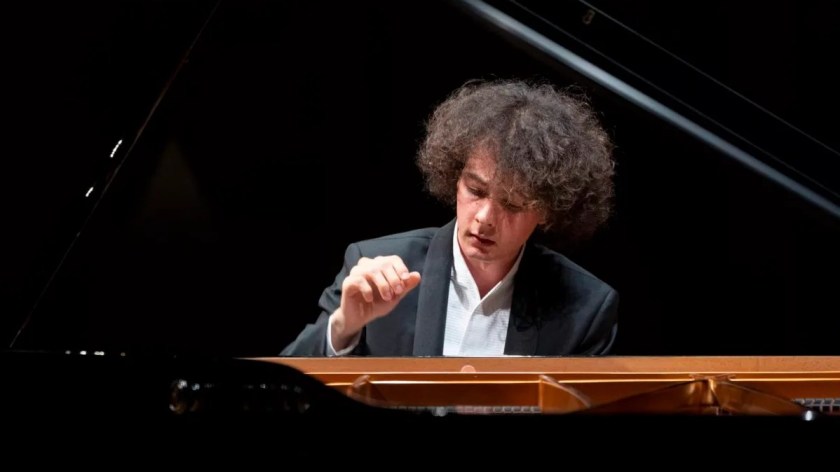
Can Çakmur won the first prize and the chamber music prize at the 10th International Hamamatsu International Piano Competition in 2018. As a part of the prizewinner’s package, he has performed over 20 concerts in Japan in 2019 and 2020 and recorded a debut disc with BIS, then signing for a new complete edition of Schubert’s solo piano music. Volume II will be released on 9 February. It will include Schubert 3 Piano Pieces D.946 and 4 Impromptus D.935 juxtaposed with Brahms 4 Piano Pieces Op.119.
He will appear at Kings Place in London on 19 January 2024 for the Hamamatsu International Piano Competition Showcase with the chairperson of the competition Noriko Ogawa and esteemed musicians Ben Gilmore, Rosalind Ventris and Tim Posner playing solo and chamber works by Mozart, Beethoven, Schubert and Fazil Say.
Who or what inspired you to pursue a career in music and who or what have been the most important influences on your musical life and career?
My interest in music and the decision to embrace it as a profession developed gradually without a real turning point, from attending concerts as a five-year-old to deciding to move to Germany for undergraduate studies. My family members are not musicians and neither are they particularly astute about the intricacies of the beginning of a music career, but they adore music. That was a blessing – I could hold onto the magic of music without questioning whether I was “good enough”. I was not exactly a child prodigy and if I had been pushed into the role, I would have suffered. The moment closest to a turning point was the first masterclass I attended, along with many pianists I would regularly study with later (Diane Andersen for 11 years, Jun Kanno…). I was thirteen at the time and it was the first time I came face to face with the possibility of becoming a professional musician.
My teachers have all been in a way people who provided balance when I could have easily been engulfed in a particular way of thinking. I always had a way of learning whereby I got passionate about a certain thing, went crazy about it for a while and then moved on to the next thing. Then some of these influences I later disregarded while others stayed on. Fischer-Dieskau’s musical interpretation is one that stayed with me, although I must say that nowadays, I am less persuaded by music-making of the post-World War 2 era. It feels to me that the Urtext harmed our musicianship a lot because of what that era attributed to it, namely the final word in composer’s “musical intentions”. Instead of it being something liberating, Urtext became something limiting.
The other big influence – which came through friends – was historically informed practice. I was obsessed with doing the “right thing”. I perhaps didn’t realise that while rejecting the literal reading of the Urtext, I was replacing it with yet another dogma. That way I developed a taste for early recordings. This is something I still enjoy very much today, if for nothing else just to listen to all possibilities of interpretation. While I’d vehemently disagree that the presumed “shortcomings” of those performances, I would not go as far as to praise the “good old days” and try to act as if these recordings were the only correct way of doing things. Lately I have discovered Robert Fripp and King Crimson and I have the feeling that I am starting to understand modern music for the first time. As classical musicians, our mother tongue is predominantly “regular” music, whether metrically or harmonically. It is so nice to hear music played by musicians whose native tongue is not necessarily “regular”. There is something that is simple and intuitive about their music. Why wouldn’t the same apply to modern classical music as well?
What have been the greatest challenges of your career so far?
It is a bit strange answering this question at 26. So far, my greatest challenge is still ongoing. What I mean by that is establishing myself in the concert circuit while still having a clear vision of what I would like to do artistically.
Which performances/recordings are you most proud of?
I actually like the CDs I have recorded with the producer Ingo Petry for what they are. I don’t necessarily agree with how I played things but I think they are well made and are consistent within themselves. Among those I enjoy listening to, Without Borders and the Schubert Vol. 2 (which will come out in February) would come first, without necessarily wanting to become critical.
Unless I am producing a CD, I try not to think too much about what the future Can will be thinking. Performances are a line drawn in sand: if I get emotional and make somebody’s evening slightly better, it’s all good.
Which particular works/composers do you think you perform best?
Well, it is easy to say Schubert as I am recording all of his piano music but I actually think I am most comfortable playing Liszt. I also really enjoy playing modern music, irrespective of the composer. Bach is my favourite composer but from a technical point of view, I struggle with playing his music on the modern piano. Mozart is fun too but I am not very good at finding a compromise between the dynamic range I feel comfortable with and what a large concert hall and a modern piano requires. It is getting better though; I think I learned a lot this year.
What do you do off stage that provides inspiration on stage?
Running has been a companion since the pandemic. I got pretty serious about it and I am also quite proud of how it’s been developing. I just hope to find a bit more time for it in the coming months. I got very curious about what the professionals are doing and tried to find as much insight into it both from an anecdotal and scientific perspective. I think the athlete’s mind and the performing musician’s mind have a lot in common. We have a lot to learn from them, especially pedagogically. I have a meme of a sad Eliud Kipchoge on my phone for the times I lose focus and start procrastinating.
How do you make your repertoire choices from season to season?
I generally play whatever I am asked to play! I am quite flexible with programming and love learning new repertoire.
Of course when it comes to recordings, I have to decide the repertoire beforehand, but even then, there is a bit of flexibility to decide when I’ll record what.
Do you have a favourite concert venue to perform in and why?
There are a few halls with a capacity of around 600 people where I feel it is small enough that I don’t have to think about projection, but also offering a space large enough to avoid the need to downscale. It is also a big plus if I have a well-prepared piano. One of my favourite concert halls is in Kirishima, Miyama Konseru. It is at the southernmost end of Japan, on volcanic soil around mountains. It is just magical. I played there twice and I felt so inspired each time.
What do you feel needs to be done to grow classical music’s audiences?
I think classical music’s audience is growing. The streaming numbers are up and I seem to remember reading that in 2022, classical music was the fastest growing genre. Now, I think we need to ask ourselves what we have to do to draw these casual listeners to concert halls and bring more variety to their listening experience. I think we need to completely revamp the culture of classical music, starting from us performers, to marketing and to the eventual concert experience people are subjected to. To me it has a lot to do with classical people’s idea of integrity and with the distance (both metaphoric and physical) between us and the audience. Classical performance – in its performance practice as well as the whole listening cult – assumes and desires prior knowledge of the score or at least a thorough listening background. In other words, the whole business focuses very much on execution and of the minute differences on that level whereas I’d argue that the audience’s attention is much more focused on the connection they have with that music at that particular moment. Execution in direct reference to other recordings or to the score is not really relevant. To say the performance X is special because it has more rubato than usual is quite meaningless if the person can’t vividly remember the usual manner of performing the piece. A few research papers (notably by Glen Kwok and Chris Dromey) argument quite convincingly that the musical perception is not reliable even in the case of professionals. So much of our musical taste (as professional musicians) has been cultivated through direct comparison of recordings (X plays faster, cleaner; Y plays flatter, Z plays melodies with so much inflection…). For most listeners, it is daunting to even make a comment on a performance they’ve just heard, lest they make the wrong judgement by saying X has played virtuosically where there had actually been insecurities in their playing. I also believe that greater freedom of expression is absolutely necessary in the concert hall, especially when the audience could just stream music. Many pop bands, it is said, play so much better live than on tape. Very often that comes with a specific version of that piece with different ornamentation and with different effects. Some people love it, some hate it but it is an “experience” either way. That applies to our music as well! Music that is produced and music that is performed are different genres and require different approaches.
What is your most memorable concert experience?
I haven’t attended as many concerts as I would have liked. Having studied in the tiny town that is Weimar, most of the cultural life revolved around the university. The class concerts were something quite special, specifically two of them where my classmates Lovre Marusic and Deren Wang played Liszt Funérailles and Rachmaninov Third Concerto respectively. Those two remain my favourite concert experiences to date. Even though I knew their playing well (we used to play for each other often), it blew me away with how much love and care they performed those pieces.
As a musician, what is your definition of success?
Not having to think about whether I will have enough work to live reasonably comfortably. If what I do matters more than how much I do, I can be content.
What advice would you give to young/aspiring musicians?
Career is a by-product of doing other, more valuable things. Sometimes it is necessary to do things to ensure one’s livelihood but while studying, artistry counts more than anything else. It is (or rather should be) a safe space to try out things.
Sciences, arts, sport and good friends are not to be underestimated. Music is wonderful but life has more to offer than playing an instrument in a badly ventilated practice room and then going on stage.
Most of all, asking the question “Why?” is never a bad idea. Finding an answer and doing something about it is always a good idea.
What’s the one thing in the music industry we’re not talking about which you think we should be?
The idea of curating a concert. We are still stuck in offering a program of 80 minutes plus intermission, ideally with a larger piece and some smaller ones. It is good and fitting for certain places but for most, it is antiquated. I would like organisers and artists to work together to decorate time, creating space for intellectual (but not snobbish) discourse, offering a safe haven from the dopamine addiction we all suffer from, and drinking. Then perhaps we would see that music is indispensable not because “Oh it is so important!” but because it changes people and gives them something they would never get if they went by their daily lives. There are these wonderful initiatives all over the world but they are, as of now, fringe events. It would be nice if they slowly moved towards the mainstream.
What’s next? Where would you like to be in 10 years?
Well, hopefully the world stays in one piece. Current developments make me question the future of civilisation.
What is your idea of perfect happiness?
Working is fine! This is something I found very endearing in East African athletes: they seem not to train so that they are done, they seem to do it… because they do it. No justification, no end goal; just a way of life.
What is your most treasured possession?
I really, really, really like my piano. Also, some souvenirs from family and friends: I sometimes feel guilty that I am less present than I would like to be in their lives and those help me during these times.
Photo: HIPIC
Discover more from MEET THE ARTIST
Subscribe to get the latest posts sent to your email.
 MEET THE ARTIST