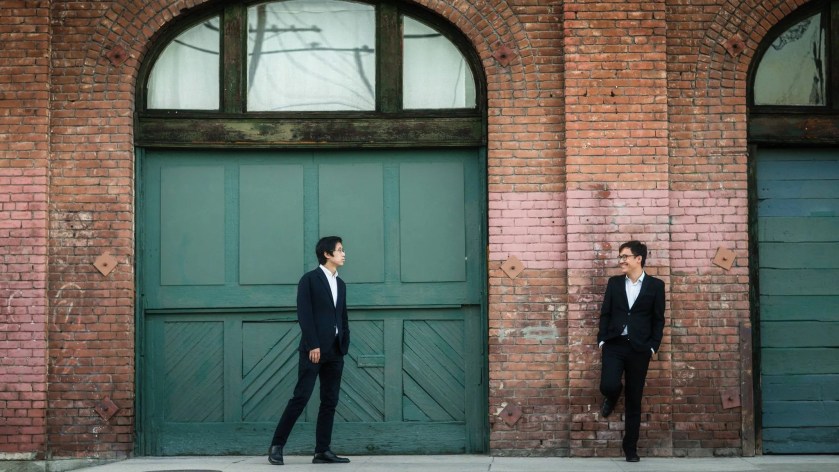
Who or what inspired you to pursue a career in music and who or what have been the most important influences on your musical life and career?
Both of us were born into musical families and received formal training at very young ages. While we have always been inspired and influenced by the usual greats of classical music, both performers and composers, our work as the Super Piano Brothers has always come from our passion for the soundtracks of video games and movies.
As children we were enraptured and fascinated that the act of just listening to these soundtracks recreated the experience of engaging with the game or film itself. Actually performing these soundtracks ourselves, and later reinventing those performances through the lens of classical styles, brought that experience to a whole new level.
The greatest influence on us has always been the fans. Although we do not make most of our artistic decisions based on the whims of the audience, it is the thrill of seeing their smiles and hearing their joy that will keep us going forever.
What have been the greatest challenges of your career so far?
Our journey hasn’t been without hurdles, some of which we’ve come across since the very beginning. As pioneers of bridging the audiences and artistry between classical music and popular media (films, video games, etc.), we’ve had to continuously adapt our music to appeal to audiences of both genres and find the balance of support. This hasn’t always come easy given our formal classical music education at The Juilliard School (Oskar), The New England Conservatory (Wesley), and other prestigious institutions.
Logistics and technology have also been challenging at times, as the two of us have continuously lived far apart since 2009. This has impacted our consistency of collaboration and while we have experimented with various technological setups (low latency collaborations, etc.), it is hard to create spontaneous and seamless music while apart. Lastly, being a two piano group, we’ve often had to play on keyboards, electric pianos, or just on one piano given not all halls have two grand pianos.
Which performances/recordings are you most proud of?
We have a soft spot for two recordings, both from our earliest days. One is the video that gave us our first big break: “Bob-Omb Battlefield”, which won us the 2013 ECAASU Talent Competition, and the other is our haphazardly-recorded “Smash Melee Opening” that was our first real entry in the world of online music-making.
In recent years, our epic recording of the “Star Wars Suite” in collaboration with director Christine Zivic is a cherished feather in our cap. And – although it hasn’t happened yet – our upcoming debut at Las Vegas’s “The Industry”, front-lining the Re-Classified concert series, is something we’re incredibly psyched-up for!
Which particular works/composers do you think you perform best?
SPB enjoys a unique niche where the entirety of our output is personally composed / arranged, but always based on or influenced by the work of other composers. This creates a fascinating crossover between the styles of our various in-house composers and the soundtracks we pull from.
Although every one of us has our own preferences in terms of musical style and of course, games and movies, our ability and determination to find something to love in every single piece is what gives us that edge when performing them.
What do you do off stage that provides inspiration on stage?
It may sound silly at first, but aside from the obvious – listening to as much music as we can – we do research by playing video games and watching movies! It is essential to our work that we are familiar with as many sources of inspiration as we can, and there is no better way to capture that feeling of joy than to engage with the sources directly. This way, pivotal moments in-game or onscreen, uplifted by an amazing soundtrack, can be directly translated onto the page and performance on a foundation of personal experience.
How do you make your repertoire choices from season to season?
We divide our repertoire into two categories: new releases, reflecting both popular trends and our evolving tastes, and a rotating list of old favorites, some of which date back to our earliest days as a group. The distinction between these two categories is actually an important theme for our upcoming Las Vegas concert, where classics such as our rendition of “Bob-Omb Battlefield” will be pitted against “Undertale”, underscoring a live theatrical performance portraying the uneasy but loving relationship between a father and his daughter.
Do you have a favourite concert venue to perform in and why?
While we have played to sold out halls across the world in both classical and pop venues, our ideal hall is a place that combines the best of both worlds. It would have the acoustics and stage setup of a classical music concert hall, but with the frills and excitement of a pop venue (think smoke machines, pyro, etc.). And given that we often take melodic inspirations from films and games, we want a space where we can pay homage to the original sources through background splashes and animations. All in all, we haven’t found the perfect place yet, but we have a few coming up that seem incredibly promising, including “The Industry” in Las Vegas.
What do you feel needs to be done to grow classical music’s audiences?
We are firmly in the camp that classical music would benefit from more crossovers and collaborations. Many audiences don’t know that so many of their favorite soundtracks and pop songs have classical notations, instrumentation, structures, and so much more – and double clicking on this common ground and fundamentals is key to unlocking new listeners.
What is your most memorable concert experience?
While not the biggest, our most memorable performance to date was also our U.S. debut at 2013’s ECAASU Opening Gala after winning the talent competition by popular vote. It was one of our first instances of performing to a primarily young crowd of 2000+ who were knowledgeable and enthusiastic about the films and games we depicted in our songs, and one of the first times we performed at a pop venue with different lighting and effects than the traditional classical concert halls we’ve been used to playing in. We also shared the stage with comedians, pop singers, and dance groups so the overall vibe was totally different and memorable.
And although it technically hasn’t happened yet, preparing for our upcoming debut at Re-Classified is definitely going to be another cherished milestone. It will be a groundbreaking event in so many ways, ranging from the experimental styles we will try out, our first foray into working with a cutting-edge in-concert digital display system, our first collaboration with live actors in an original theatrical work, the list goes on. We hope you can join us, whether it be live, online, or even retroactively!
As musicians, what is your definition of success?
Above all, as artists we strive to satisfy our own wishes and desires with the work we produce. We cannot hope to inspire and uplift others without having first done that for ourselves. Therefore, when we engage with the audience directly during or after a performance, we know in our hearts that we are connected by the same feelings in that moment.
What advice would you give to young/aspiring musicians?
Find your core as an artist and always be ready to learn. The things you absorb from every part of your life can, with some reflection and self-awareness, be channeled into growing your core. This ranges from developing your skills to further refine your central mission, to the necessary pruning that happens as we mature, and of course, promotion of ourselves and the best possible representation of the message and experience we have to offer.
Above all, never limit yourself in terms of what you can grow from.
What’s the one thing in the music industry we’re not talking about which you think we should be?
Growing up as classically-trained musicians, we have seen in countless others (and ourselves) this focus on musical development at the cost of most other essential forms of development. This focus on the “front-end” – how to perform and how to compose – is no less vital than the “back-end” – how to manage and how to promote, among many other important skills. Even so-called basic, even cliche tasks such as tax-paying and marketing are too-often neglected by artists, usually because they conflict with what it should feel like to be an artist. To be a professional musician, as distinct from an amateur or hobbyist, is to treat one’s self or group as a business, and to grow that business accordingly.
While we are happy to see that many music conservatories such as Juilliard now offer entrepreneurship training and classes, we would encourage them to focus not just on the ideation and execution phase of a venture – but also on the maintenance and operational functions as well.
What is your idea of perfect happiness?
Oskar: Happiness for me is a continuous state of exploration, discovery, learning, and sharing. Whether that is through traveling, teaching, performing, or something else – as long as I am able to grow and develop myself while also helping others, I am at peace.
Wesley: I am happy when others around me are happy, and happiest when I have personally been integral to that happiness. As an artist and an educator I feel endlessly privileged to be in a position to deliver both short-and-long-term happiness to the people I work with.
Super Piano Brothers compose, transcribe, arrange, record and perform music from a wide variety of media such as popular music, asian pop, video games and movies. They create covers, medleys, arrangements and original music for two pianos.
Super Piano Brothers are:
Tiedan Oskar Yao (Columbia University, The Juilliard School)
Wesley Chu (New England Conservatory)
Discover more from MEET THE ARTIST
Subscribe to get the latest posts sent to your email.
 MEET THE ARTIST