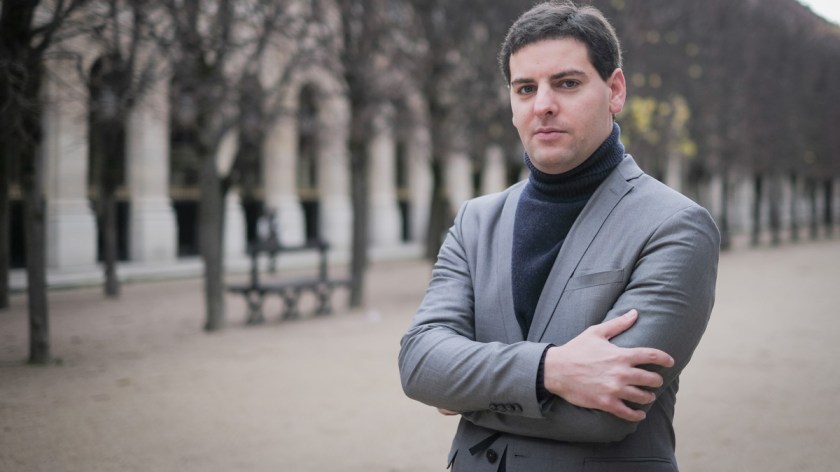
Who or what inspired you to pursue a career in music and who or what have been the most important influences on your musical life and career?
Two people: my dad and Itzhak Perlman! My father is a pianist and pedagogue, and of course my first contact with music was with him; then I remember that he made me listen to the famous recording of Brahms violin concerto by Perlman/Giulini. I was 5 years-old, I was literally in shock and I felt then that music would be my life.
What have been the greatest challenges of your career so far?
Playing under personal difficult circumstances is maybe the greatest challenge an artist can face, but it’s also the best remedy.
Which performances/recordings are you most proud of?
I loved recording Liszt’s Opera Paraphrases and Transcriptions; it was definitely a big challenge and the project was electrifying. And of course, I’m very proud of my latest baby, ‘Vienna: Joyful Apocalypse’, for Warner Classics!
Which particular works/composers do you think you perform best?
I feel at home with French, Viennese, and Russian music in general. Recently I gave a concert of Rachmaninov’s 3rd piano concerto and I felt a real osmosis between my personality and this work.
What do you do off stage that provides inspiration on stage?
I live a normal life, I read a lot, I enjoy meeting my friends: I don’t think it provides inspiration (inspiration as a concept is hard to define!), but I at least try to maintain a a good living environment, and this is very important for a musician. On stage, I try to play the works as if it was the first or the last time of my life.
How do you make your repertoire choices from season to season?
It may sound selfish, but I only play what I want to play! Piano repertoire is huge, so we’re lucky to be able to choose. When I feel a visceral need to play a certain kind of repertoire, I don’t hesitate.
Do you have a favourite concert venue to perform in and why?
Opéra de Paris was the venue where I gave my very first concert, when I was 9. It was a gala, and just before my performance and entrance on stage, Rudolf Nureyev, the legendary ballet dancer, shouted «toï-toï !» (that’s like « good luck» for musicians!) and smiled at me. I’ll never forget that moment, and this is the reason why I have kept this mythical venue in my heart.
What do you feel needs to be done to grow classical music’s audiences?
Thanks to fantastic music teachers in conservatories (who are heroes in my opinion), or marvellous experiences like El Sistema, we have living proof that young people from every social condition can access the beauty and nobility of music. We need to support educators whatever it costs, because they are the key. The cost of ignorance should justify those expenses in politicians’s eyes. But we also need to fight against ugliness and demagogy, those are tenacious enemies.
What is your most memorable concert experience?
Once I had to play Mozart concerto in Venice. We took a vaporetto with the whole orchestra to join the concert venue, a beautiful palazzo. It was a moment of pure happiness – I thought to myself, this is like a reward for all the sacrifices I made for being a pianist.
As a musician, what is your definition of success?
After a concert in Montreal, a man came backstage to kindly congratulate me, and said “you made me reveal some parts of my soul I even had no idea about”. So I guess this is my definition of success!
What advice would you give to young musicians?
I would say that this is the hardest job on earth, but it’s also the most beautiful one. So never give up (and practice )
What’s the one thing in the music industry we’re not talking about which you think we should be?
I think that the music industry is sometimes polluted by questions that have nothing to do with music itself. If I were to be provocative, I would say we’re not talking enough about music. It’s sacred.
Tell us a little more about Joyful Apocalypse – what can listeners look forward to on this album?
It’s the story of the rise and fall of Vienna through its music. In this album, especially in the first pieces you enjoy the eternal joie de vivre of Vienna with its waltzes. Then, slowly but surely, we can feel that happiness doesn’t last forever, a certain anxiety arises, until the very last piece of the album, Ravel’s La Valse, which is both an apocalypse and apotheosis, like a celebration of
Old Europe, written by a man who experienced the horrors of World War I, and the end of an era. More generally, there is the idea that empires, like nations, or human beings, are mortal. We have to cherish them as long as they’re alive, and even after their deaths.
What is your idea of perfect happiness?
Listening to Brahms’s 4th symphony, having a good espresso, playing chess, enjoying the company of my friends, and cuddling cats. If possible, in Tuscany – that would be perfect, thanks!
What is your most treasured possession?
My building and apartment burnt last year, so I lost all my possessions! Life and music in my head are my only possessions, and I treasure them 🙂
Aurélien Pontier’s album, Vienna: Joyful Apocalypse, is out now on Warner Classics
(Artist image courtesy of BS Artist Management)
Discover more from MEET THE ARTIST
Subscribe to get the latest posts sent to your email.
 MEET THE ARTIST