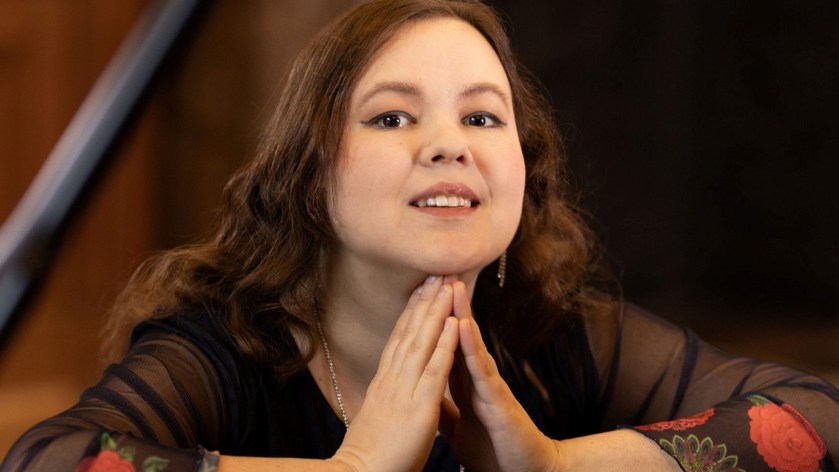
Who or what are the most significant influences on your musical life and career as a composer?
My teacher, who I was lucky to learn from, the fantastic Ukrainian composer Iryna Aleksiychuk, has greatly influenced my style and approach to composing music. As a pianist, I tend to write extensively for the piano. This includes solo piano works, which allow me to present my music personally, as well as compositions for ensembles with piano, and works for piano and orchestra. This inclination towards the piano can also be seen as a specific influence on my compositional style.
What have been the greatest challenges of your career so far?
Balancing different professional roles with family life has been my greatest challenge. I am a pianist, a piano teacher, and a composer, and each of these roles could easily be a full-time occupation, demanding all of my free time. However, I also believe that my daughter deserves as much of my free time as possible. Finding harmony between these responsibilities is not always easy, but it is something I am constantly working on.
What are the special challenges/pleasures of working on a commissioned piece?
Commissioned pieces are wonderful for pushing boundaries and challenging oneself. Many of the pieces I’ve composed came about only because of commissions. The biggest challenge here is often stepping out of my “comfort zone” to explore unusual instrument combinations or new genres. Of course, meeting deadlines is another significant challenge.
What are the special challenges/pleasures of working with particular musicians, singers, ensembles or orchestras?
I believe that clear communication of compositional intentions is key to making collaboration between musicians and the composer as smooth as possible. As an interpreter who has played a lot of modern music, I understand what it feels like from the other side. That’s why I always try to review my scores with an “interpreter’s eyes” before handing them over to the musicians.
Of which works are you most proud?
I am usually most proud of my latest works. Right now, that’s “After” for solo piano, which will be featured on my upcoming “War Poems” CD.
Other works I’m proud of include “The Dollhouse,” a concert fantasy for piano and orchestra, and the piano trio “Cyclic Moments.”
How would you characterise your compositional language?
I consider myself a traditionalist: I primarily write tonal music, but I enjoy blending it with atonal elements, or sometimes the reverse. I like to play with Baroque ornaments, incorporating them into 20th-century-style musical material. My main goal is to connect with the listener’s emotions, so I prioritize emotional impact over appearing modern or innovative. It’s important to me that people feel something when they listen to my music.
How do you work?
I always start with a thematic element that serves as the foundation for everything else. I often have a collection of themes or motifs that come to me at random times, which I immediately write down. When I’m ready to start composing, I choose one of these themes to develop further.
As a musician, what is your definition of success?
Success for a musician is the ability to touch the hearts of listeners. My goal is always to make people feel something they haven’t felt before when they listen to my music. After all, that’s what music exists for, right?
What advice would you give to young/aspiring composers?
Never give up. It’s tough sometimes, and self-doubt can easily take over if you let it – so don’t let it.
Network, network, network! Although you might prefer to spend your time writing music, networking is crucial.
If you can, play an instrument at a profound level; it can be a great way to exchange favours with other musicians. “You play my piece, I play yours”—this model can be really helpful when you’re starting out.
What do you feel needs to be done to grow classical music’s audiences?
I genuinely believe that an emotional connection to classical music can be easily developed in children. Adults, with their established listening habits, tend to stick to styles they already enjoy. Therefore, bringing younger generations into concert halls and making classical music a part of their listening routine can help cultivate a new generation of classical music lovers—or at least eager listeners. This is why it’s so important to offer a variety of programs tailored to children of all ages, combining classical music listening experiences with other child-centered activities.
What’s the one thing in the music industry we’re not talking about but you think we should be?
I’m not sure if this is specific to the music industry or just our success-centered society in general, but we should talk more about the importance of “soft skills” for independent musicians. Many of us spend years honing our craft, practicing our instruments, or writing music, all while trying to win competitions or grants. But the reality of the music industry often has little to do with these accolades unless you’re among the top 10-20 musicians playing in the major halls. For everyone else, success comes from networking, making contacts, and organizing your own events. This requires a skill set that’s quite different from the “sit-down-and-practice-10-hours-every-day” mindset often instilled by music institutions. Nowadays, being a good musician isn’t enough; you also need to be a manager, a creative writer, a blogger, a PR specialist, and an excellent communicator. This is something younger musicians should be made aware of from the very beginning.
What is your idea of perfect happiness?
Right now, the war in my home country is the one thing preventing me from being happy. Apart from that, perfect happiness for me is being among my loved ones, knowing that they are safe and happy, and knowing that my music makes someone happier than before.
Maria Narodytska’s new album “War Poems” is out on 16 August on the SOMM label: https://listn.fm/warpoems/
Discover more from MEET THE ARTIST
Subscribe to get the latest posts sent to your email.
 MEET THE ARTIST