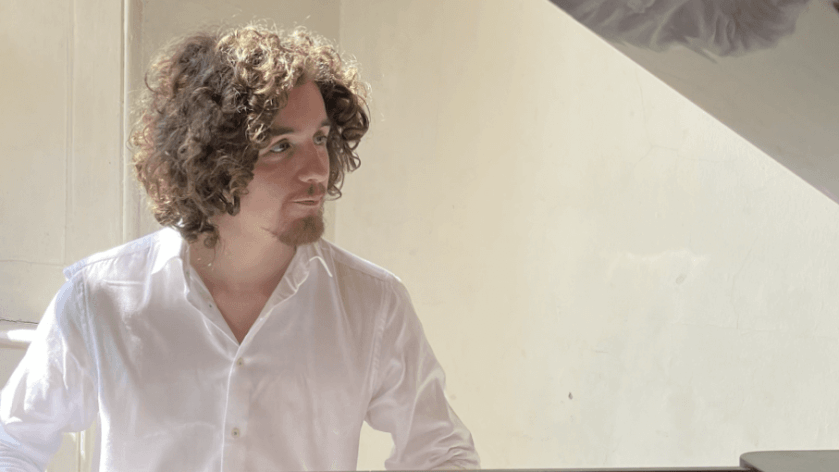
Who or what inspired you to pursue a career in music and who or what have been the most important influences on your musical life and career?
Until I was 12 years old, I didn’t know classical music existed. My grandmother took me to a recital at the local theatre, and I was so moved by what I heard that I felt something significant had happened to me in that moment. After the recital, my grandmother bought me a CD of Beethoven sonatas, which I listened to endlessly. It was ecstatic to discover this incredible world, and I immersed myself in string quartets, symphonies, and lieder. I taught myself to read music and spent as much time as I could trying to play the piano at school. The first piece I learned was Beethoven’s Sonata Pathetique. In that period of time, I felt that nothing short of a miracle had been presented to me.
It was a stroke of luck that I was discovered by pianist Richard Meyrick who directs a charitable scheme to find talented pianists from underprivileged backgrounds. After visiting my school and hearing my rather shoddy rendition of the Pathetique, I was offered a scholarship to study with him in London.
From the very start of my musical life, Mozart, Beethoven, and Schubert were the three composers who captured my being. They are the driving force in my life. I always draw inspiration from the great musicians of the past; some of my favourites are Clara Haskil, Clifford Curzon, and Wilhelm Kempff.
What have been the greatest challenges of your career so far?
At the start of my career, I struggled to find a sense of direction in the truly vast ocean that is the classical music industry. Having not been linked to any institution or teacher when I started and coming from a poor non-musical background, I had to learn on my own the vital skill of networking. A more recent challenge has been trying to find a balance between my musical life and being a truly present father for my beautiful little daughter.
Which performances/recordings are you most proud of?
My first performance of the last three Beethoven sonatas remains something I am positively surprised with. I grappled with these works for years, not knowing whether I would ever feel brave enough to play them in public. After the performance, I felt a cautious sense of optimism that I may be getting a little closer to doing some sort of justice to these ethereal masterpieces.
Which particular works/composers do you think you perform best?
As mentioned earlier, I have a particular affinity for Mozart, Beethoven and Schubert. For reasons unknown to me, these are the composers I feel the most at home with. My repertoire contains barely any Chopin, much to the annoyance of my Polish wife!
How do you make your repertoire choices from season to season?
Unless a specific composer or work has been requested (which I have been lucky to not experience very much so far), I try to always include Mozart and Schubert if I can; being both such incredible vocal composers, they make perfect partners. I also try to include something new that has caught my imagination at that particular time; recently, I have become fascinated with some rather rare French repertoire, which I hope to programme soon. I would never perform anything with which I didn’t have a real connection, as it would then be impossible to convey the work to an audience with the love and sincerity it deserves.
Do you have a favourite concert venue to perform at, and why?
St. John’s Smith Square in London. A friend told me that the legendary pianist Fou Ts’ong considered the acoustic to be London’s finest, and it was definitely my experience.
What do you do off stage that provides inspiration on stage?
Live.
What is your most memorable concert experience?
It was the first time I ever performed Beethoven’s op. 111. In the Arietta, I had a very deep spiritual experience. I had goose bumps and felt some kind of euphoria. I cannot explain what happened.
As a musician, what is your definition of success?
There is no success. Only the endless voyage to serve the composer’s intentions to the best of one’s abilities with honesty, integrity, and sincerity of the heart.
What do you feel needs to be done to grow classical music’s audiences?
I don’t feel I have a definite answer to this; however, music and instrumental education desperately need to be given the status and importance they deserve in the curriculum from the early stages and be funded properly by the government so they are accessible to children of all backgrounds. They are the artists and audiences of the future.
What’s the one thing in the music industry we’re not talking about which you think we should be?
The tragedy of drifting away from the miracle of the music itself and using it to serve politics, societal trends, and anything else that is extraneous to the actual musical content…
What advice would you give to young or aspiring musicians?
On the musical side of things, don’t feel that you should have to play everything; find the composer(s) you really “click with” while staying open to new things. Also, practice away from your instrument. After realising every detail the composer may have asked for, which should always be the starting point, think of phrasing, shaping, colour, and your musical conception away from the instrument—less mechanical work and more thinking! On the practical side of things, it isn’t enough to be a talented musician; you must be your own manager. Find those who can help you get where you want to be and connect with as many people as possible. Play everywhere and anywhere that is interested in having you, and form relationships with these places. Never stop being proactive in seeking all the opportunities you can find; keep going, and some surprising things may happen.
What is your present state of mind? Anxious to be presenting a completely new programme on an upcoming tour…
Discover more from MEET THE ARTIST
Subscribe to get the latest posts sent to your email.
 MEET THE ARTIST