Which performances/recordings are you most proud of?
I remember in this respect (almost certainly with rose-tinted glasses) a cadenza for the second movement of Mozart’s concerto KV415. It was the second of a series of 3 concerts with the same orchestra and conductor, and as always I improvised different cadenzas each time. I started this cadenza with a kind of three-part invention on a four-note motif, gradually incorporated various themes from the Mozart movement, and ended back up in a falling sequence around the opening motif which led naturally into the final trills. It really felt very satisfying, as it seemed organic – not a difficult thing in and of itself if one just sticks to the classic mould – and yet also had a structure and content totally different from traditional cadenzas. As I remember it, there were no rhetoric pauses, cheap humour or gratuitous excitement, just a more or less continuous flow that nonetheless was not boring and went far enough in many directions to make the coming home feel significant.
How do you make your repertoire choices from season to season?
I generally avoid playing the same piece many times, since I like to keep the feeling of each performance being an “artwork” and not a “product”. Often I would conceive an interpretation, and if I find it interesting, I would put the piece on a programme. Of course I hope that it then, in concert, exceeds my expectations. If it does not, I might have an inkling of what I should want to do differently, and I would try again somewhere else. But when it does happen, or indeed after any performance which feels right, I like to stop playing the piece, for I subsequently tend to just chase that performance and imitate its details, and that is not something that fulfils me, even if it may objectively turn out well. (I guess I fully enjoy the luxury of playing concerts as much for myself and my fulfilment as for the delivery of some ostensibly favourable result.) Once I wait long enough, I might start having different ideas and feel the urge to create something new with the piece. For some pieces I am still waiting. (I might try them as encores once in a while, and perhaps thereby hit upon the germ of something.) For other pieces I have gone through many iterations, developing my interpretation each time further – and then I would sometimes hear a long-past iteration on the radio, and think to myself “yea, that was better!” So one thing I try always to keep in mind with all the pieces I like: to never forget the feeling of encountering it for the first time, and what I wanted from it then.
The whole process is complicated by the fact that programmes are usually announced quite far in advance, so often months pass between each of the steps that I described. I suppose I have learnt to somewhat temper my expectations, or at least to fit them to the time-frame of reality, for it now rarely happens that I get to a concert and forget why I wanted to play that particular programme!
What do you do off stage that provides inspiration on stage?
I have never really thought about it that way, but rather the other way around: how have my experiences on stage contributed to who I am and how I see the world? Indeed I believe they have taught me many things that would have been rather harder to come by as someone whose spirit, educational path, and aspirations are firmly centred in the natural sciences. For instance, making music must surely be an advanced lesson in how to create something substantial in an area where there is no right or wrong – by substantial I mean something interesting, memorable, upon which one can continue to build thoughts and visions. The way things like music, art, and literature have always been made and talked about confronts me with the idea that the experience, so central to these fields, of doing things that one does not fully understand, proceeding on nothing but received cultural values and tradition, can mysteriously lead to what feels like unreservedly and truly great accomplishments.
Many familiar works of music suggest in me the feeling that they encapsulate some valuable observations about mankind: how emotions develop, how we like to process them, how they interact with each other, and the characters that may have always constituted human behaviour in society. Sometimes I might, in a real-life interaction, be reminded of an emotional trajectory in a piece of classical music, and often I am positively surprised to see that life mirrors art.
But I want to get back to your question as you put it. It is tempting to think thus: music making is a nearly infinite series of little decisions, and each of these will be informed to some extent by one’s life experiences. So everything that one has seen, felt, and thought etc. will be reflected in one’s music. However, it would be unscientific of me to leave it at that, for I do entertain the possibility that music, in particular the tradition of classical Western art music, may be a world onto itself, operating by rules that do not need outside justification – that everything is in the notes, and any resultant relevance or similarity to life is in the eye of the beholder, as it were. After all, it is historically no rarity in this field that people with little to no “normal” social experience (for reasons of youth or of personality, for instance) have made very meaningful contributions. Artificial intelligence should let us delve deeper into this question, and I hope to be right there as we discover more about what this kind of music can tell us about ourselves.
What is your most memorable concert experience?
Many things are memorable in the moment, and other things are memorable in hindsight. Apart from all the entertaining anecdotes that one invariably accumulates, my answer would be: the feeling, any time it emerges, that my music has brought about attentive silence in a group of people. That is really the greatest affirmative experience and will always be deeply moving, humbling, and memorable.
As a musician, what is your definition of success?
It is a difficult question, if for no other reason than that music is fundamentally not a goal-oriented endeavour. If one day we manage to quantify, with an appreciable level of universality, the positive effects that we suspect music can have on people, then it would become possible to measure “success”. As it is, I consider that my greatest wish is to share things I love with others. So making that possible, by creating a setting and an interpersonal atmosphere for the essence of the music at hand to be shared, is my definition of success as a musician.
What’s the one thing in the music industry we’re not talking about which you think we should be?
We seem quite focused on winning people over as audience members but less vocal about encouraging people to make music themselves. It is understandable, for nowadays the audience is indubitably the lifeblood of the industry. But when we think back a century or two, the clientele of the music industry was not just concertgoers; it was those who made music at home, whose appetite for new scores, be they compositions or arrangements, kept the system running. Sonatas were made not for an interpreter to communicate with an audience, but rather for a composer to communicate with players. The players represented an essential middle on the passive-active spectrum of music consumers, which nowadays is marginalised in favour of the two extremes of “performers” (active) and “audience” (passive). As a player myself, whose formative musical experiences consisted of playing all sorts of music alongside amateurs – just for ourselves – I know how this active-passive manner of experiencing music is infinitely the more enriching and fun.
In this context I would like to mention the former church of Sainte-Thérèse in Hirson, France, an art deco building of 1930, which I own since 2012 and where I now host cultural and musical events. Around these, a regional as well as international community has gathered. Our latest project was “La semaine de la voix”, where professional musician colleagues and the city’s voice amateurs shared the stage on 3 evenings, with showcases ranging from art song to symphonic chorus, from opera to pop. I look forward to our regular upcoming gatherings featuring chamber and vocal music at the highest level – not only of professional renown, but also of personal authenticity.
Tell us about what audiences can expect from your upcoming performance at London Piano Festival. What repertoire will you be performing? Have you performed at the Festival before?
The concert that Michael Wollny and I shall be giving at Kings Place on 5 October will be a concert of improvisations. In essence, we will be starting each musical section with a blank slate, onto which we will throw ideas that come to us in the moment, and develop them according to our perceptions and tastes, thus letting our two musical worlds interact. We first came together on an occasion a bit more than 10 years ago, and had great fun in a short improvisation. In the meantime we each have explored widely in our fields and experienced music-making of various styles and visions. So we thought: let’s see, after the intervening years, what happens when we, with the memory and inspiration of our respective musical lives, leave all this at the door and enter a room to fill with our momentary imagination. For me personally, it has turned out to be a most enriching space, with beauty, joy, and thrills that I could not have foreseen. And it is something we certainly couldn’t do without our public!
What’s next? Where would you like to be in 10 years?
I would love to be somewhere I can have a little flock of chickens. I had pet hens as a child in California, to whom I was closely attached. As I moved for my studies and various other activities, I was away for long periods and could not spend much time with them. They learnt to be quite independent and had the run of the yard. In the end, the last one, whom I named Nitrogen (being the 7th one to join the family), hung on until one of my infrequent return visits to California, and passed peacefully during the night at the age of 9 years. That was 16 years ago. In the meantime, admiring cute chickens on Instagram – as lovely as they are – is not quite fully satisfying!
What is your idea of perfect happiness?
Probably some combination of hormones in the brain that we have not yet precisely modelled. I do not know. Biochemistry has so far never been my strong suit.
What is your most treasured possession?
For now, I could not imagine answering anything other than one’s faculties.
What is your present state of mind?
Extremely happy about the delicious watermelons that grew in my garden!
I sometimes wonder about the relative intensity of emotions I experience from basic natural phenomena – the wind in my back, the calm lapping water of the lake, the taste of primary foodstuffs – compared with those related to ostensibly “higher endeavours”. I think I can say this without pretension: I am a human first and anything else, whether it be “scientist”, “artist” or any such thing, second.
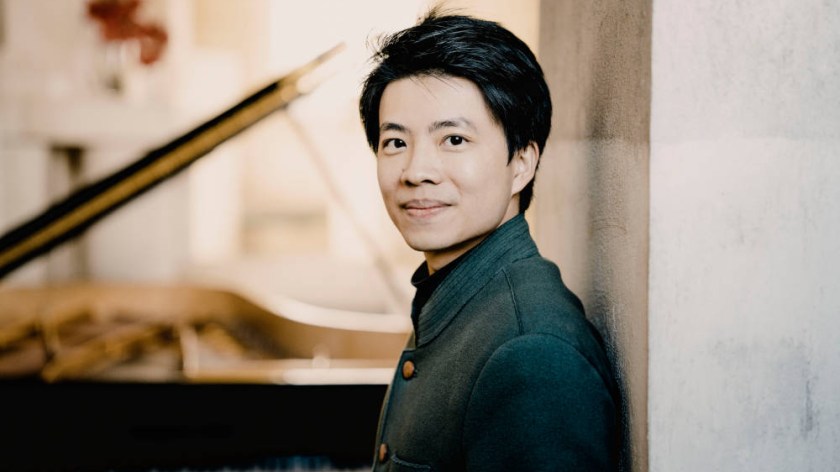
Kit Armstrong performs in a concert with Michael Wollny on Sunday 5 October, part of this year’s London Piano Festival at Kings Place. Find out more
Photo credit: Marco Borggreve
Discover more from MEET THE ARTIST
Subscribe to get the latest posts sent to your email.
 MEET THE ARTIST