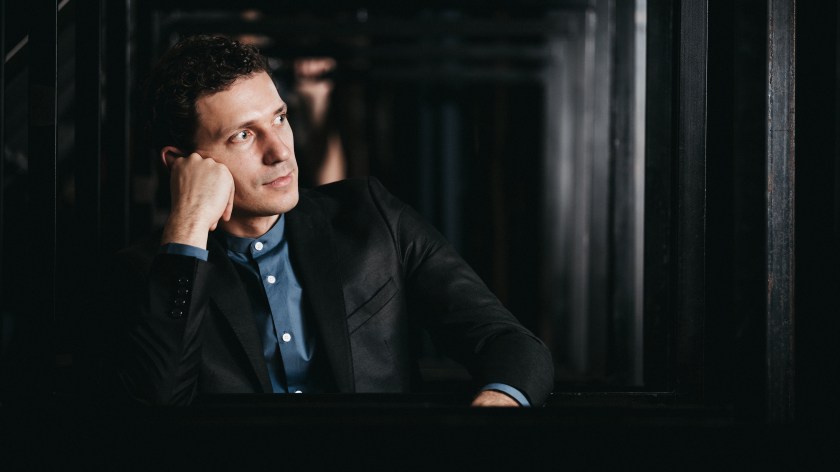
Who or what inspired you to pursue a career in music and who or what have been the most important influences on your musical life and career?
My list of inspirations begins with my grandmother’s upright piano that I improvised on as a child, and her turntable and collection of LPs – lots of Richter and Gilels there -, and then our school choir teacher René Salaks who, concert pianist that he was, could not help but play all the song accompaniments in the most delicious arrangements imaginable. This got me onto the road to wunderkind life, as this teacher became my piano teacher and I became his guinea-pig student, because he tried out a unique teaching method on me. I think it probably worked, because we toured around, him giving lectures about his method, me performing all Bach Inventions and Sinfonias from memory as an 8-year old. After winning several piano competitions, I had to change school and teacher and I also got into the teenage years and music went to sit in the backseat. My new teacher, Raffi Kharajanyan who was famous all over the Soviet Union for his Riga Piano Duo performances, had a tough job getting me to keep going at all. A really big change came when I was re-inspired to pursue music by God. Yes, God. As I cautiously looked into the Christian faith, I found new compelling motivation, in the Scriptures, to diligently develop the gifts entrusted to me. This means that I did realise I had gifts at the time, I just didn’t care very much to do anything about them. But now I did, and I still do. My next teacher, Boris Berman (Yale university), demolished my technical foundations and showed me a new, mindful way of playing the piano. I often remember his way of playing the piano and I take inspiration from those memories when I get stuck in solving some interpretation puzzle. And my last academic teacher, at the time the head of keyboard at the Royal Academy of Music, Chris Elton helped me perhaps in the most perfect way, because he saw what I already had, but he adjusted it all with his particular brand of intuitive suggestions. He eased my edge, if there is such a phrase, and that was as bull’s-eye for me as could be at the time. Of course, there are many others who have influenced me through one lesson, one conversation or perhaps one album or concert. And during my studies I had sponsors, and I am yet to grasp the full weight of what it means for a young artist’s future career.
What have been the greatest challenges of your career so far?
For many years I thought that the only way to make it as a concert pianist is if you have a good agent. To that end, I kept sending many emails inviting various agents to my performances. But all that never came to anything, and so I thought for a good while that the greatest challenge of my career is that I cannot get an agent. However, now I have come to think that there are certain benefits in having an agent, but it’s absolutely not the only way to make a living as a concert pianist. I am a living proof of that. I’d love to perform more internationally, and that’s where having an agent can help, but I have a busy performance schedule even in my little lovely home country of Latvia, and I am also touring abroad once every month now. Still, if you are an agent/manager getting curious as you read this, do drop me a line.
Which performances/recordings are you most proud of?
For me, being proud of one’s work is a somewhat strange concept. I mean, I always try to perform on stage and in the studio to the best of my ability, but… I am not proud about my performances, ever. I am thankful to God if it works out as hoped, or oftentimes better, and I am all the more thankful if the mess I sometimes make passes by unnoticed, somehow. I am thankful if I can lose myself in the music and not try to please anyone or fear anyone, but instead serve the audience by serving the music well. I think performers do know, in their heart of hearts, that a fantastic performance is never fantastic because of them alone — it is rather a gift, a miracle to be grateful for.
Which particular works/composers do you think you perform best?
I have a special relationship with Messiaen’s two-hour long Vingt regards, with Beethoven’s Hammerklavier sonata, Liszt’s B-minor Sonata and Bach’s Goldberg Variations. Latvian composers also have written for me cycles that take 90 minutes to play. All these reveal my penchant for taking the time, for going on a long journey with my audience. I do not specialize in one composer, nor one style — my overflowing curiosity does not like me sitting with one thing for too long. However, there are two specific areas of repertoire that I regularly return to: one is Latvian piano music which I unearth, commission, record and perform a lot; the other, a group of pieces with spiritual roots — including the aforementioned Messiaen, but also Pärt, Tavener, Dubra, Bach, Pelēcis, Selickis, Franck and others.
Pilgrims of Light. Pianist Reinis Zarins
How do you make your repertoire choices from season to season?
In my case, it is not an organised, planned endeavour. I might hear something stunning on my way to a concert and I would make note of it; or read something in a book, and that idea suddenly ties itself to a piano piece gathering dust on my shelf; I might become interested in one particular composer, and in the process of learning about them, I find so many other composers I’d love to play. Browsing on Spotify and Naxos Catalogue educates me so much, as does browsing on Everand for books. So all the ideas I like I write down in my notebook and some of them eventually become recital programmes and CD recordings.
However, there are external objective circumstances that lead me in one direction or another: I very much care for the audience I will play for, so I try to visit the concert venue, if I can, before I decide on the programme, to make decisions based on the room size and acoustics and piano quality and whatever I can gauge about the audience that might come. If the recital takes place around the time of some holiday, like our Independence day or Christmas or Easter, I will always build the programme around that.
One relative downside of not having an international agent is that I do not get to tour my programmes in an organised way – the repeat performance might come only a year or two later. That way, I keep coming back to pieces over the years while every next concert has a different programme. Which is brilliant and tough at the same time.
Do you have a favourite concert venue to perform in and why?
I don’t and I do. I don’t because I care for my listener more than for myself, but I do because the music gains from excellent piano and acoustics, and so does the listener. There is a wonderful wood-panelled chamber hall near Riga, the Dzintari Small Hall where I perform often, also tomorrow with Gidon Kremer. Wigmore Hall is a visual and acoustical gem where I have also performed my handful of recitals, always with pleasure. But last month, for instance, I played in a quaint village church in southern France with marvellous acoustics — and I mention this because it’s one of those places that sounds really good but there’s no concert life there, with rare exceptions, and there must be thousands of such church buildings. I am grateful that I get to perform in acoustically lush venues on excellent pianos, but I also take opportunities to play in unusual settings on less-than-fine pianos when I see that I can bring blessing to people using the universal language of music.
What do you do off stage that provides inspiration on stage?
Long-distance running outside the city is my thing. There, I get my physical exercise, I rest my mind while running, I receive a huge shot of inspiration from nature, I challenge myself and test my limits.
A great gift in this life is having one’s own family. My wife and I, we both raise our four children and find that investing ourselves in our children is really meaningful, because we already begin to see how our efforts are transforming into their character traits. Indeed, raising children means a massive sacrifice of one’s perceived freedom, but nothing truly valuable can be born without sacrifice. And my time with my family rejuvenates me in a unique way — mostly the conversations we have during our walks or meals or evening reading hour. I believe that what my fans love about me on stage partly belongs to my family off stage.
I like to think about things and question perceptions, including mine, and I feed this trait by reading a lot of theological and philosophical literature. The chief volume I open daily is the Bible, which I study with several different groups. The ideas I investigate through my recitals often originate in this inexhaustible well which keeps inspiring my mind and heart and providing meaning to all I do.
What is your most memorable concert experience?
“Memorable” can mean various things. I don’t remember any particular mishap anecdote, or a particularly loud and long applause, but I do remember some very long silences after my solo recitals, and those I value the most. One recent such moment was after the world premiere of a Via Crucis cycle composed by Rihards Dubra. I had created a parallel lights scenario that painted each Station of the Cross differently, and for the final Resurrection scene, we made the sunrise effect which gradually swallowed me in a thick ray of light, and I was very happy at that moment — not only to be at the end of a 90 minute long gruelling journey, but to lose my “me” form, to become only a black silhouette amid overwhelming light. And then, we all sat there in silence for a very long time. When I think of it, I prefer silence over applause.

As a musician, what is your definition of success?
For no one who hears my music-making, to go away empty-handed. Joyful, tearful or angry is equally fine, but not empty-handed, not indifferent. And yet, this is not something I think I can and even should manufacture myself — I would be the first to say that trying frantically to be interesting is pathetic. Instead, that definition of success is my fervent prayer; and I have no means of knowing its net result apart from those long communal silences, those backstage greetings and post-concert messages.
What do you feel needs to be done to grow classical music’s audiences?
I think most of my colleagues agree that we all have this common mission to make sure classical music (I prefer to call it “art music”) has a perpetual audience. People have different gifts and there are different ways to grow an audience. One thing we see a lot these days is the simplification of art music for pop taste — playing only the best known, easy-listening, only what works as a background music, only mood music, without narrative or argument that might require dedicated listening. Intuitively, I think it doesn’t help art music while inundating its potential audience with a comfortable substyle that makes true art music feel almost scandalous and thus all the more narrow. But perhaps I’m wrong. Perhaps this approach does the job indirectly.
One thing I like to do is speak in my solo recitals in a personal but also gently pedagogical way, so that my audience can learn something about my repertoire directly from me: I would sometimes offer some cues to listen out for, or explain the basic structure; my overall aim with this is to help my audiences become more involved listeners who gradually learn the art of following music’s argument instead of daydreaming away as soon as the first effect wanes. I know this from feedback but also because I have the same problem — I easily wander in my thoughts and quickly get distracted and lose the narrative, and I hate that, but I know that I can follow the music if I am not expecting for it to entertain me, but humbly wish to receive what it wants to say to me.
What’s the one thing in the music industry we’re not talking about which you think we should be?
Oh, it could be several things — our relationship with AI, for instance. But perhaps the previous question can be tied to this one, too: to not lose and even grow the audience for art music, the musicians and their helpers need to reestablish the inner fundamental value of doing it, of creating it. We need to know, first and foremost for ourselves, why we should keep doing it, what is the purpose of art. Money is part of the equation, of course, but how big a part? What are we prepared to exchange for money? And I think the emergence of AI can help push artists to think harder about the why of making art. For instance, what is the net value of a recital of art music, after all is said and done? I actually think the value can be way above the fee the artist receives… but I also think it often is way below. And the difference is hidden in the view the industry participants hold about the purpose of their art.
What advice would you give to young or aspiring musicians?
Take the time to think long and hard about your motivation for pursuing a career in music. Why should we make music at all? What is the purpose of music for humanity? It’s a great responsibility and not a light burden, therefore you need access to the deepest root you can find so that you always have enough sap to be fruitful for others’ enjoyment.
Tell us about what audiences can expect from your upcoming performance at London Piano Festival. What repertoire will you be performing? Have you performed at the Festival before?
I will perform a piece unlike anything else in the piano repertoire — Olivier Messiaen’s most successful piano cycle “Vingt regards sur l’enfant-Jésus” which translates as something like “Twenty Contemplations on the newly born Jesus”. It is an absolutely genius piece of art with a thematic arc linking the twenty parts together into a unified whole. Its performance lasts for 2 hours non-stop. Messiaen, a synaesthete, an ornithologist and rhythmicist, often said that the most important task for him is to reveal theological truths through his music, and so the work contemplates various points of view on the birth of the son of God — both the more obvious ones, like Father’s, Mary’s, shepherds’ and angels’, but also those of time, birds, silence, the Spirit, the cross. There is also a chopinesque lullaby, a wild dance and a picture of the Big Bang. And while a lot of this music is incredibly rich in colour and surreal beauty, some of it is sheer terror, and upon reflection, I sense that the inclusion of the terrifying gives the whole piece a ring of truth that it wouldn’t have with just sweet Sunday school pictures.
However, this is not another example of the narrowness of art music. This huge work of art is brilliant as pure music, as an incredible feat of human imagination, and if I play it well, it should speak volumes to any and every body present, regardless of their worldview and religious affiliation. In my opinion, it has the potential to provide catharsis experience, and even though objectively it is a marathon, it is a very happy marathon.
This is my first invitation to perform at the London Piano Festival, and I would like to compliment the artistic directors for their courage to include this work, because it always is a daring act, in many senses.
What’s next? Where would you like to be in 10 years?
One vision I had about 15 years ago, has come to pass in the last few years. I have grasped its fulfilment only about now. But I am yet to find a new vision of equal value for the next decade or so.
What is your idea of perfect happiness?
When I sit down and think about it, my life today is exactly that. I am grateful to God for every big and little thing, also for those things that seem like my failures or those that people generally call “bad luck” — I am grateful for all of that, because I can already see, with some of those failures and “bad luck”, that in fact it has been a blessing, though I usually see it only much later.
What is your most treasured possession?
This is a great probing question, not easy to answer. Is my greatest treasure my ability to understand and speak in the language of music? Is it my family? Is it a thing I have been given or an honour bestowed on me? Is it an experience I seek to go through again and again? And then I wonder — what becomes of me, if my most treasured possession is taken from me. Do I lose my mind, my self, my meaning of life? I suppose I would, if that possession could be taken from me. Is my life my most treasured possession then? But I will lose this life sooner or later, that’s for sure. So, if I lose my life and everything I possess tomorrow or a bit later, is there any point at all in having such possessions? That is, since I do not really possess anything at all in this life but can only steward the things entrusted to me? I could go on an on about this conundrum, but the point I’m trying to make here is that my most treasured possession should be found outside myself and outside my here and now, it should be above and beyond this reality, or else I will one day find I treasured something that is not a true treasure at all.
What is your present state of mind?
Grateful for this unexpected opportunity to consider such important questions!
Reinis Zariņš performs Messiaen’s Vingt Regards on Sunday 6 October, part of this year’s London Piano Festival. Find out more
Photo credit: Andris Sprogis
Discover more from MEET THE ARTIST
Subscribe to get the latest posts sent to your email.
 MEET THE ARTIST