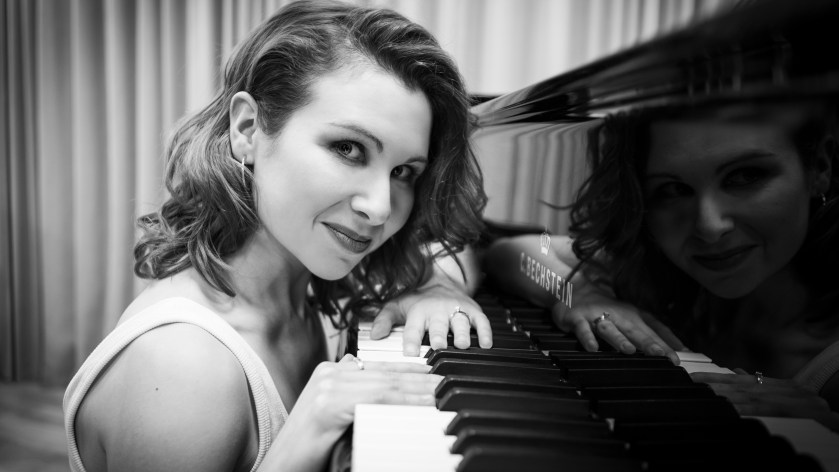
Who or what inspired you to pursue a career in music and who or what have been the most important influences on your musical life and career?
From what my parents told me, even as a child I was always strangely confident about my future and becoming a professional pianist.
Thanks to my parents (who believed the words of a child!) at the age of seven I auditioned and got admitted to a state music school in Warsaw; from that moment onward I was continuously educated in such institutions (combining music and general education) until going to Chopin University.
The music education system in Poland is completely different to one in England. The state music schools are at a really high level and free of charge, but there is a price to it: not only it is very difficult to get in, but also once you’re in, you are required to show full commitment to the instrument and meet very high demands. People who couldn’t see their future as professional musicians or didn’t have the determination to work towards it, would simply drop out and change schools.
Pianistically speaking, I have been very fortunate to have met a lot of incredible artists to guide me along the way, such as Ewa Pobłocka and Maja Nosowska (my professors at Chopin University), Hinrich Alpers, and my most recent and amazing mentor here in London, Norma Fisher, who opened my eyes to what playing the piano really is. There is a thousand ways to interpret music and there is not one certain way to play, but rather a constant question – what is it about, what is the music/the composer trying to say? What do you want to communicate? What is the sense and the essence of it?
What I really appreciate about Norma is that all the pianists she mentored are completely different regarding their style, their sound, interpretations etc. Norma really approaches everyone individually. It almost feels like she has a magic power to instantly see and bring out what’s best in you. And the best part of it – it is never really about you in the first place – it’s always about the music.
What have been the greatest challenges of your career so far?
Moving to London in September 2019, starting my studies at Royal College of Music only to find myself in the midst of covid a few moths later, performing in empty concert halls in front of cameras; and this year – recording my debut album, a day after a close member of my family passed away.
Which performances/recordings are you most proud of?
At the moment I am absolutely over the moon and excited about my long overdue dream coming to life – my debut album ‘Variations’ (released by Rubicon Classics) premiered in September this year!
Which particular works/composers do you think you perform best?
I have a very special affinity for performing compositions by Clara and Robert Schumann. Musically I feel weirdly connected to both of them, and the more I read, especially about Clara, the more I admire her! She was such an incredible and iconic woman – a goddess of piano, great composer and such a strong personality. Her mental and physical strength and resilience must have been immense considering everything she went through and everything she achieved.
Apart from the Schumanns, I always feel a special connection to Chopin because of my Polish roots; I also very much enjoy performing music from the 20th and 21st century.
What do you do off stage that provides inspiration on stage?
I am trying to have a full, interesting and meaningful life! I love to travel, learn about new cultures and perhaps most importantly – meet new people. I always find that I can learn from anyone I find on my path – whether it is something they do, they say, the way they are, or what they have been through.
I also try to research and read about the composers – it always interests me what stage of life or what circumstances they were at while composing the particular piece. It helps me connect to the music on a deeper level.
As a soloist, I take huge inspiration from working with singers on Lied repertoire which is certainly my big passion. Working with singers, I have the privilege to listen to the most human and emotional instrument that exists; I am also inspired by beautiful, sometimes heartbreaking poetry. All of this I then try to bring into my solo performances.
How do you make your repertoire choices from season to season?
If I have the so-called ‘free rein’ when it comes to repertoire, I try to create programmes where all the works are linked in some way, or there is a certain story behind them, or a certain unique feature that they have in common. Nowadays I really try to avoid programmes that are just a combination of pieces – especially if those are the ‘standards’ of piano repertoire.
I really enjoy including the works that are lesser known and lesser performed – even if the composer is well established (like my recent discovery – Schumann’s Studies on a theme by Beethoven).
When planning an encore, I try to connect to the place and people that I am performing for, and make sure to play something they would recognise and identify with, or something that has a special meaning to that particular place.
Do you have a favourite concert venue to perform in and why?
A few I think!
Definitely Warsaw National Philharmonic Hall – it was THE venue, growing up in Warsaw; Chopin’s birthplace in Żelazowa Wola (very intimate and inspiring) and most recently – Wigmore Hall where I made my debut during the Wigmore Hall/Bollinger Song competition (and l have been awarded a Jean Meikle prize with Clara Barbier Serrano!). Wigmore is just as magical as they say it is. I can’t wait to perform there again.
What do you feel needs to be done to grow classical music’s audiences?
I think a lot could be done when it comes to programming – I would love to see venues open up to more creative programming, not being scared to include new music more often (which sometimes, surprisingly, is the easiest for the audience to connect with) and new formats, also experimenting with other genres like dance, audiovisuals etc.
What is your most memorable concert experience?
A few years back in Germany when an old lady told me she cried listening to my Brahms; Liszt second piano concerto with Warsaw Philharmonic, and recently – recital at Festival de La Gente in France, where the audience was so receptive, alive and enthusiastic!
As a musician, what is your definition of success?
To be able to perform the music that always excites me, to be able to evoke emotional response to my music from audience members, to be able to perform as much or as little as I want, to pay the bills and still find time to be with your loved ones!
What advice would you give to young/aspiring musicians?
1. It is not easy to be a pianist, but it is also an incredibly beautiful life.
2. Don’t let anyone tell you you ‘can’t’ perform certain repertoire. People might try to put labels on you – try not to let them. But at the same time – be honest with yourself – know what your strengths are and make most of them.
3. A performer’s life is very stressful – but just the fact that you are stressing out about a performance (and not about your safety, health or roof over your head) means your life has been very fortunate!
What’s the one thing in the music industry we’re not talking about which you think we should be?
I can only speak about where I currently live – in England – the state support for musicians and freelance artists in general is almost non-existent. It would be great if we followed countries like France that have developed a better support schemes for artists.
What is your present state of mind?
Grateful, a little overwhelmed with the amount of things happening right now, but also very happy and excited for the next months full of music!
Joanna’s debut album ‘Variations’ (Rubicon Classics) is out now! Find out more
Discover more from MEET THE ARTIST
Subscribe to get the latest posts sent to your email.
 MEET THE ARTIST