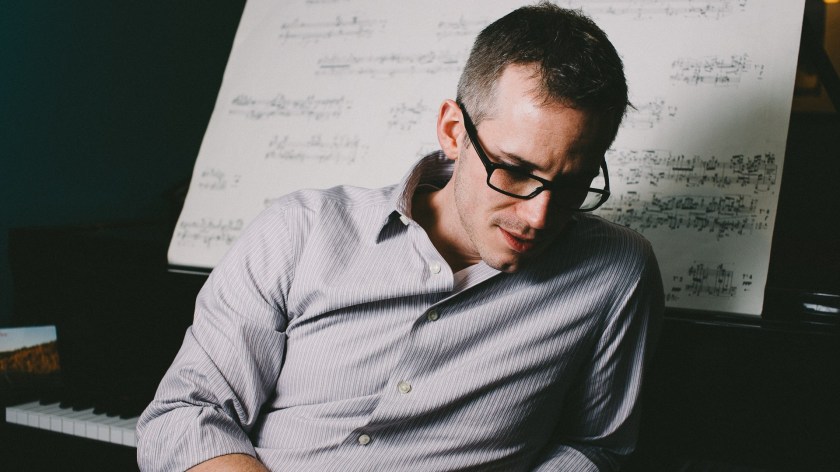
Who or what inspired you to pursue a career in music and who or what have been the most important influences on your musical life and career?
I grew up in the middle of nowhere—the Appalachian Plateau in western Pennsylvania—a place somewhat notorious for its lack of opportunities. There also wasn’t much to do in a town of 600 people. This was somewhat compounded by the fact that growing up, the things that appealed to folks in the country never particularly appealed to me.
My mother was a gospel singer, and we had a family piano, so music was always a part of my childhood. Sometime around age 11, I was improvising some sort of dramatic piece about animals and my mom suggested taking lessons.
I wasn’t an especially good student—I may have had a somewhat inflated sense of my own maturity and hated having to play from method books. So, my first piano teacher very graciously kicked me out of her studio, and I spent the next several years attempting to learn how to play own my own. At the time, my family attended a church whose pastor was a pianist and he became something of a mentor to me until I started college.
During these years, I listened to music voraciously—whether it was the classical radio station, or the many records and CDs I acquired. I became enamoured with Leonard Bernstein and Glenn Gould, and wanted to fashion myself in their intellectual and artistic image. In fact, it was conducting that initially drew me to study music after high school.
I never really planned what I was going to do after high school, but the only thing I really cared to pursue was music. So, I took a late audition to the only school I applied to—a small, public university with a respectable music program—and was accepted.
My piano professor, James Staples, was influential, of course, as was the conducting professor, Jack Stamp. The most influential figure in my formative college years was the Finnish pianist Paavali Jumppanen. He became a friend and mentor to me, and remains a strong presence in my musical life.
My undergraduate academics were not impressive, and I very nearly never finished. I spent two years in limbo until my best friend—unbeknownst to me—re-enrolled me in the program. That was the last push to get me through my academic career and into the professional world.
What have been the greatest challenges of your career so far?
Frankly, focus. I am prone to sudden and intense fits of captivation—I often find myself completely obsessed with a newly-discovered work, and feel compelled to throw myself entirely into it. I’m told this is because I’m a Gemini.
Getting attention as a pianist that specializes in a niche repertoire has its challenges, as well. I always knew that was going to be the case, but it doesn’t make cultivating a career and reputation any easier.
Which performances/recordings are you most proud of?
I’m proud of all of my recordings—not that I have any ego about it. Recording is a very gruelling process, so I think anyone who does it is entitled to a measure of pride. Beyond that, I put a lot of thought into each of the programs I’ve recorded, and feel strongly about their cohesion as programs, and I’d like to think that my interpretations offer some insight into the works.
All of that said, among my recorded works, I feel particularly proud of my reading of Schoenberg’s Drei Klavierstücke Op.11. When I recorded them, they were new to my repertoire, but I think I found a manic energy that’s missing from other recordings—and I think it’s an energy that is essential to them. I’m also proud of my reading of Debussy’s Images. I took a lot of interpretive risks, and I think they work. I also think I was able to capture a sense of Debussy’s ear as an orchestrator and translate it to the piano.
Which particular works/composers do you think you perform best?
I think I have a knack for mid-century serialism. It has a vibe that makes sense to me, and I think I’m able to convey it clearly to audiences.
What do you do off stage that provides inspiration on stage?
I share Arthur Rubinstein’s sentiment. A musician needs to live, because that music is life. I practice 3-4 hours most days; otherwise I’m learning something about science, or how hats are made, or watching a cobbler resole a pair of shoes.
I enjoy trying new whiskey or wine and learning how to find the nuances there. I like to learn about filmmaking and acting. All these things create a tapestry of experience and knowledge that helps me see a wider world, and—hopefully—express that through my art.
How do you make your repertoire choices from season to season?
This depends on what fascinates me at any given moment. That said, my fascination is usually balanced by other artistic considerations. I believe deeply in the importance of representation within the classical industry, and I do my best to show the diversity that’s present now, and encouraging emerging composers and performers. Why I select certain works for a program is going to vary from program to program.
Do you have a favourite concert venue to perform in and why?
I like any venue with an audience willing to listen. A building is just a building. One piano is (usually) as good as another.
What is your most memorable concert experience?
I was invited to play a concert in one of the more rural parts of Pennsylvania. I had to make a last-minute programming change because the piano that was available was a mid-grade upright. I took 4 days and worked up Hans Otte’s Das Buch der Klänge. Despite the compressed preparation and less-than-ideal instrument, it was a profound experience for all of us. We were all changed a little.
As a musician, what is your definition of success?
Am I doing what I want to do?
What advice would you give to young/aspiring musicians?
Have a hobby outside of music. There’s a notion within the classical music industry that every waking minute must be spent with music—if you’re not practicing, you should be listening to recordings, or studying scores, or learning about the lives of composer, and on and on. It’s fucking insane, and it’s unhealthy.
I bought a motorcycle a few years ago, with the express purpose of learning how to maintain it as well as ride. It has been the most transformative thing for my mental health.
Find something that keeps you balanced.
What do you feel needs to be done to grow classical music’s audiences?
Audience sizes are an economic concern, not an artistic one, and I’m not a capitalist. I think we need to get over the idea that any particular genre of music is for everybody. Classical music isn’t special, it’s not “universal”—whatever that means. No genre is going to appeal to everyone, and if it did, it would be exactly the kind of kitsch most people in the industry complain about.
Of all the classical works written, those that we regard as “great” are astonishingly few in number. This is the case for every genre of music, whether it’s classical or hip-hop, or rock. I think we spend far too much f*cking time and energy try to convince people their opinions are misguided.
The things that I think would help the classical industry have nothing to do with the music and everything to do with the culture. I’m reminded of the line in Amadeus: “Oh, bello, bello, bello! Come on now, be honest. Wouldn’t you all rather listen to your hairdressers than Hercules? Or Horatius? Or Orpheus? All those old bores! people so lofty they sound as if they shit marble!”. I think this captures the culture of classical music rather well—at the very least, it captures what the popular perception of classical music.
The history of classical music is full of fascinating people, but because of its close historical ties with the church and with wealth, that fascinating history has been largely whitewashed to accommodate the sensibilities of very conservatively minded patrons.
People don’t love Taylor Swift because the music is great. They think the music is great because they love Taylor Swift. She connects with the audience in a way that is authentic, that creates a sense of shred experience. People don’t want to be preached at about a work of art being great, and how much they should like it.
We need to let classical music be its authentic self, and if that brings in a larger audience, then great.
What’s the one thing in the music industry we’re not talking about which you think we should be?
The putrid vestiges of Victorian morality that still loom. Or, our perpetual obsession with spectacle.
What’s next? Where would you like to be in 10 years?
Somewhere with fewer cars.
What is your idea of perfect happiness?
Quiet. Solitude.
What is your most treasured possession?
A handwritten note from my undergraduate piano teacher, written after listening to my first album.
What is your present state of mind?
It’s the day after the 2024 presidential election. My state of mind has been better.
James W. Iman’s latest album Iman: Album III is available now on CD and streaming on the Metier label. Find out more
Discover more from MEET THE ARTIST
Subscribe to get the latest posts sent to your email.
 MEET THE ARTIST