Who or what inspired you to pursue a career in music and who or what have been the most important influences on your musical life and career?
I was born in the Far East of Russia on the banks of the Amur River. I don’t come from a family of musicians: my mother is a doctor, a pediatrician, and my grandfather was an important scientist.
There was a music shop near our home that sold CDs. To attract customers, they played music all the time – music by Tchaikovsky, Chopin, and Beethoven. One day, when I was five years old, I heard that music and was immediately captivated by the wonderful sounds, by the miraculous world of music. I couldn’t move; the music took my breath away.
I began spending all my time in that shop, listening to the music. I was there every day until my mother came to collect me and bring me home – she always knew where to find me.
After a while, I approached my mother (I was still five at the time) and told her, “I want to play.” I was very persistent, so she took me to the kindergarten where she worked, where there was a small piano room.
Soon after, my mother enrolled me in a music school. I made rapid progress, and within several months, I was already performing as a soloist with a local orchestra. A few months later, after moving to the capital, I performed as a soloist with the Moscow Philharmonic Orchestra.
Mstislav Rostropovich had a great influence on me as a musician. We often met in Moscow, where he gave me lessons. I learned a lot from him, and he was a very inspiring figure to me. Maestro Rostropovich also introduced me to Van Cliburn, an amazing musician who became another important teacher in my life.
What have been the greatest challenges of your career so far?
To be honest, when I play music, whether on stage or off, I forget everything else in the world. That sense of complete immersion is one of the greatest joys of my life, but it also brings its own challenges. When I’m so deeply absorbed, it’s easy to lose track of time, and even the need for balance. Music can feel like an entire world of its own, and sometimes stepping back can feel challenging.
Which performances/recordings are you most proud of?
When I’m on stage in a live concert, I treat each performance as if I’m creating the piece from scratch, playing it for the very first time. I have the same approach when recording a CD – I never record in small sections. Instead, I play the entire piece through several times, immersing myself fully in each complete take, and then I select the best version. This way, my performance remains true to the moment.
My most recent CD, called “Monument to Beethoven”, is a program that inspired me a lot. In this program, I presented works that were composed by Chopin, Mendelssohn, Schumann, and Liszt to help raise funds for the first monument to Beethoven.
In the 1840s, Liszt decided to erect the first monument to L. van Beethoven and began collecting funds for the project. Many other composers also contributed their music to this cause. Mendelssohn wrote his Variations Sérieuses; Chopin, the Prelude in C-sharp minor, Op. 45; and Schumann, the amazing Fantasy in C major, op. 17. These pieces were compiled and published in an album, and the proceeds from the sales went towards the monument to Beethoven. The monument was eventually erected in Bonn in 1845, where it still stands to this day.
On this CD, I have also recorded Liszt’s transcription of Beethoven’s Allegretto from the 7th Symphony and the rarely performed Variations in Form of Etudes by Schumann on this same theme. At the end of the program, I perform my piece called Petals of Peace, which I was commissioned to compose by the United Nations.
Which particular works/composers do you think you perform best?
There is so much amazing music written that it is truly hard to choose. And luckily, I don’t have to.
During the Covid lockdowns, I recorded the complete works of Frédéric Chopin – about 220 videos.
I also love playing German music, some of which is featured on my new CD.
French music brings me great joy and inspiration as well. I have transcribed some of French orchestral works for solo piano, for example most recently Three movements from Ravel’s Daphnis and Chloé.
I have composed a Fantasy on themes from Satie’s ballet Parade and the score of this work has been published.
I have to say, it is a very special pleasure to perform my own music on stage. I get to relive the moments that inspired its creation and often discover new details and dimensions in my compositions while performing them.
This year, I gave the world premiere of my latest composition, Fantasy, at Victoria Hall in Geneva, followed by its performances during my Asian tour. Currently, I am working on a piano sonata, a piece that will be premiered in a few months.
What do you do off stage that provides inspiration on stage?
In everything I do, I like to go to the source, to the origin of things. In music, I want to know all the circumstances surrounding the creation of the piece – manuscripts, letters, first editions. The most important source for me is the manuscript. I have studied manuscripts in libraries and private collections around the world.
Let me give you an example. Chopin’s last composition was the Mazurka in F minor, a piece written in his last apartment Place Vendôme in Paris. I studied the manuscript, located in Warsaw, and even held the original in my hands. In that moment, I felt a connection to Chopin. His handwriting is frail and broken; you can sense how much he was suffering at that time. After seeing this, I could never play this Mazurka in the same way.
I have a deep interest in literature, especially poetry, and I enjoy reading it in the original language. Currently, I speak, read, write, and give interviews in 11 languages, including 7 European languages as well as Hebrew, Arabic, Chinese, and Japanese. And I plan to learn more. Speaking with people in their native language is a pleasure unlike any other.
Poetry is very much about sound, and even the best translations cannot do justice to the original. Poetry and music are closely related; there is so much music in poetry, and poetry in music.
I have recently been particularly enjoying reading a lot of poetry by Li Gang, a Chinese poet of the 12th century, in the original Chinese. It is amazing how the sound and feelings of a great artist could be transmitted across centuries and touch me deeply today.
How do you make your repertoire choices from season to season?
I have a long list of works I would like to perform for my audience. My programs reflect what I most want to play at the time, which is why I don’t stick to just one program throughout the season. I perform different programs depending on the location, the audience, and my artistic desires. I also enjoy introducing my own composition in my concert programs.
Do you have a favourite concert venue to perform in and why?
I have been fortunate to perform and share my music in some of the most incredible halls around the world. Many of these venues are truly special. Some have great historical significance, like Carnegie Hall in New York, Moscow’s Great Conservatory Hall, and London’s Wigmore Hall. Others are modern, with outstanding acoustics that make them perfect spaces to create music.
Théâtre des Champs-Elysées in Paris, where I gave a recital in June this year and will perform again on December 17, 2024, is a particularly special venue. It has an inspiring history, as many of the great artists of the 20th century performed there. It was the venue where Stravinsky premiered his Rite of Spring in 1913. In homage to this historic event, I performed my solo piano arrangement of Three Movements from The Rite of Spring by Stravinsky at my recital there in June.
What do you feel needs to be done to grow classical music’s audiences?
Apart from playing masterpieces loved and admired by everyone, I also enjoy introducing newly written works into my programs. I believe the audience needs to feel a connection to the present and realize that we are not living in the past, listening solely to pieces that are 100 years or older. Music is alive today, and wonderful new compositions are being created right now.
Last year, I gave the world premiere of a beautiful work, Glass Suite, by the amazing American composer JJ Hollingsworth, during my recital at the historic Herbst Theatre in San Francisco, where the Charter of the United Nations was signed. This piece, inspired by Depression-era glassware from the 1930s, is a work of great sensitivity and fragile beauty.
What is your most memorable concert experience?
Every time I go on stage, I feel great joy and happiness. It is a place where I feel truly free, a place where I can express myself fully. My concerts are never the same – the piano is different, the audience is different, and so am I. However, there have been special occasions that are unforgettable, and I will tell you about a few of them.
In 2022, I played a concert for peace in the Human Rights Hall at the United Nations. Great personalities from around the world, including representatives of 193 member countries, were present. For this occasion, I was also commissioned to write a piece. I gave the world premiere of my work, Petals of Peace, during this concert.
Another concert I will never forget was in Tokyo at the celebrated Suntory Hall. I was performing a program of Chopin’s music, and the Emperor of Japan, Akihito, along with Empress Michiko, attended my concert. After the concert, they came backstage, and I had the privilege of speaking with them in Japanese, discussing Japanese poetry.
As a musician, what is your definition of success?
When I create a performance on stage, I put all my imagination, my feelings and my heart into it. I enter a different state. I also feel the energy of the audience, which becomes a vital part of the performance. Their presence, their silence add to the atmosphere, creating a unique connection. For me, the ultimate success is when the boundaries between myself, the music, and the audience dissolve, and we’re all immersed in a shared moment of beauty.
What advice would you give to young/aspiring musicians?
You must have a lot of passion and dedication to spend your life with music. Talent is a good start, but hard work is indispensable. It is this inextinguishable fire that motivates me most to keep playing and exploring new music. We must never lose our sense of wonder and curiosity about music. Stay inspired, explore new compositions, and continue your quest for beauty.
Music is a lifelong pursuit. Your journey as a pianist will be unique, and the joy of playing the piano is a reward in itself.
What’s the one thing in the music industry we’re not talking about which you think we should be?
One important topic that doesn’t get enough attention in the music industry is the need for more meaningful connections between musicians and audiences. We often focus on commercial success, streaming numbers, and social media presence, but the true magic of music lies in creating an emotional connection in the concert hall and shared experience.
I believe in power of music to bring people together, and to unite us all.
What’s next? Where would you like to be in 10 years?
I have many exciting musical projects ahead, and I am looking forward to them. I am currently creating an orchestra called the Peace Philharmonic Orchestra in Geneva. It is an ensemble of passionate musicians dedicated to creating a world where music and beauty reign supreme. I believe with all my heart that through our performances, we have the power to unite people, heal divides, and foster a sense of solidarity among all.
We already have several concerts planned for this season and the next.
I also plan to continue composing and giving concerts. When musical ideas come to my mind, I sit at the piano and start improvising. Creating new music is always an amazing and fulfilling experience.
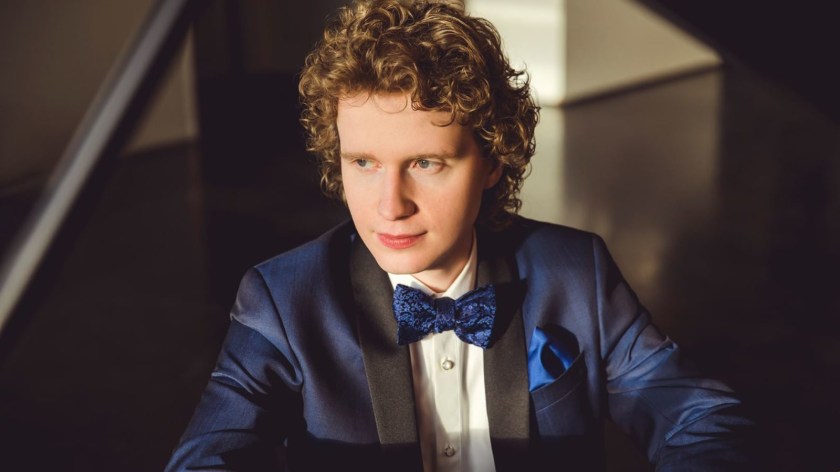
(Photo credit: Marie Staggat)
Discover more from MEET THE ARTIST
Subscribe to get the latest posts sent to your email.
 MEET THE ARTIST