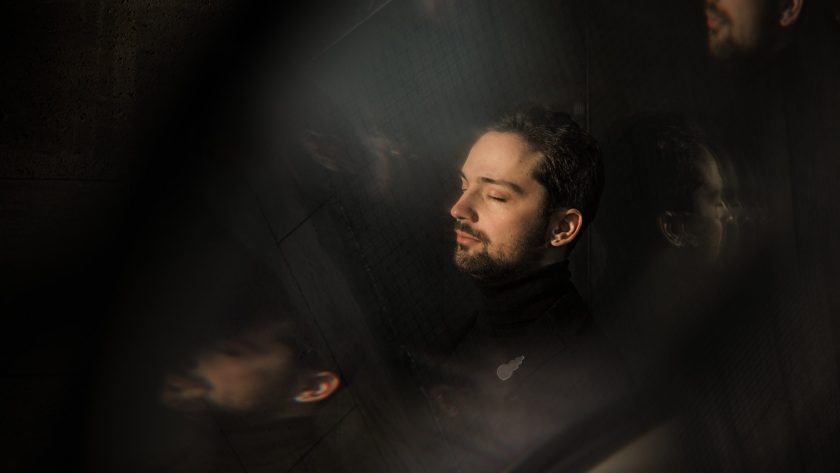
Who or what inspired you to pursue a career in music?
I grew up in a family where my father, Sandu Sandrin, had been a professional musician. Music was always at the centre of our family life. My father’s piano reigned over the house in the living room and in the evenings, our home was buzzing with his musician friends visiting us for dinner. I therefore took music for granted and felt no pressure from my parents to pursue a musical career. It was a performance, or rather a series of concerts, given by Christian Zacharias with the Lausanne Chamber Orchestra that persuaded me to seek a career as a professional pianist. Zacharias is a sensation in Romania with playing that electrifies the Romanian public. I was so impressed by his performance of the Mozart Concerti that I began to contemplate my life as a professional musician. I was 13 at the time.
Who or what have been the most important influences on your musical life and career?
Unsurprisingly, my late father was the greatest influence on my musical life. He was a stern and serious figure in my family, someone who lived entirely through music. Music made him quiet and maybe lonely. As a child I found his characteristic silences intimidating. The key to gaining his attention and beginning a conversation was to ask music-related questions. I remember bombarding him one evening with questions about piano concertos, such as “Why did Beethoven write only 5 piano concertos? And Liszt and Brahms just 2? And Mozart 27?”. Unfortunately, I do not remember the answer – his answers were mostly serious and he always forgot the fact that he was speaking to a child. Seeing his commitment to music and to practising has been hugely influential. He would practise every day until late, even when he had no concerts coming up in his diary.
What have been the greatest challenges of your career so far?
I approach challenges in a positive way, challenging myself at every step of my career. I dare myself to learn new and unfamiliar music and I set myself ambitious musical goals. I believe it is important to remain curious about music and to work on pieces that are out of your comfort zone – this remains for me the only avenue to artistic growth.
Of which performances/recordings are you most proud?
It is difficult to be proud of recordings, as they are essentially as time-capsules and versions of your younger self that may not resonate at all with our present self. The only way I can find some love for them is by shutting down the criticism, and embracing my lesser-witted past self at face value. Perhaps it is easier for me to think of successful live performances of which I am particularly proud, such as playing Schumann’s Kreisleriana at the Holywell Music Room in Oxford and the Goldberg Variations at the Konzerthaus in Berlin.
Which particular works do you think you perform best?
I have been told that I have an affinity for Mozart and Schumann.
How do you make your repertoire choices from season to season?
Unfortunately, long gone are the times when a young artist could afford to stick to the same repertoire per season. Today, we have to constantly adapt to the requirements of concert organisers – this sometimes entails having to work on a huge amount of repertoire at the same time. However, fortunately I am able to organise many of my own opportunities and then I can manage my repertoire and workload differently. I am constantly trying to learn new pieces, and I am always thinking of learning repertoire that would suit a particular theme during a solo concert. As I mentioned previously, I want to keep myself curious at all times and I would like to keep my audiences curious about my repertoire choices too.
Do you have a favourite concert venue to perform in and why?
There is a huge psychological aspect to performance that is often overlooked: the idea of entering the” flow state”. When an artist enters this completely focused state of mind, he or she fully inhabits the piece and remains calm and unperturbedduring the performance. Paradoxically, I find that when I reach this high state of utter concentration, I do not remember the performance very well, but there is an indescribable sense of bliss at the end of the concert. For me, particular acoustics or instruments facilitate entering this so-called “flow state”, among them the pristine acoustics of Wigmore Hall, or Holywell Music Room and the Salle Cortot in Paris or the Konzerthaus in Berlin.
What is your most memorable concert experience?
It happened in a small, yet intimate venue in Sunderland, last autumn: the previous night I had performed in neighbouring Darlington, and it appeared that members of the audience travelled to Sunderland to hear me for a second time. I recognised them in the audience and it made me feel particularly appreciated. I felt a lot of positive energy coming from the audience that helped me to perform particularly well that evening.
As a musician, what is your definition of success?
I think the challenge of being a professional musician is to keep going. We will encounter financial difficulties, time management problems and personal constraints, and at the same time we must constantly enlarge our networks with new students and new audiences. If I reach my 70s and I can continue to perform and teach, then I will consider myself successful.
What do you consider to be the most important ideas and advice to impart to aspiring musicians?
Keep challenging yourself, learn to brush off any career disappointments, surround yourself with supportive friends and choose a mentor who encourages you to think independently.
What is the most important issue we should be talking about in classical music that is not being addressed?
There are plenty of issues in the music industry that we do not talk about. Among them, most importantly, is the difficulty, dare I say impossibility, of securing a salaried, and therefore secure, music teaching position as an instrumentalist. Most teachers work for their education institutions on a self-employed basis. There is an inherent indignity in this – a system that does not acknowledge musicians and music educators as true professionals.
What is your idea of perfect happiness?
Mozart’s piano concertos. Listening to them and certainly, performing them
What is your most treasured possession?
My piano, unsurprisingly.
What is your present state of mind?
Slightly worried about learning a contemporary piece that has been submitted later than I expected.
Cristian Sandrin releases his new Beethoven album: ‘Kavatine/Piano Sonatas Op. 109, 110 & 111’ on 7th March 2025 on Evil Penguin. He is in concert on Sunday 2nd Feb at 7.30pm at Sinfonia Smith Square where he will present ‘New Goldberg Variations’, performing Bach’s Goldberg Variations alongside 3 brand-new variations, especially commissioned by Cristian Sandrin from composers Louise Drewett, Philip Dutton and Farhad Poupel.
More information here:- https://www.cristiansandrin.com/
(Artist image by Yvonne Hartmann)
Discover more from MEET THE ARTIST
Subscribe to get the latest posts sent to your email.
 MEET THE ARTIST