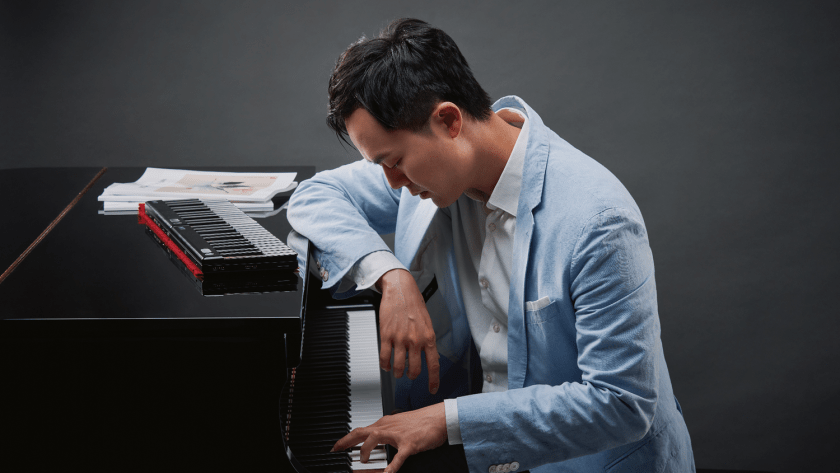
Who or what are the most significant influences on your musical life and career as a composer?
My musical life and career have been significantly shaped by two unexpected sources: my background in finance/investment and my backpacking adventures in Tibet and India. Finance/investment instills discipline and analytical rigor in my creative process, while backpacking immerses me in diverse cultures, instruments, and philosophies that spark fresh ideas. As a result, my music often features philosophical stories, intriguing tonalities, and a mindful sensibility.
What have been the greatest challenges of your career so far?
Without a formal musical education, my greatest challenge has been learning everything from scratch and independently crafting my own roadmap—covering composition, production, and building a musical career. I have since enlisted the help of mentors – composers, profressors, and other musicians – to help me build a technical framework for the musical ideas I’ve carried with me for years but did not have the tools to articulate.
What are the special challenges/pleasures of working on a commissioned piece?
One of the biggest challenges is time pressure—I always need to complete my work ahead of each concert. However, this constraint also fuels my creativity and enhances my productivity as a composer.
What are the special challenges/pleasures of working with particular musicians, singers, ensembles or orchestras?
Musicians often approach music differently than a composer—especially someone like me. While I enjoy incorporating improvisation, most musicians I have worked with prefer clear instructions. That’s why I especially appreciate those who bring their own personality to my pieces, surprising me with interpretations that make me reconsider what I had intially intended and think more open-mindedly.
Of which works are you most proud?
The Silicon Island Septet narrates the 400-year journey of the Taiwanese identity. The entire piece is structured in three movements, each representing a distinct three phase of the journey: contact, clash, and fusion. It’s a piece that I am not only proud of musically, but culturally. I was born and raised in Taiwan and our music reflects our timeline in terms of the originality of our sonorities as well as the incorporation of harmonies and motifs from other nations.
How would you characterise your compositional language?
Symbolism plays a key role in my work, with music often reflecting journeys of self-discovery and cultural intersections. Instead of overloading with complexity, I embrace delicate shifts in harmony and rhythm, inviting the listener into a reflective, almost meditative state. My pieces are designed to be organic yet structured, offering both clarity and mystery—like a Place of Origins 2nd movement, guiding yet leaving room for exploration.So often I start composing based on a musical idea which represents some aspect of Self, only to find that while exploring that idea, I’ve learned something else about myself. It’s a surprising journey.
How do you work?
I approach composition with intuition, often starting with a thematic concept inspired by my experiences in financial markets, travel, or cultural exploration. I usually compose in early morning and late at night.
As a musician, what is your definition of success?
I define success by how deeply my music resonates with listeners, creating a lasting emotional impact that remains long after the final note. like my piece ‘Danielle’, composed in memory of a friend’s tragedy. I feel more fulfilled hearing from one listener that my music spoke to them emotionally than I am watching my Spotify statistics.
What advice would you give to young/aspiring composers?
I suggest that young composers explore a wide range of subjects—science, technology, finance, healthcare, culture, and beyond—to gather insights and channel that inspiration into their compositions. This broader perspective can enrich our compositions, shape new collaborations, and ultimately help the industry evolve in more innovative ways. In turn, these subjects can benefit from the creativity and structure of music-making, as it may encourage leaders to think about difficult concepts in a more abstract way.
What do you feel needs to be done to grow classical music’s audiences?
In my own journey as both a composer and a hedge fund manager, I’ve seen how cross-industry collaborations and diverse perspectives can spark fresh interest. By showcasing classical music alongside other disciplines—we can expand its appeal, break the “high art” barrier, and invite broader communities to experience its depth and beauty.
What’s the one thing in the music industry we’re not talking about but you think we should be?
The practical realities of making a living through music—how a composer can secure a stable income and build a sustainable career.
What next – where would you like to be in 10 years?
Being a successful composer and fund manager, by combining creative inspiration with analytical discipline.
What is your idea of perfect happiness?
My perfect happiness lies in continuously discovering new ideas in unexpected places, moments, and people, across both music and investment, fueling a lifelong journey of growth and exploration.
What is your most treasured possession?
My most treasured possessions are the pieces I’ve already published and those I’ve yet to compose.
What do you enjoy doing most?
That synergy between seemingly unrelated fields keeps me curious, motivated, and constantly evolving as an artist.
What is your present state of mind?
Peaceful, neither arising nor ceasing
“The Awakening,” the first in a forthcoming eight-movement piano suite by Owens Hunag, inspired by Mussorgsky’s “Pictures at an Exhibition”, is now avaulable all digital streaming platforms
Discover more from MEET THE ARTIST
Subscribe to get the latest posts sent to your email.
 MEET THE ARTIST