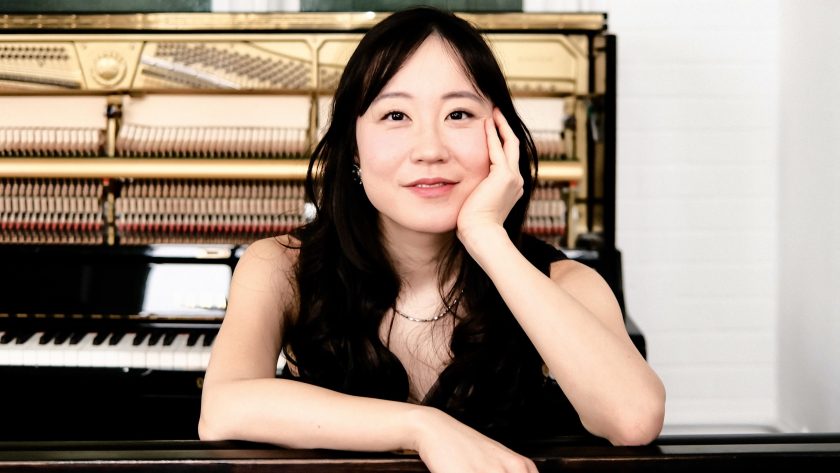
Who or what inspired you to pursue a career in music and who or what have been the most important influences on your musical life and career?
When I was little, I used to listen to a CD of classical favourites at night before bed. That really sparked my dream of becoming a pianist.
Then came the joy of performing. That excitement I feel when sharing music — it’s something that’s driven me ever since.
But behind the scenes, it was my mum who passionately encouraged me to play piano from a young age. She made sure I practised every day and instilled self-discipline in me. I think she’s been the biggest influence in getting me to where I am today. Along the way, I’ve also had supportive teachers and mentors who helped me believe in myself, and I’m so grateful to them for their influence on my career as a pianist.
Writing music is something I became curious about after moving to London. Discovering Hania Rani and her music about four years ago really inspired me — it gave me the courage to start composing in a style that draws from the classical tradition. Seeing someone classically trained write and perform with her own unique voice — blurring the lines of different genres — shifted my perspective.
There’s something so liberating and satisfying about performing music you’ve created yourself. You’re literally shaping invisible waves from silence. You begin from a blank canvas. I find writing music such a unique, meaningful process — to contribute something only I can to this big world, in my own little way. Capturing a moment in time through music. Haru no sanpo (A stroll in spring):
What have been the greatest challenges of your career so far?
Going through long stretches without performing or sharing music. I often feel like I’m not making progress — like there’s nothing to show for the work I’m doing behind the scenes. I’m still learning to navigate the ebbs and flows of a freelance career and trying to build patience with it.
Which performances/recordings are you most proud of?
One of the projects I’m most proud of is my ongoing work combining classical music with digital art. I began exploring this interdisciplinary concept during my Fellowship at the Royal College of Music as the 2023–24 Constant/Kit Lambert Fellow. Then, I received the Accelerate Award last year, which has allowed me to expand this project further.
A highlight so far was performing one of my own compositions at the Britten Theatre (RCM) in March 2025, as part of the 25th Anniversary of the Creative Careers Centre. It was a deeply personal moment, and the culmination of many months of collaboration. I’ve had the privilege of working closely with two remarkable digital artists — Theodora Serbanescu and Bethan Hancock — who have helped bring my musical ideas to life through evocative visuals.
Light within Darkness:
What I find most rewarding is the collaborative nature of this project. It’s been empowering to support and lead a group of young creatives like me, building something meaningful together. I feel that we’re contributing to the music world in our own way — creating immersive experiences that blend tradition with innovation.
I’m especially excited to continue this journey with a new iteration of the show at World Heart Beat Embassy Gardens on June 21, as part of the 2025 Wandsworth Arts Fringe. The upcoming performance explores the theme of night, weaving together music by Debussy, Takashi Yoshimatsu, and new works for piano and electronics by composers of diverse backgrounds. The programme journeys through music and images of dreams, reflection, and mystery — showing how this universal theme of night transcends time and culture.
Which particular works/composers do you think you perform best?
From the first time I’ve been introduced to Ravel during my teens, I have been in love with his music. And lucky for me, I think my small hands are really suited to his works, especially for those delicate flowing passages. I love the colours, the harmonies and the textures he creates in his music. One day, I would love to record all of his piano music.
And recently, I’ve also been performing music by Debussy too. I’ve always loved the music and art from the turn of the century. A lot of it captures imagery or scenery, and when I play pieces by Ravel or Debussy, I feel completely immersed — almost like I’m living inside the music. I think that’s why I connect so deeply with their work, and why I play it best.
How do you make your repertoire choices from season to season?
I choose music that speaks to me — pieces that pull me in emotionally. I think that connection is so important because you’re going to be spending a lot of time with the piece. It’s like entering a relationship. Each one is different, and there’ll always be ups and downs, but if that connection is strong, you’ll build trust and find your way through. I want to spend my precious time in this life playing music that truly resonates with me.
Ravel’s Pavane pour une infante défunte:
Do you have a favourite concert venue to perform in and why?
I have a personal connection with Sydney Opera House, as it is my home venue. I was fortunate enough to be able to perform as a soloist in the concert main hall when I was 16 amd I still can feel the excitement in my soul from being on stage in front of 1000+ people in such a big space. It was so quiet you could hear a pin drop.
It’s where I grew up, and where many of my closest friends and colleagues live, so it will always feel like home.
What do you do off stage that provides inspiration on stage?
I seek out interesting concerts, performances and art exhibitions. Seeing other creatives be brilliant— especially those who are constantly innovating and evolving as an artist, composer, performer, etc — inspires me. There’s something so electrifying when you see a live performance and feeling the energy in the room.
When I am at home, I listen to my favourite pianists (Sviatoslav Richter, Jean-Yves Thibaudet and Steven Osborne) and a wide range of audiobooks.
What is your most memorable concert experience?
I have many good memories on stage, but 2024 felt like a really big year for me. I got to perform at the Royal Albert Hall (Elgar Room), St John’s Smith Square, and on BBC Radio 3. All three were magical in their own way, but the Royal Albert Hall was especially meaningful. It’s such an iconic venue, the concert was sold out, and so many friends came to support me. I felt like I was truly living my dream in London.
As a musician, what is your definition of success?
Being able to play music you love and share it with people who love it too. Creating honest, meaningful performances that resonate — with yourself, and with others.
Liszt’s Liebestraum:
What do you feel needs to be done to grow classical music’s audiences?
There is so much potential to explore interdisciplinary performances which combines classical music with art, dance, literature and technology. These performances reach people who already engage with the arts but maybe haven’t discovered classical music yet.
We need to create more of these opportunities. And rather than rejecting crossover or collaboration, we should encourage it. Programming diverse repertoire can help us connect with a wide range of people. It makes listeners to be curious about classical music.
What’s the one thing in the music industry we’re not talking about which you think we should be?
Technology and AI.
I love live music — and to keep it alive, we need to create experiences that can only be felt by being there in person. When it’s done right, the energy of live performance is like nothing else — so unique. We need more of that, because it’s so easy now to just stay home and stream.
AI is here, and while it’s scary, it’s happening. That’s why it’s more important than ever to build an artistic identity. What makes you worth seeing live instead of an AI-generated performance?
As composers and performers, we should embrace the possibilities technology offers — digital art, lighting, immersive setups. How can we use it to elevate our work rather than fear it?
What advice would you give to young or aspiring musicians?
Be curious. Go to concerts and exhibitions that interest you. Play music that excites you, even if it’s outside your usual style. Try new ways of programming your concerts. Collaborate with different people and learn from them. Keep experimenting. Think outside the box.
And take time to reflect. Celebrate what you’ve achieved, and think about where you want to go next 🙂
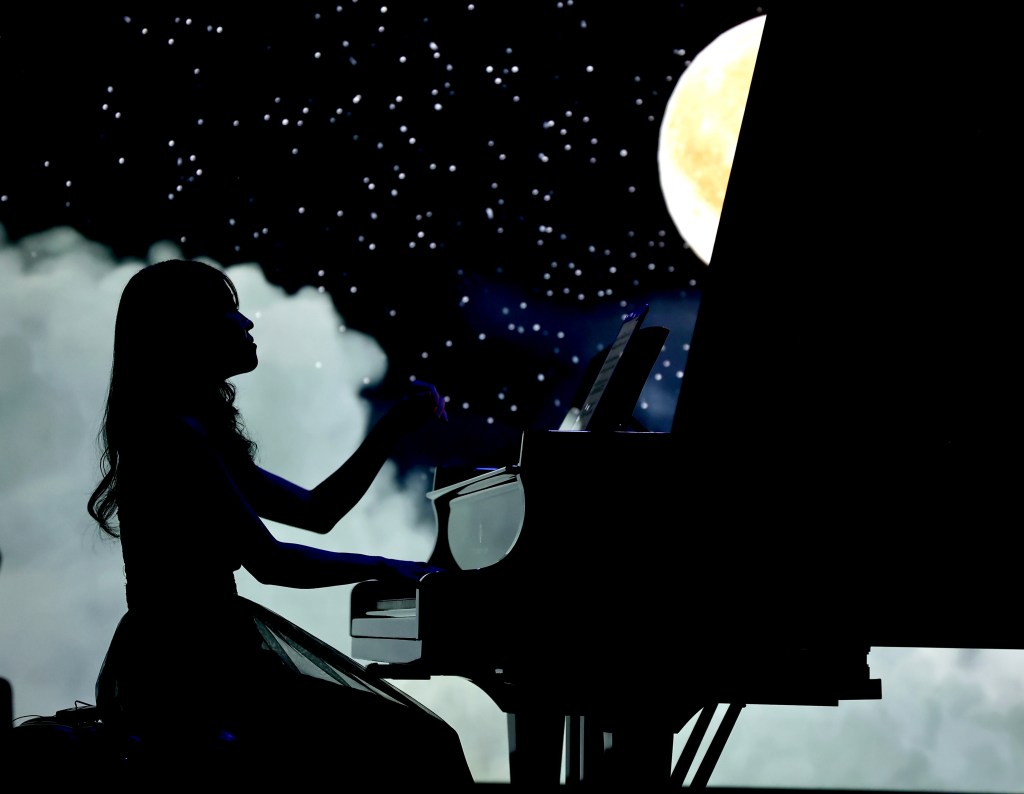
Rieko Makita’s upcoming concert, ‘Immersive Night Music Show’ as part of Wandsworth Arts Fringe Festival, is on 21 June 2025, 7.30 – 9.30PM at World Heart Beat Embassy Gardens (3 Ponton Rd, Nine Elms, London SW11 7BD)
Event Information & Tickets here
Discover more from MEET THE ARTIST
Subscribe to get the latest posts sent to your email.
 MEET THE ARTIST