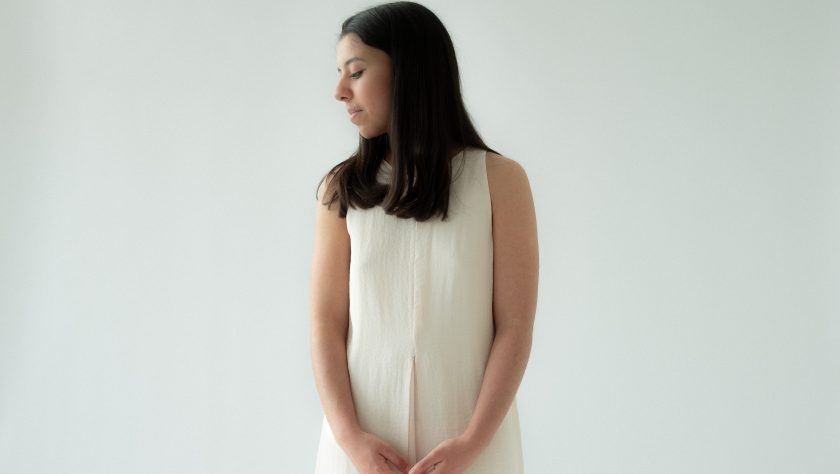
Who or what inspired you to pursue a career in music?
I fell into professional music-making slightly by chance. My first piano teacher, Yana Kaminska, noticed my love for music and my competitive streak so she entered me for the youngest category at an international competition when I was 8, in which I came first out of 77 participants. One competition led to another, and suddenly I was playing concerts and people were calling me a pianist.
I was very lucky to have a mum who would play a lot of classical music in the car and take me to music initiation classes at a very young age. I was raised on Glenn Gould’s recording of the Bach Inventions and Sinfonias, Martha Argerich’s recordings of various piano concerti, and Ashkenazy’s Beethoven Concerti recordings to name a few. I arrived at my first piano lesson aged 5 already with a full sonic imaginary and quite good aural skills, which definitely helped with my progress.
Who or what have been the most important influences on your musical life and career?
I was extremely fortunate to have extraordinary teachers. In particular, Nicole Salmon—a legend who encapsulates everything from being a piano master to a personal coach through to being an astute career strategist, always on the lookout for opportunities for her students. She has the strongest work ethic I’ve ever seen, and pushed me to overcome limit after limit, be it technical or musical. Like every visionary pedagogue since Socrates, she has the perfect mixture of toughness and warmth. They don’t make them like her anymore!
Other big influences in my life and career are Roberte Mamou, who convinced me to apply to specialist music schools in the UK, and Malcolm Singer who encouraged me to apply to Cambridge to read music. Not only were these two places immensely fulfilling from a musical point of view, they also gave me a network at the heart of British (and global) music-making which was extremely valuable career-wise.
Musically, I am continually inspired by so many mentors and wonderful colleagues who lead by example, and also all the great composers and interpreters of the past. It’s impossible to name them all here.
What have been the greatest challenges of your career so far?
I think the hardest challenge is taking ownership of one’s life and artistic voice, and believing in pursuing projects that are most aligned with one’s vision and values, even when the majority of people might be doing things very differently. This might come as a surprise to some readers, as I have been known to undertake quite unusual projects, but I am actually very risk-averse as a person. Deviating from the ‘conventional path’ doesn’t come easily to me, even when my gut and my brain tell me it’s the right thing to do.
Which performances/recordings are you most proud of?
My début album is coming out in September – it’s a programme which tells the story of Ravel’s Miroirs in a different way, by reordering the movements and interspersing them with lesser-known miniatures from around the world. I’ve poured a lot of myself into the project including my preoccupations with themes of nature, spirituality, connection, memory, and self-discovery. Putting this project together from scratch was a huge amount of work, and I’m still somehow in disbelief that it is actually a matter of weeks until it’s out in the world!
At Cambridge, I also directed a production of [Handel’s] Giulio Cesare. It was a crazy project which involved 60 students over two months. I loved every moment of it, and made friendships through it that will probably last a lifetime. It was altogether one of the best things I’ve ever done.
Finally, I am really proud of the Classical Piano meets Comedy Show, which I performed for the first time at the 2023 Bloomsbury Festival. It was a packed room, the atmosphere was absolutely wild, and I was just so energised making people laugh and connect with them in this way, as well as the way I’m more used to which is just playing the piano. It won an award, the Barbican Imagine Award, which is crazy, and I also got asked to do it in a festival in Morocco, all in French…! I’m looking forward to more performances of this show in 2026, organised in collaboration with 7 Star Arts.
How do you make your repertoire choices from season to season?
The way I pick repertoire for public performances has changed over the years. Nowadays, I ask myself questions like: ‘which works can I, with my particular set of lived experiences, skills, and sensitivity, bring most effectively to my audience?’. Other questions would be: ‘am I the best-placed person to perform this piece at this time?’. The answer might be no, because there are plenty of amazing pianists, each with their distinct set of qualities, and since I have limited time and wish to make as strong an impact as I can, I might consciously decide to leave certain pieces to others. If I decide I should play a work, it might be ‘because no one else is playing it’, or ‘because I have a perspective which I’ve never heard in other interpreters which I think deserves airing’, or ‘because I have an idea of a way to present it in a way that’s never been done before’. And then I make a decision based on what I think the world needs most from me right now: this might be making the public discover a lesser-known piece, or change the perception around an underrated composer, or frame a famous work in a totally novel way…
As a musician, what is your definition of success?
Being true to yourself and your values, and leaving a positive, and, if possible, lasting mark on people’s lives. I believe I would have had those aims even if I hadn’t become a musician.
What do you feel needs to be done to grow classical music’s audiences?
I think that if we simply aligned with best practices in the wider music industry (other genres) we would come a long way.
Firstly, before seeking to grow audiences, we should seek to deepen the connection we have with our existing audiences. I would very much recommend Amanda Palmer’s Ted Talk The Art of Asking (available on YouTube) in which she argues that 1000 true fans is all an artist needs.
Whatever we do, we should always be guided by data, which is something that the brilliant Audrey Bergauer often talks about. And that doesn’t mean compromising on artistic integrity, changing our repertoire, message, or values. It means finding the most effective way to communicate what we want to communicate, with the people we want to communicate with. I’m very passionate about this and if you are interested you can often find me rambling about it on social media!
What advice would you give to young or aspiring musicians?
Be true to yourself, keep learning, and if you feel that something should exist but doesn’t, don’t be afraid to start it.
Aïda Lahlou’s debut disc, Mirrors & Echoes, is released on 19 September on CD and streaming on the Resonus Classics label
Album launch concert at the 1901 Arts Club, London, on Wednesday 24 September. Find out more
(Artist image by Ben Reason)
Discover more from MEET THE ARTIST
Subscribe to get the latest posts sent to your email.
 MEET THE ARTIST