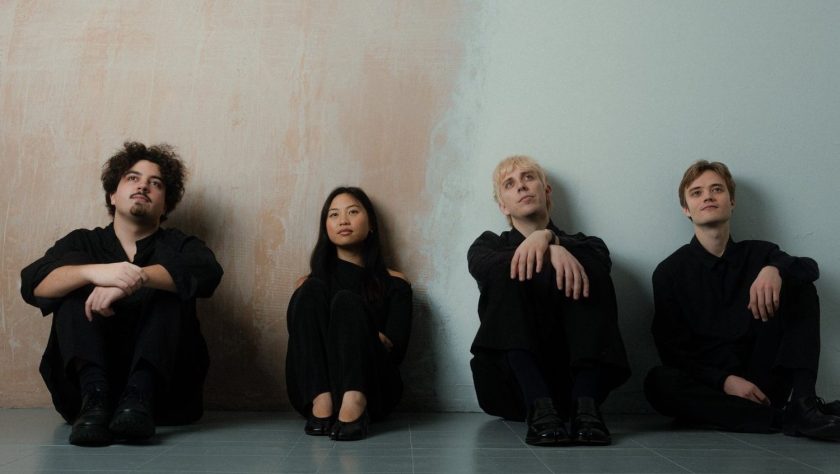
Who or what inspired you to pursue a career in music, and who or what have been the most important influences on your musical life and career?
We actually met at the Royal Academy of Music, and that’s really where the quartet began. At first it was just four people who enjoyed playing together, but quite quickly it became something much more serious. Developing as a group in that environment, surrounded by so many inspiring musicians, pushed us to think long-term about what we could become as a quartet.
One of the most important influences on us has definitely been our teacher, Alex Reddington. He’s shaped not just how we play, but how we think as an ensemble, about sound, structure, and the level of detail that’s needed to really make this repertoire work. That guidance has been incredibly important in giving us a clear direction early on.
What have been the greatest challenges of your career so far?
One of the biggest challenges has simply been making the quartet work logistically. All four of us have very busy individual schedules with studies, projects, concerts, so finding enough consistent time together isn’t always easy.
A string quartet really needs regular, focused rehearsal to grow, and we realised quite early on that if we didn’t organise things properly, it just wouldn’t function at the level we wanted. So we had to become quite structured about how we plan rehearsals, schedule projects, and avoid clashes. Since putting that system in place, things have worked much more smoothly, and it’s allowed us to focus properly on the music rather than the logistics.
Which performances/recordings are you most proud of?
One that stands out for us is the Cavatina Quartet Competition. We spent a long time preparing for it, really going deep into the repertoire and refining our playing as a group.
What was special in the end was not just the preparation, but the actual experience of performing there. There’s something about that kind of environment that brings a different energy, and we really enjoyed being able to share what we’d worked on. It was also great to come away with a proper recording from the competition, it feels like a really great snapshot of where we were as a quartet at that moment.
Which particular works/composers do you think you perform best?
As the Karelia Quartet, we feel especially at home in the quartet repertoire of Beethoven and Haydn, where clarity, structure, and dialogue are so central. More recently, we’ve also been exploring the colouristic world of Ravel, which we believe really suits our natural strength as an ensemble. One of our defining qualities is our ability to blend seamlessly while still creating a wide spectrum of colours and character, and these composers give us the perfect canvas for that.
I think as a quartet we really feel at home in repertoire where there’s a strong sense of conversation between the parts. Composers like Beethoven, Brahms and Bartók are always really rewarding for us because the writing demands that balance between individual voice and collective sound.
At the same time, it’s important to us not to stay only within the standard repertoire. We’ve been really enjoying exploring lesser-known works recently. We’ve started working on the string quartets by Miriam Hyde and Peter Sculthorpe, and we’re also looking into music by Lotta Wennäkoski. That process of discovering new pieces and figuring out how to present them feels really exciting and quite personal to us as an ensemble.
How do you make your repertoire choices from season to season?
We like to think of programming as storytelling. When planning a season , we aim to strike a balance between familiarity and discover, pairing well known works with lesser-known pieces that deserve a wider audience. This approach not only keeps things fresh for us artistically, but also helps draw in new audience members who might come for something familiar and leave having discovered something unexpected. We often look for connections between works, i.e. historical, emotional, or textural. This makes each programme feel cohesive and engaging.
It’s very much a shared process. We’ll all bring in ideas and then gradually shape programmes together. One thing we think about a lot is the audience experience, how a program feels from start to finish. We’re quite conscious of pacing and contrast, and how to keep people engaged throughout.
We like building programmes that have a sense of journey, whether that’s through a theme, a particular contrast in styles, or just the way the pieces speak to each other. At the same time, we try to make sure we’re including works that challenge us and help us develop as a quartet.
Do you have a favourite concert venue to perform in and why?
We do really love more intimate settings, things like salon or soirée concerts, where the audience is close and you can feel that immediate connection. There’s something very special about that kind of atmosphere.
That said, one of the most memorable experiences we’ve had was performing at Wigmore Hall. It really feels like the hall itself is an instrument. The acoustic is so clear and responsive, and there’s a kind of liveliness to it that changes how you play and how you listen to each other. It creates a completely different experience on stage, and makes communication within the quartet feel incredibly direct.
What do you think needs to be done to grow classical music’s audiences?
We have to recognize how much times have changed. The younger generation especially has grown up with social media like TikTok and short form content, where everything moves very quickly and attention spans are shorter. Because of that, it is harder to get people interested in coming to a classical concert if it is presented in the exact same way as before.
To attract new audiences, concerts need to offer something a little more than just the music at first, something that catches people’s attention and makes them curious enough to come. Once people are actually there, the music can speak for itself. But the initial draw might come from collaborations with other artists, visual elements, lighting, sound design, or even newer music.
For me, a big part of growing the audience is about collaboration and adding more dimensions to the concert experience. That could include short speeches that help the audience connect with the music, small theatrical elements, or visual aspects that give people something to see as well as hear. I am not saying it should become a huge spectacle where lights and visuals take over the whole performance. The music should always remain the focus.
Instead, these extra elements should be used carefully and tastefully so they support the music rather than distract from it. When done well, they can actually enhance the experience and help the audience engage more deeply with what they are hearing. I think concerts that are designed this way, where the music is still central but presented in a slightly more creative and collaborative format, could really help bring more people into classical music.
What’s the one thing in the classical music industry we’re not talking about which you feel we should be?
The atmosphere of traditional classical concerts is something that I think we are not talking about enough. While I personally really love and appreciate the way concerts have always been done, I can still recognize that this same tradition can create barriers for new audiences.
The formality, the unwritten rules, and the overall structure can feel intimidating, especially for people who are not familiar with it. This connects to my earlier point about needing to adapt concerts slightly in order to attract new audiences. If the experience feels too rigid or exclusive, it becomes harder for people to feel comfortable attending in the first place.
I do not think that tradition should be removed, because it is a very important part of classical music. But I do think that small changes could make a big difference. Things like speaking to the audience, creating a slightly more relaxed atmosphere, or adding subtle visual elements could help people feel more included, while still keeping the music as the main focus.
What advice would you give to young or aspiring musicians?
My best advice would be to take inspiration from other musicians, but not to simply follow or copy what they do. Of course, many musicians are incredible, and it is very important to look up to them and learn from them. But in the end, I have come to realize that we are all very different.
It is useful to be able to imitate others and learn through that, but the greatest feeling comes when you start to find your own way. That is when you feel the most confident and free in your playing.
I would also add that it is important not to get stuck on things. Paying attention to small details and striving for improvement is essential, but it is very easy to get too focused on things like technique. When that happens, your inspiration, creativity, and love for music can start to suffer.
You should never give up, but at the same time, you should not allow yourself to become stuck. Finding a balance between discipline and freedom is really important.
Karelia Quartet appear at this year’s Winchester Music Festival, which runs from 1 to 4 May. Find out more https://www.winchesterchambermusic.com/programme-2026/
kareliaquartet.com
Image credit: Ben Reason
Discover more from MEET THE ARTIST
Subscribe to get the latest posts sent to your email.

