Who or what inspired you to pursue a career in music?
My family weren’t musical – although my granddad on my mother’s side was a brilliant organist. He had died by the time I was born amid a scandal nobody spoke about (he was murdered by his mistress)! I got interested in conducting when my granny bought me an album called Music For Frustrated Conductors – with little cartoon pictures of how to beat a 3/4, a 4/4, etc. (Years later I read that that young whippersnapper, Simon Rattle – 6 years my junior – also had had a copy of it as a kid).
Even though I was seduced by classical music at the age of about ten, (I used to conduct the dining room furniture to a Concert Hall Records mono version of Schubert’s 9th symphony conducted by Carl Schuricht) the Beatles explosion came along shortly after that, and blew me away overnight. But I was into everything from Wagner’s Siegfried Idyll to Jimi Hendrix’s Hey Joe. Playing in the pub at 14 developed my piano skills (I’m self-taught in piano, composition and conducting, but would never have qualified to do Higher Education in Music). My headmaster warned against throwing myself into an uncertain music business but I knew by then it was all I wanted to do. (I had been planning to go to Sandhurst and join the army, but decided that the pull of music was too strong to resist).
Who or what have been the most significant influences on your musical life and career as a composer?
Too many things to list. But pop-wise, Beatles, Rolling Stones, Beach Boys, Frank Zappa. Classically – I guess the romantics appealed the most. So starting with Schubert (symphonic, not lieder), Beethoven, Delius, Vaughan Williams, all the usual suspects. Mozart, of course. Dvorak. The Russians, particularly Prokofiev, Stravinsky, Borodin. Hearing Bartok’s Concerto For Orchestra was a massive Eureka moment for me.
What have been the greatest challenges/frustrations of your career so far?
How long have you got? I suppose my own eclectic tastes as a listener and practitioner are what have provided me equally with the thrills and the spills. By being perceived as a generalist, you almost disqualify yourself from comparison with specialists; but of course I don’t go along with that. The one biggest accelerator and inhibitor to my career has been The Wombles. A rocket-booster giving me carte-blanche to create four adventurous albums of widely ranging music, including classical styles, leading inevitably to the confidence of a record company (Sony) to finance my more ambitious compositional and vocal solo albums that were successful internationally except in the UK where the Womble image even to this day distorts people’s perception of me. My love for the orchestra sometimes leads people to bag me as “prog-rock” – a label I dislike and with which I don’t identify.
How do you work? What methods do you use and how do ideas come to you?
Having spent the first half of my career scoring directly to paper, sitting at the piano with 24-stave paper – often overnight with a session the next morning – I enjoyed the thrill of deadlines, and I set self-imposed ones if real ones don’t exist. The best deadline is to book the orchestra before you begin composing! In 1989 I was introduced to Finale software, – which to my mind at that time, had “cracked” the main technical problems with computer-scoring software, such as allowing slurs and articulations to be applied as accurately and quickly as when done by hand. At that point I moved to Finale, and have used it ever since. Sibelius came along and, being easier to use, more people use that now, but I think Finale, although less user-friendly, has wider capabilities. Sadly, it’s being discontinued.
For songwriting I almost always sit at an acoustic piano with manuscript paper , and allow the lyrics and melody to come at the same time, hurriedly scribbling the melody with the words underneath. It’s much quicker than recording on a phone or something, and easier to see, sort and construct as you go. If I’m orchestrating – particularly for example with this new symphony, I’m usually not actually orchestrating pre-composed tunes and harmonies – I write straight into Finale from left to right, allowing it to develop as a homogeneous piece. There’s no sketch. A new melody created as I go along will often initially be conceived as a “trumpet duet moment” or a “viola moment” rather than a general thematic tune first and foremost. Then if I deem it keepable I’ll develop it and integrate it into the ongoing score. The beauty of Finale is that you can instantly delete something if it isn’t working – or move it out of the way in case you need it later.
How would you characterise your compositional language/musical style?
Impossible to describe. Other people seem to be able to tell it’s me, whatever genre I’m working in, but there’s no deliberate doctrine or language. In what we’d call “classical” (that troublesome word) you’ll find suites and overtures in my catalogue that are very much tonal and traditionally melodic. For example, The Dreamstone Overtures and Watership Down Suite. They use themes and motifs designed for and eventually incorporated into dramatic visual material) , even though they often start out as structured orchestral compositions. But they do not try to hit any particular zeitgeist or trend. If there’s an anguished or violent moment, you’ll hear anguish, violence and more atonality. The balance one tries to achieve is accessibility with originality. I think Prokofiev was the master of that; unpredictability but without changing the language to achieve it. Oddly enough, the orchestral “style” and harmonic/melodic/rhythmic approach is “edgier” in my rock works. Albums like “Six Days In Berlin” pushed the accessibility limit to the extent that I was dropped by my record company (!) but you’ll find ideas just as ”out there” in “Tarot Suite” and “Schizophonia” (both with the LSO) which were very successful – none of which were ever deemed (or intended) as “classical”. It’s the rock instruments that bag those albums as not classical. So when I want to write “classical” (in the case of this symphony at least) I’ve avoided rock instrumentation and electronics completely – just when a lot of modern classical composers are accepted, using it. I think it’s called swimming against the tide! I was never “of my time” and I really don’t mind not being. The symphony does, however, expose where my heart lies, harmonically and melodically; it’s a natural way of writing. I am not trying to find my way or looking for a voice. If I’ve gone the “wrong” way, (for some people) it happened long ago and it’s too late to go back now!
Of which works are you most proud?
Classically? “Dublin Overture” written for the National Symphony Orchestra of Ireland as part of a tribute to the great Irish Tenor, John McCormack. My above-mentioned orchestral suites, Watership Down and Dreamstone Overtures. The Aspidistra Suite. In combined-genre, ‘Zero Zero” with the Sydney Symphony, and “Tarot Suite” with the LSO. “The Hunting Of The Snark” again with the LSO. Oh, and my score for the movie “Caravans” (LPO, 1978).
As a musician, what is your definition of success?
I admire anyone who can make a living doing what they enjoy doing, whether it’s running a grocer shop or dress designing. In my case, it’s composing and performing. Being “allowed” to do the next piece (artistically or financially) is the success for which I always strive. Of course as we achieve goals, our goals change, so yes, there are higher mountains, too.
What advice would you give to young or aspiring composers?
Don’t try to be “of now”.
What’s the one thing we’re not talking about in the music industry which you really feel we should be?
The mystery of streaming.
What next? Where would you like to be in 10 years time?
At AIR Lyndhurst studio.
What is your idea of perfect happiness?
Not needing to think about achieving perfect happiness
What is your most treasured possession?
My health and sanity (if that counts as a possession). If not, my laptop!
What is your present state of mind?
Generally, – concerned and saddened but hopeful. Today specifically, – relaxed and happy.
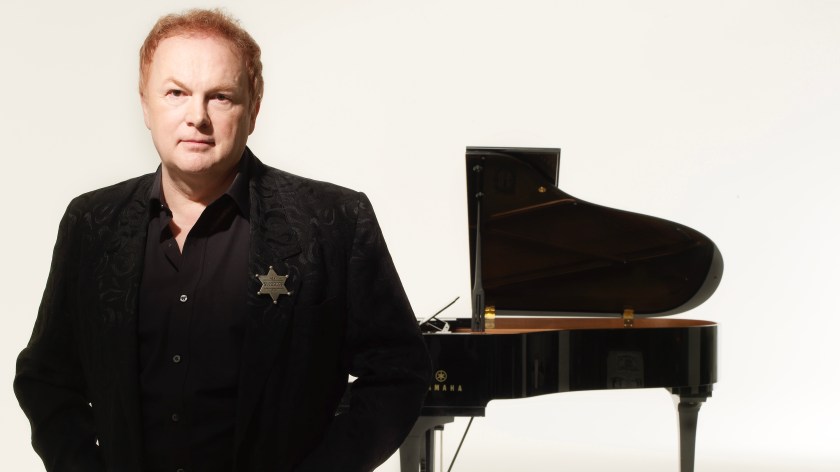
Mike Batt releases his first symphony on 5 July 2026. SYMPHONY No. 1 ‘Ukraine’ is dedicated to and inspired by the people of Ukraine, whilst also intended more broadly as a reflection on the conflict and suffering that is ever-present in modern world affairs. Batt conducts the London Symphony Orchestra is this world premiere recording. Pre-order link
Discover more from MEET THE ARTIST
Subscribe to get the latest posts sent to your email.

