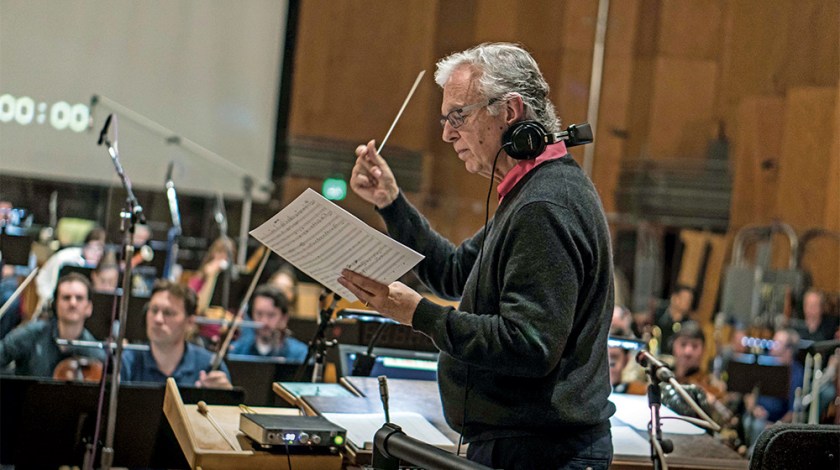
Who or what are the most significant influences on your musical life and career as a composer?
My family was the first big influence on my musical life. My grandfather was a composer; an
uncle was a songwriter. All my grandparents could play an instrument; one was a trained singer;
everyone in my immediate family — my parents, my brother, and I — played the piano and brass
instruments and could sight-read and sing. My brother was a professional trombonist and a
composer/arranger in the movie studios. I began piano lessons in second grade and was handed a trumpet soon after. I eventually switched to the horn, but the piano was my main love.
My brother and I grew up playing in bands while we were in school. We went to summer music
camps where we learned elementary music theory.. Although as a boy, I wanted to be an animator, by the time I went to the University of Southern California, I had decided to major in
music. I don’t recall any great passion for it, but it was familiar. I majored in composition because
it was the one part of music I knew the least. I had already started writing music when I was
about twelve, so it made sense to me to study it.
I entered University with “Tchaikovsky ears,” meaning I wasn’t up to date on contemporary
music. As a high school student, I had only just heard The Rite of Spring, but mostly I listened to
Beethoven. By the time I left USC, I was much more familiar with 20th-century composers such as
Bartók, Penderecki, Britten and Stravinsky. My Tchaikovsky ears were expanding. I joined CBS
Television’s Music Operations right after college as an assistant music supervisor. My musical
education took a sudden turn when I began to learn firsthand about dramatic commercial music.
The first recording session I attended was for the TV western, Gunsmoke. It was composed for 18
brass players. I thought I knew brass music, but I’d never heard anything like this! This was
music written for effect! This was the start of the second huge influence on my musical life. I began writing television scores while working at CBS. In addition to television shows, CBS began
producing motion pictures, and our department hired the top film composers, such as Jerry
Goldsmith, Johnny Williams, Michel Legrand, Quincy Jones, Dave Grusin, Laurence Rosenthal,
and many, many others. Over the years, I became acquainted and sometimes friends with many
composers whose work I had seen and heard in movies and television. While at CBS, I had the
opportunity to study their music, as I had studied so many others at USC. The proficiency and
musical acuity of many of these composers, who were still alive! – was a tremendous influence in
my music, both in the movies as well as in my concert work.
Many years later, while still working in film and TV, I had the opportunity to teach as a part-time
lecturer/professor at UCLA and USC. This was my third big influence. It’s said that if you want to
learn something, it’s best to teach it. I found this to be true. Working with young composers of
varying abilities, styles, and understanding is a terrific way to improve your own abilities and
understanding. Additionally, writing concert music, which is not constrained by any
commercial considerations, is an excellent way to expand one’s boundaries and musical
imagination in every direction.
What have been the greatest challenges of your career so far?
Because my career was primarily in commercial music, especially film and television, one of the
greatest challenges was simply to reorient my thinking toward the use of music rather than its
content. This means, among other things, having to learn and become competent in many new
styles of composition, to write objectively for a subjective reaction, to be able to write on demand
and under pressure, to be able to adapt quickly to changes of opinion, content or style, to be able to quickly rewrite or rearrange a section or an entire piece to someone else’s desires, and to make it all sound natural, i.e., like a piece of music. There are many great technical benefits to this sort of work. One gets the opportunity to practice constantly, to hear what one has done soon after it was composed, and to get criticism. There is always both the opportunity and the necessity to learn and master a new skill, technique, or style. One learns quickly to write specifically. If the music is unacceptable to the demands of the job, it is not used.
When one ventures into the concert world, many of the rules change. One does not follow a script or compose to someone else’s desires and demands; the forms are not pre-set, and the aesthetic and artistic ceiling becomes much, much higher. Limitless, actually. Commercial music can give one a specific technique, but concert music provides the opportunity for self-expression and an emotional, aesthetic connection on a much broader level. The primary difference is that music is no longer an adjunct to or a support of something else; it is the entire thing.
What are the special challenges/pleasures of working on a commissioned piece?
One of the challenges of working on a commission is to compose for a specific individual or group, according to their abilities, strengths or weaknesses, and to any constraints, if any, on the style or size of the piece. In other words, the question I ask is, How can I compose something that will be able to be performed by this individual or group in the best possible way? Of course, aside from aesthetic or musical challenges, just getting paid for one’s work is often the biggest challenge. One looks for donors or consortia for the financial or social help to compose a certain piece. The greatest pleasure, however, is not aesthetic or financial. It’s the experience of having your piece actually completed and performed, and the knowledge that it didn’t languish on the shelf unplayed.
What are the special challenges/pleasures of working with particular musicians, singers,
ensembles or orchestras?
If I have the opportunity to work with a group or an individual whom I particularly admire, who I
know will give a performance that is unique and special, that is the greatest pleasure. It is a
wonderful thing to hear one’s music performed well, with understanding, skill and emotional
connection.
Of which works are you most proud?
I think I am proudest of the pieces that produce the greatest effect on people. I went into
commercial music, especially the movies, to write music that would let people feel. I wanted the
musicians and the audience to be participants in the music and to connect to it. Whenever I’m at a performance of something of mine, and I can feel the audience experiencing it, I feel as though,
through the music, I have done something special. I have some pieces that I am proud of in this
way: my tuba concerto; my piccolo concerto; my oboe concerto, And on the Sixth Day; my piece for band and choir, Two Sermons. There are others, but these few come to mind right away.
Lately, I have been getting letters from people I don’t know thanking me for composing this or that piece. Sometimes the pieces are from films, and sometimes they are concert pieces. People will wait for thirty years (literally) to write me a note, and my feeling is that this is extraordinary: to be able to give joy to someone I don’t know and will never meet, and to have such a person let me know after decades of listening that my music was and remains meaningful for them. I’ve found that it doesn’t really matter which ones I’m proud of. If something makes contact, it’s a success. Period.
How would you characterise your compositional language?
Varied. I write according to what I want to hear. Overall, I’m sure I qualify as a traditionally
based composer. I believe in melody, harmony, tonality – all of that. But I believe in it as I believe
in air. It’s been around for a long time, and people haven’t gone off it. I am most interested in
making contact, and I have found that I can work in any number of styles that are not melodic,
harmonic or traditionally tonal and still make contact. For me, being considered “interesting” is
not as great as someone engaging emotionally with what I did. But being interesting is better than being dull, and I aspire to compose the former and not the latter.
How do you work?
Generally, I work at the piano and then transfer my notes to Sibelius, the music-writing software in which, once transcribed, I can get some idea of how the piece plays. But I usually do better if I
wait to engrave it and continue imagining the piece at the piano. I can imagine better sounds and
combinations than I can when working with software in which all the sounds are pre-packaged,
and the combinations are not acoustic. I also hear performance when I’m working in my head, not just the pushing out of sound waves.
I have, on occasion, written a piece without the piano. It comes out a little differently, perhaps a
little fresher, since my hands aren’t wandering around familiar combinations. My tuba concerto
was written that way, also my English Music for horn and strings.
Until the music gets performed, it’s somewhat of an imaginary piece. It mostly lives in the
performance. Performers, venues and audiences all influence the way it gets presented. There are so many different performances and recordings of the same piece – think Beethoven or Bach – even though the notes never change. The piece doesn’t really become music until it’s performed, or, for that matter, until it’s heard.
I learned from my wife, a violinist, the difference between performance, reading, and construction. The notes are not a performance. A reading is not a performance. The piece itself is not a performance. It’s a map, a guideline, a living thing with possibilities. A performance by an artist who has worked on the piece, who has an understanding of the phrasing, the line, the flow, the details, is the music. When I’m composing, I have to think of all of that: who the piece is being
written for, how it will be played, where it will be played, and whether it will ever get played again. I have heard my pieces played badly and played well. Well is much, much better than badly, but both ways are versions of the same piece.
As a musician, what is your definition of success?
I believe that if I wrote the piece to the best of my ability, and if the music connects with the
players and with listeners, then the piece is a success. If the piece gets played a lot, I can consider
the piece to be even more successful. Sometimes, a piece I’ve written gets a lot more attention than I expected. (The reverse is just as true.) But my definition of success would be whether I thought I did a good job on it and it connected. If I think it’s a good piece and no one else does, I can still be happy with what I did. Sometimes writing a piece is just a matter of problem-solving. If you solved the problem, then, regardless of approval, you have to acknowledge you were successful.
What advice would you give to young/aspiring composers?
In composing, the idea is the thing, but a good idea badly used is really unfortunate. When learning, one cannot underestimate the value of the basics, things like tonality or atonality,
scales, intervals, harmonic systems, melody and form. It can be tedious to learn, but it’s the
foundation of everything else that follows. Music is an art, of course, but it’s primarily a craft, and
it’s the craft that often gets short shrift.
Composers, like all musicians, must practice. They have to learn their craft in order to be fluent.
It’s done by practicing over and over and over. Everyone who plays an instrument knows they
have to practice, and so with composing you have to write, write, write. There are some
techniques, like counterpoint or instrumentation, that are unforgiving when ignored or glossed
over. It’s easy to tell music that has been poorly put together. One doesn’t need a great idea to
write a really good piece. But one does have to learn how to make an idea effective.
I think it’s also important to pay attention to music that you don’t particularly like. There’s a
reason you don’t like it, and you should find out what it is. It’s important to listen to and absorb
many different styles and techniques.
What do you feel needs to be done to grow classical music’s audiences?
It’s a truism that people like what they know. It’s too easy to simply say, Just write what people
want to hear and the people will show up. Although that may be partially true, it’s also important
for music to be able to express itself in different and non-traditional ways, in ways that are not
familiar and well-known. Personally, I think we badly need new music. I’ve read that in order for
a new piece to be successful, it should contain music that’s 50 percent familiar and 50 percent
unfamiliar. I’m not sure whether that’s the answer or not, but I do know that personally, I’m
generally not interested in going to a concert that is a reiteration of something that I have listened to all of my life and something I have recordings of at home.
What’s the one thing in the music industry we’re not talking about but you think we should be?
I think it’s important to let new composers get heard. If they don’t get to hear their works played,
they won’t be able to improve them. Composers need to hear what works, what doesn’t; what’s a
reasonable request, what isn’t; and especially what’s worth listening to and what isn’t. Otherwise,
we’re simply hearing the same old familiar pieces over and over.
What next – where would you like to be in 10 years?
Since I’m getting old, just being around would be good. But if I’m around, I want to be writing
music that still has something in it that connects to my listeners.
What is your present state of mind?
Expectant, curious, grateful, and anxiety-free.
Discover more from MEET THE ARTIST
Subscribe to get the latest posts sent to your email.

