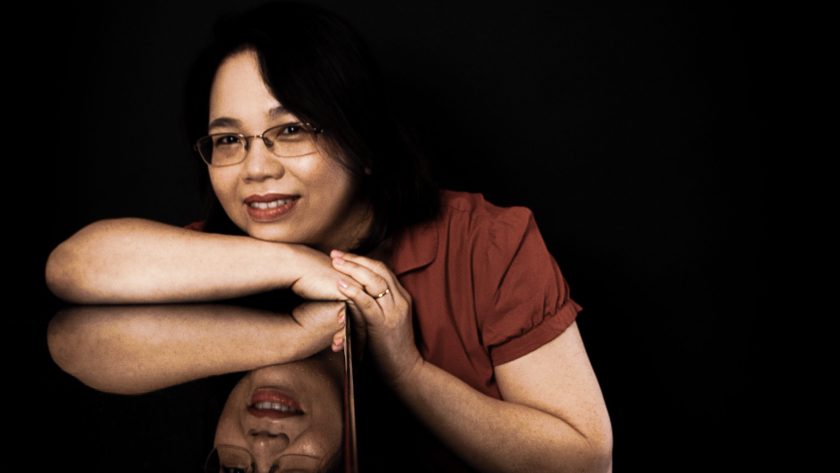
Who or what are the most significant influences on your musical life and career as a composer?
In March 2022, my family and I contracted Covid-19, so for three weeks, I was unable to teach piano from my home. I started composing piano pieces and uploading them onto social media. They started gaining attention and received lots of positive comments. My friends encouraged me to try and get them published. Being a fan of Ben Crosland’s beautiful piano books published by Musica Ferrum, I contacted Nikolas Sideris, the publisher, who received my compositions with great enthusiasm. He has gone on to publish My Lyrical Notebook, My Quirky Notebook, My Garden Notebook (nominated for the Art of Piano Education award in 2024), My Seaside Notebook, My Forest Notebook (nominated for the Art of Piano Education award in 2026) and Echoes of the Orient, which was released by Naxos World. You can listen to snippets of each book here.
What have been the greatest challenges of your career so far?
In 2015, I was diagnosed with carpal tunnel and cubital tunnel syndrome. This meant that I can only play the piano for a few minutes at a time, which was incredibly frustrating for me. I was fortunate that my ex-student, Katie Yao Morgan, was happy to perform all the tracks in the Echoes of the Orient album at West London Studios. I also wrote for the erhu, performed by the talented Xiao Wang, who has been featured in Shang Chi and Kung Fu Panda soundtracks
What are the special challenges/pleasures of working on a commissioned piece?
Naxos World required an album to last at least 45 minutes, so writing longer pieces was a challenge for me, as I was used to writing short educational works. It had to amalgamate classical music with ethnic sounds, so I listened to Malay, Chinese and Japanese music for inspiration. Ikan Kekek was my arrangement of a popular Malay folksong that I learnt as a child. You can listen to the track here:
What are the special challenges/pleasures of working with particular musicians, singers, ensembles or orchestras?
It was an absolute pleasure to work with Katie Yao Morgan. She was a child prodigy who was offered a scholarship at the Yehudi Menuhin School, studied piano at the Amsterdam Conservatory and won the Grachten Festival in 2024. She performed my pieces in Echoes of the Orient with incredible flair and sensitivity. Xiao Wang’s tender and emotional performances of Plum Blossom, Blue Lotus and Monsoon reduced me to tears. You can listen to the album on any platform or here.
Of which works are you most proud?
One of the tracks in Echoes of the Orient is Grandfather’s Grocery Store which describes my childhood memories of the hustle and bustle of customers gossiping in the shop and the clickety-clack of my grandfather’s abacus. It has hand-crossing scales, octaves in contrary-motion and glissando which are such fun to play.
How would you characterise your compositional language?
My piano music can be described as neoclassical, similar to music by composers such as Alexis Ffrench, Einaudi, Yiruma, Yann Tiersen and Ola Gjeilo. However, I have written in a much simpler form for intermediate players so that it’s more accessible.
How do you work?
I often work late at night when the house is quiet.
As a musician, what is your definition of success?
I get such a buzz when people message me to tell me how much they enjoy performing and listening to my music. So far, 23 of my pieces have been broadcast on BBC Sounds, mainly on the Sleeping Forecast. My pieces have also been used in the ABRSM, LCME, ANZCA and AGMS exam syllabus. I hope that my music brings joy and peace in this stressful and chaotic world.
What advice would you give to young/aspiring composers?
Set up a website to showcase who you are and add links to where people can listen or buy your music. Put your music on YouTube and other social media.
What do you feel needs to be done to grow classical music’s audiences?
Classical music could be played in the background in schools when they are working. Music education should be seen not as an optional extra but essential for mental, emotional and spiritual wellbeing.
What’s the one thing in the music industry we’re not talking about but you think we should be?
I would like us to talk about the decline of students taking GCSE and A level music and subsequently, the decline in the number of universities offering music degrees.
@angelinebellpianomusic
Discover more from MEET THE ARTIST
Subscribe to get the latest posts sent to your email.

