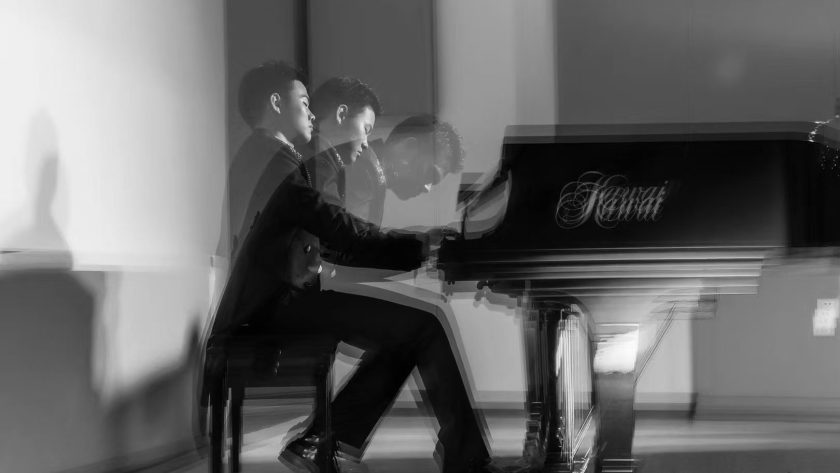
Who or what inspired you to pursue a career in music, and who or what have been the most important influences on your musical life and career?
The person I would name first is my mother. She inspired me to pursue music, and her birthday is on 28 June, two days after my recital at Smith Square Hall. I think of the concert partly as a birthday present to her.
Artistically, I am often drawn to pianists who possess qualities different from my own. Seong-Jin Cho’s restraint, colour and poise make me listen differently. André Watts’s live performance of Liszt’s Sonata in B minor also transformed how I hear that work: every gesture feels prepared and connected, yet never calculated. These influences do not make me want to imitate them; they help me recognise what I still need to develop.
What have been the greatest challenges of your career so far?
The greatest challenge has been moving beyond technical command and finding an artistic voice that genuinely feels like mine. Sometimes I listen to my own recordings and hear something artificial or disconnected, even when the notes are correct. The difficult task is to respect the score, style and historical context without using them as somewhere to hide. I want every musical decision to feel personally understood rather than simply inherited.
Which performances or recordings are you most proud of?
The performance I am most proud of was the final of the Pianissima International Piano Competition. It was my first competition after a break of three or four years, so the experience felt unusually fresh and exhilarating. I realised immediately how much I had missed the feeling of performing in front of people.
I played Liszt’s Sonata in B minor. Cyprien Katsaris, who presided over the jury and has a deep association with the work, was listening. That made the occasion particularly meaningful. What remains with me most, however, is not the competitive result but the sense of returning to the stage with renewed excitement.
Which particular works or composers do you think you perform best?
My natural territory is probably Beethoven, Liszt and Rachmaninoff. Their music demands projection, scale and physical confidence, which are qualities that come relatively naturally to me.
At the same time, I do not want natural affinity to become a limitation. I deliberately listen to and study musicians whose strengths are restraint, colour and poise, because those are qualities I want to develop further in my own playing.
How do you make your repertoire choices from season to season?
I do not choose programmes simply to demonstrate range. I prefer to begin with a question or tension and then find works that approach it from different directions.
My Smith Square programme—Beethoven, Berg, Ligeti and Liszt—asks what happens when a musical language reaches the limits of what it can express. The pieces come from different periods, but each places its musical structure under pressure. I want a recital to feel like a single argument rather than a collection of impressive works.
Do you have a favourite concert venue to perform in, and why?
I do not yet have a favourite concert venue. I am still discovering how different halls, instruments and audiences affect the way I play, and I would rather remain open to those experiences than choose one too early.
What do you do off stage that provides inspiration on stage?
I compose. I do not write continuously or according to a schedule; I tend to write when something in my life feels too strong to leave unexpressed.
I wrote after losing my grandmother, and again when I became engaged. At moments like those, composing at the piano helps me reconcile myself with what has happened. It reminds me that music can begin as a private necessity before it becomes a public performance.
What is your most memorable concert experience?
Seong-Jin Cho’s all-Ravel recital at the Barbican in May 2025. I found the entire performance exhilarating. His command of colour, atmosphere and proportion was extraordinary. For me, he is the finest living interpreter of Ravel.
What makes him particularly important to me is that his restraint and poise are different from my own natural temperament. Listening to him makes me more conscious of the qualities I still want to develop.
As a musician, what is your definition of success?
For me, success means artistic freedom. I want the freedom not only to perform existing repertoire but eventually to expand beyond the conventional role of a pianist—to compose, write variations or paraphrases, and create work that expresses something unmistakably my own.
Engagements and recognition matter, but primarily because they can make that freedom possible.
What do you feel needs to be done to grow classical music’s audiences?
Classical music needs to be encountered more often outside the concert hall. People already hear it in films, but that exposure could extend much further—into games, digital media and everyday culture.
Familiarity often comes before knowledge. Someone may not know that a melody was composed by Beethoven, but if they have heard it before and formed an association with it, they already have a point of connection. When they later encounter the work in a concert, it no longer feels remote or unfamiliar.
To grow its audience, classical music first needs to be seen, heard and woven more naturally into people’s lives.
What’s the one thing in the music industry we’re not talking about which you think we should be?
I do not think we talk enough about the way fidelity can become a form of concealment. Classical musicians are trained to respect the score, style and history, and rightly so. But this can also become a safe way of avoiding the harder question: what do I personally have to say?
Too often, performers concentrate on reproducing an accepted idea of how a composer should sound rather than discovering how they themselves can speak through that composer. The industry is very efficient at rewarding correctness; it is less effective at creating space for genuine individuality.
What advice would you give to young or aspiring musicians?
Develop your strengths, but listen especially carefully to musicians who possess qualities you lack. Do not confuse imitation with learning.
Technique is essential, but once the technical differences between performers begin to narrow, the real question is why someone should want to hear your performance rather than another correct one. Respect the score, but do not hide behind it. The aim is not to sound different for its own sake, but to understand every musical decision personally.
What’s next? Where would you like to be in ten years?
In ten years, I can imagine a life combining teaching and performing. I want performance to remain central, because the stage keeps artistic questions alive, but I also see teaching as a serious part of my future.
Over time, I hope composition—and perhaps my own variations and paraphrases—will become a more visible part of my musical life.
What is your most treasured possession?
I do not think my most treasured possession is an object. It is probably the ability to return to the piano and turn an experience I cannot explain in words into music.
What is your present state of mind?
Slightly nervous, but excited. I am preparing for the prospect of several hundred people choosing to come specifically to hear my recital, and that creates a particular kind of pressure. I feel responsible for the trust involved.
At the same time, the pressure is energising. It sharpens my concentration and reminds me how much I value performing for people
Zeju Fan makes his London debut at Sinfonia Smith Square on Friday 26th June. Find out more
Discover more from MEET THE ARTIST
Subscribe to get the latest posts sent to your email.

