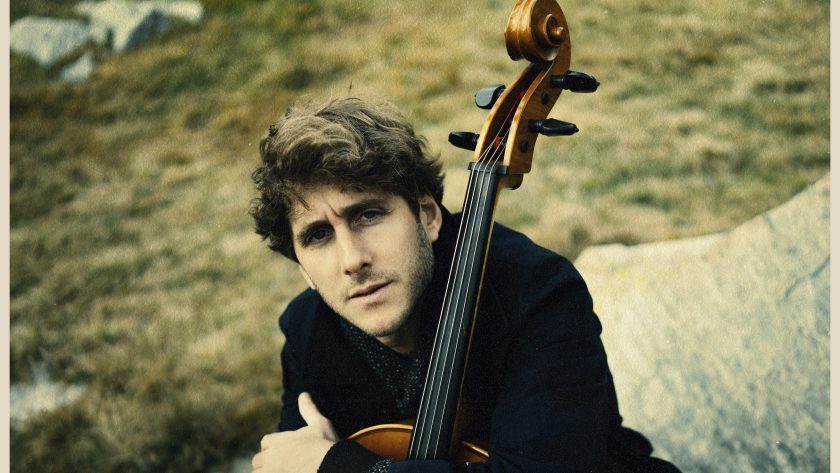
Who or what inspired you to pursue a career in music and who or what have been the most important influences on your musical life and career?
I grew up in a family of musicians, so there was a lot of music in the house while I was growing up.
Although I began studying the cello at the age of seven, it wasn’t until I was thirteen that I decided to pursue music seriously and aim to become a cellist. That moment of clarity came after hearing a soloist perform the slow movement of Haydn’s Cello Concerto No. 1 in C major. That evening, I told myself, “I want to be the one on stage playing this piece,” a goal I went on to achieve two years later.
Afterwards, listening to the music of Vangelis really opened my mind to different sounds and electronic music.
What have been the greatest challenges of your career so far?
One of the early challenges I faced was leaving my home country, Argentina, alone at seventeen after I was left without a teacher, as he had left the country due to the 2001 economic crisis that was happening in Argentina at the time.
Later along the way, a major challenge in my career occurred when my computer and hard drives were stolen from my car in San Francisco in April 2013. I lost many works, including the first version of “Verve,” which I later decided to reconstruct years afterwards.
Which performances/recordings are you most proud of?
The Berlin Studio Versions of the album Save Me Not offer a way to explore not only how the record was made, but also my broader approach to recording and layering instrumental lines.
More recently, the recording of “Myself and I” from my latest record SOLO feels like a central point of gravity for the album as a whole.
How do you make your repertoire choices from season to season?
In general, when I tour, I select works from different albums, and this selection changes frequently.
Do you have a favourite concert venue to perform in and why?
Yes, the Funkhaus in Berlin is one of my favourite venues to perform at. The acoustics are incredible, and being surrounded by your audience in 360 degrees is truly beautiful.
What do you do off stage that provides inspiration on stage?
I need be calm and alone, I need silence and space before going on stage.
What is your most memorable concert experience?
It was a concert I performed in a natural cave in Sardinia, Italy. It was a vast natural space with a hole in the ceiling, through which the sun created a beam of light at midday. It was truly haunting, and the natural acoustics were incredible. It was, by far, a memorable concert experience.
You are also a composer. How would you describe your compositional style/musical language?
I think my musical language sits in a space between contemporary classical writing and ambient music, with the subtle use of electronic elements. My music places a strong emphasis on emotional narrative rather than formal development in the traditional “classical” sense. It is also highly cinematic.
For me, space and letting the music breathe is as important as melody or harmony.
Of which works are you most proud?
I am proud of, and very grateful for, the Grammy nomination for Verve, which was released in 2019. For this record, I focused strongly on musical narrative and flow.
How do you work, as a composer?
I write and record all the instruments myself, layering one instrument at a time. The result becomes large ensemble or orchestral textures that blur the line between acoustic and electronic sounds.
Composition and production happen simultaneously for me; the space, decay, and texture of a sound are part of the writing process.
I let pieces evolve over time until they feel natural in their pacing. If something doesn’t feel necessary, I remove it. In the end, it’s more about listening and responding intuitively than imposing structure.
As a musician, what is your definition of success?
To feel what you create intensely, and to be moved when you listen to your own music.
What do you feel needs to be done to grow classical music’s audiences?
I believe it is important to diversify orchestral repertoire and bring in more new works.
I also think it helps when classical music isn’t kept in a separate box, but is allowed to exist more naturally alongside other genres.
What’s the one thing in the music industry we’re not talking about which you think we should be?
I believe more clarity is needed, especially when it comes to deals between music streaming platforms, distributors, and record labels.
Also, the modern music economy is no longer just about music in the traditional sense, it is about data and algorithms. These invisible layers now shape careers as much as songwriting or production.
What advice would you give to young or aspiring musicians and composers?
First and foremost, search for your own voice, search intensely and passionately; the times we live in require it.
I would then advise starting to finish a lot of music. Don’t wait until things feel perfect; most progress comes from completing work, not endlessly polishing ideas.
Listen actively, not passively. When something moves you, try to figure out why whether it’s harmony, sound design, timing, or silence. Develop your taste.
Learn the basics deeply, but don’t get stuck in theory without applying it. I truly believe the goal is to turn knowledge into instinct.
What is your present state of mind?
I’m excited for everything that’s coming, especially the new music
Sebastian Plano’s album Solo is out now.
Discover more from MEET THE ARTIST
Subscribe to get the latest posts sent to your email.

