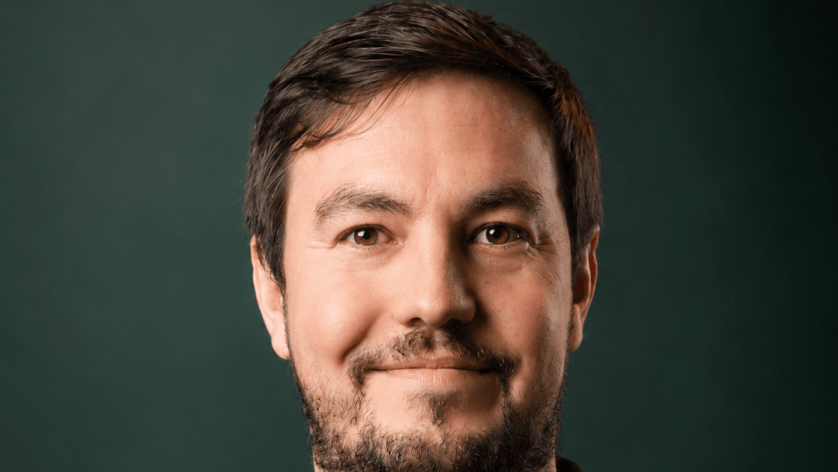
Who or what are the most significant influences on your musical life and career as a composer?
There are many people who have influenced my work and helped me in my career, and I’d love to reel off an Oscar-winner-style list of everyone who has helped me along the way. To keep things brief, though, I’ll share four particularly significant influences.
There have been several moments in my career that have led to important shifts in my creative direction. The first person who really helped me think and write about music was a composer called Alex Flood. I don’t think I would have been accepted into a conservatoire without his guidance, particularly when it came to academic writing and articulating my ideas about music.
Another important milestone was my introduction to abstract expressionist art, and for that I have Seán Clancy to thank. Through his own enthusiasm for the subject, he helped me engage with both the artwork itself and the creative processes behind it. As a visually minded person, I was immediately drawn to it, and it fundamentally changed the way I thought about music and composition.
More recently, I’ve become increasingly interested in coincidence as a creative force. Paul Newland encouraged me to write music by hand, and through that process I developed a new relationship with the score. Although I don’t really write my scores by hand anymore, it helped free my music from conventional notions of time and notation. These days, I enjoy setting something in motion and seeing where it leads, allowing chance and unpredictability to play a more active role in the creative process.
Finally, I’d like to mention a group of close friends who have been an important influence on both my creative work and my life more generally. While there are many others in the composer community whose friendship and support, I value deeply, Patrick Ellis, Ábel MGE, Robert Reid Allan, and Andrew Toovey have been particularly important companions over the years. They’ve provided encouragement when things have been difficult, offered honest and thoughtful feedback whenever I’ve asked for it, and been a constant source of support. They’re also great company, and some of my favourite creative experiences have come from spending time with them – whether that’s visiting exhibitions and galleries, discussing ideas, or simply enjoying each other’s company over a coffee or a pint.
What have been the greatest challenges of your career so far?
There have been individual pieces that were incredibly difficult to write for various reasons, but more broadly I think one of the biggest challenges is managing everything that surrounds composition itself.
Composers today are expected to develop a huge range of skills beyond writing music. We have to market our work, write applications, present projects in ways that appeal to organisations and ensembles, maintain professional networks, engage with social media, design websites, and stay informed about what is happening in the wider musical landscape. In many ways, we are also responsible for publishing and promoting our own work. And that is before you even get to the actual composing – or the ongoing task of developing an artistic voice, refining your ideas, and working out the philosophy that ties it all together.
There is a tremendous amount of work involved in being a composer today, and I think one of the greatest challenges is balancing all of those demands while still maintaining the time, energy, and clarity needed to make meaningful creative work.
What are the special challenges/pleasures of working on a commissioned piece?
Being asked to write a piece for someone is a special pleasure in itself. There’s something both exciting and humbling about being entrusted with the opportunity to create new work. The challenge, of course, is deciding what to write and how to make the most of that opportunity.
In many ways, the pleasures and challenges are often the same thing. Writing for particular performers or instruments can be enormously rewarding because it encourages you to explore their possibilities in a focused way, but it can also be difficult to get right. Likewise, there is the constant balancing act of composition: Is this section too long? Are these the right instruments for this material? Where should the listener’s attention be focused? These questions can be demanding, but they are also part of what makes the process engaging.
I’ve found that the pieces which come together most naturally often end up being the works I’m happiest with. That doesn’t necessarily mean they require less effort, but there tends to be a stronger sense of momentum and clarity throughout the process.
Perhaps the greatest pleasure, aside from being given the commission in the first place, is reaching the end of a piece and reflecting on how it arrived there. Looking back at the decisions, discoveries, and unexpected turns that shaped the work can be just as satisfying as hearing the finished result.
What are the special challenges/pleasures of working with particular musicians, singers, ensembles or orchestras?
One of the things I enjoy most is getting to know the musicians I’m writing for, whether that’s an individual performer, an ensemble, or an orchestra. The more you understand their interests, strengths, and musical backgrounds, the more you can write in a way that feels bespoke to them. I think some of the most rewarding collaborations happen when performers can recognise themselves in the music they’re being asked to play.
A good example of this was my piece HUNTER S. THOMPSON’S DAILY ROUTINE. for the Orkest de Ereprijs back in 2021. Although I didn’t have the chance work with the ensemble before writing the piece, I was aware that the percussionist had a background in Latin jazz performance. With that in mind, I wrote a largely improvisatory drum kit part with guided instructions rather than a fully written out part. This proved very effective in rehearsal, and the drum kit became one of the defining features of the piece.
For me, that experience reinforced the value of writing with performers, rather than just for them. Drawing on the musician’s strengths and interests can lead to outcomes that are both more engaging and more distinctive than anything I could have arrived at on my own. The challenge, of course, is finding the right balance between giving performers space to contribute and maintaining a clear artistic identity for the work, but that balance is also part of what makes collaboration so enjoyable.
Of which works are you most proud?
There are a few pieces I feel proud of, often because they led me in new directions. The first that comes to mind is September 6th, 1951…. I wrote this for the Plus-Minus Ensemble, who gave an incredible performance of it, and I remain very fond of the piece.
Another is HUNTER S. THOMPSON’S DAILY ROUTINE. which I just mentioned. I am proud of this work because I feel I achieved what I set out to do, and I think the text is excellent. I was also very glad to have the opportunity to work with it. It opened up a number of creative directions for me, particularly in relation to spoken text and how it can be structured and shaped musically.
More recently, I completed my largest work, GUIDE TO SURVIVAL IN URBAN ENVIRONMENTS, VOL. 1. This piece is in 8 movements, and lasts around 45 minutes and was written for CoMA London and the CoMA Singers. I am proud of it because I feel it connects in an interesting way with my background and experiences living at that time almost exclusively in post-industrial towns and cities, and because writing for amateur musicians presents its own specific challenges. I feel the piece engages with those conditions in a way that works and is true to me.
How would you characterise your compositional language?
Currently, my music is quite rugged and abrasive. I’m particularly interested in harsh, crunchy, percussive sounds. I find them energising and expressive, and I think they remain relatively under-explored within contemporary classical music, so I’m often drawn to incorporating them into my work.
Since my early teens, I’ve been a fan of heavy metal. There’s something about its intensity that has always appealed to me. It can be unrelenting and uncompromising, unconcerned with sounding conventionally beautiful or appealing. Instead, it embraces a raw, visceral energy that I find compelling and that I increasingly try to channel in my own music.
I’ve never really thought of myself as a composer of melodies. I tend to be more interested in textures, gestures, and sonic behaviours than in melodic development. As a result, percussion and noise-based materials have become increasingly prominent in my recent work. Looking back, I can see a growing fascination with sound as a physical force – something that can be felt as much as heard.
How do you work?
My work tends to happen sporadically, shaped around other commitments. It usually begins with an idea about form, or musical behaviour, or perhaps just a title, which then develops into initial material and, over time, a sense of how the piece might work structurally.
There is often a long period of reflection in which ideas are allowed to circulate and settle. The subsequent construction phase is comparatively quick, though not always smooth. The process can feel inconsistent: at times it is frustratingly resistant, while at others it seems to accelerate almost suddenly into clarity.
I have a complicated relationship with this way of working. In some ways it feels like a compulsion – I feel like I have to write – and it can become difficult when ideas aren’t forthcoming. At the same time, there is nothing quite like having a small breakthrough; when something clicks into place and I am drawn back into the work and can’t wait to work on it!
A particular example that comes to mind is the final conception of September 6th, 1951…. I spent several weeks struggling to figure out how I wanted the piece to be, and became increasingly frustrated as I wasn’t satisfied with anything that materialised. One evening, I reluctantly accepted an invitation to go to Café OTO with some friends, intending to take the evening off. I remember sitting down before the gig had even started when, quite suddenly, the ideas arrived almost instantly and in a near-complete form. The following day I began working in a kind of frenzy, and within a few days, probably less than a week, the piece was finished. Nothing like this has really happened since.
I also spend a considerable amount of time thinking about the appearance of the score. I am not entirely sure why, but the visual dimension has a strong influence on how I understand the work. It often needs to look right before it really feels right.
As a musician, what is your definition of success?
I think, for me, writing a piece well is always an aim. I like the idea of someone describing my work as “well-written”, whatever that means. Not necessarily in the sense of technical complexity or virtuosity, but in the sense that every element of the piece feels necessary, and true to the idea behind it.
Beyond that, success is really about continuing to make work that surprises and excites me and keeps me curious. Some of the most rewarding moments as a composer have come from setting up a process and discovering something I couldn’t have predicted at the outset. If a piece can teach me something, or show me a way of thinking that I hadn’t encountered before, then I tend to view that as a success.
Of course, performances, commissions, and opportunities are all wonderful, and I’m grateful for them when they come along. But I’ve never found them to be particularly reliable measures of artistic value. Success, for me, is being able to keep making work, to work with generous and creative people, and to remain excited about the next piece I want to write.
What advice would you give to young/aspiring composers?
Don’t stop.
There will be times when it feels really difficult, and I don’t know many – if any – composers who never experience periods of doubt. The difference is not that successful composers are free from doubt, but that they have found ways to keep going despite it.
You never know what opportunities, achievements, or forms of success might lie ahead – however you define your success – if you remove yourself completely from the possibility of ever reaching them.
Composing can be challenging, but it becomes much more sustainable if you can find your own reasons for doing it. External recognition is unpredictable, but a personal motivation to create, explore, or express something meaningful can carry you through the more difficult periods. If you can hold on to that, it becomes much easier to persevere. Sometimes, if things are particularly difficult, then maybe it’s time to change something up and experiment. See if you can find your way through it.
What do you feel needs to be done to grow classical music’s audiences?
I’m not really convinced by the idea that classical music audiences necessarily need to “grow” in any general sense. There is an audience for all music, and different kinds of work already find their own communities in different places and contexts. For me, the more interesting question isn’t about expanding a single unified audience, but about understanding what your music actually is, who it might be for, and how it sits within a particular community or scene.
I’m often surprised by what people respond to in a concert. You can never really know what someone is thinking in the moment, and I think it can become quite a limiting thing to try to anticipate that too precisely, or to shape work around an imagined audience expectation. Sometimes that can flatten the work, where it starts to serve a kind of abstract “general listener” rather than the specific situation it actually exists within.
That said, I do think there’s something important in making the boundaries around contemporary music more open – not by simplifying the work, but by allowing it to exist in different contexts, and by resisting the idea that there is only one route in. Sometimes that might mean rethinking how things are presented, who you collaborate with, or the framing around the work, rather than thinking purely in terms of audience growth as a numbers game.
What’s the one thing in the music industry we’re not talking about but you think we should be?
I think there needs to be more sustained conversation around access routes into composition and, more broadly, into the institutions that shape contemporary music. In particular, how application processes are designed and who they implicitly exclude.
More organisations could do more in making opportunities genuinely accessible to composers from a wider range of backgrounds. That might include, for example, reasonable caps or complete removal of application fees, or offering multiple formats for applications – not only written, or video submissions, but also video or audio-based alternatives that allow different kinds of articulation and working processes to be recognised.
Gatekeeping is still prevalent, but it looks different now. It’s less overt and more embedded in other things, like procedure, language, and expectation. There are many excellent composers who do not get performed as often as they should, and that feels like a loss for everyone. I wonder how many voices are being consistently overlooked, and how narrow the range of regularly programmed work can become because of this.
I also think there is a broader cultural hesitation around taking risks. I’ve noticed that generally, the less risk an organisation wants to take, the more rigid or narrow their programming criteria becomes.
(Photo credit: Wai Lok Cheung)
Discover more from MEET THE ARTIST
Subscribe to get the latest posts sent to your email.

