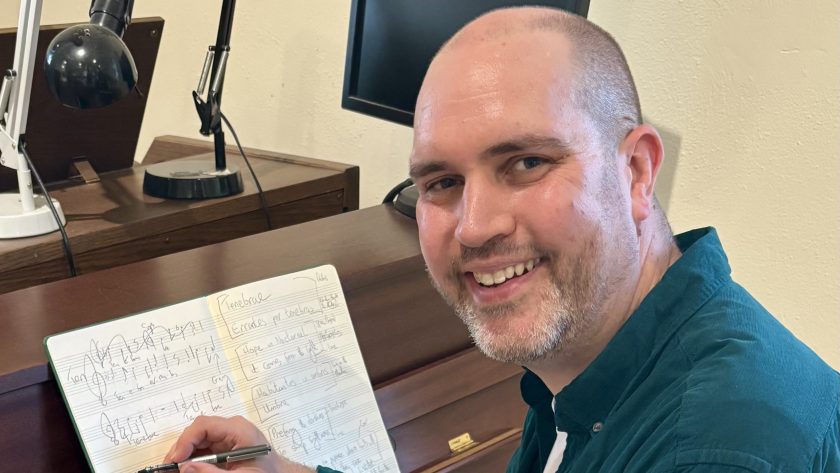
Who or what are the most significant influences on your musical life and career as a composer?
I was really fortunate to grow up surrounded by music. My dad is a violinist, pianist and composer and also worked as a teacher. He was always really encouraging and helped me to compose and improvise when I was really young. He is still a huge supporter and it was wonderful that he came to hear Tenebrae sing my piece at the Wigmore Hall as that is where he had his graduation from music college.
I work full time as a music teacher and this has had the biggest impact on my musical life. For several years I felt that I was not a ‘real’ composer as most of my time is spent in school and teaching, rehearsing ensembles and not composing. However, my students are hugely inspiring. I really enjoy encouraging them with playing and composing their own music. Doing this has definitely helped me reflect on my own practice and to keep exploring new music myself. I love musically directing school productions and finding great pieces for the ensembles to play and sing. Very occasionally I write a piece for my own pupils to perform – not too often as there is so much fantastic music that I want to introduce them to – but this has always been very positive and I hope inspiring for them.
What are the special challenges/pleasures of working on a commissioned piece?
I have been really fortunate to have some lovely commissions lately. Having a person or group say that they admire your music enough to want you to write a piece specifically for them is an incredible honour. Something I talk to my pupils about is the careful balance in composing; one needs to be confident enough in your ideas to finish the piece but also self-critical enough to improve and develop it so that it’s the best it can be. I wrote a piece for the Durham University Chamber Choir and wanted it to be a really great piece for this exceptional choir. I found myself being too self-critical and feeling as though what I wrote would not be good enough. However, remembering that they wanted something from me because they liked my other music allowed me to have confidence in my ideas and I am really pleased with the piece and delighted with how they sang it. Here is a video of ‘The Sun Will Rise’, a setting of a text by Caitlin O’Ryan from the premier in Durham Cathedral.
Of which works are you most proud?
A few years ago I wrote a piece called ‘When Darkness Descends’ at a particularly difficult time. The piece is about how, despite there being dark times, light will come. The piece has resonated with many and I am so pleased that it has brought encouragement to people all around the world. Recently it was performed by the Pink Singers in their concert at Cadogan Hall and it has been sung in the UK, South Korea, many places in the USA, Germany and France. There are performances planned in Argentina, Canda and the Democratic Republic of the Congo. I really hope it continues to provide encouragement for any in need.
How would you characterise your compositional language?
I’ve written music in lots of different styles, but looking back I can see certain characteristics that are important features. I always try to write tunes that are singable and accessible. Another balance that a composer must find is between doing what is expected and what is not. I try to write pieces that audiences and listeners will enjoy but also occasionally include a harmonic twist or change in texture that is interesting and unexpected. Here is a really fun piece with some unexpected moments that I hope many will enjoy. It is a setting of ‘An A-Z of Space and Time’ a poem by Harry Baker whose work I love.
What advice would you give to young/aspiring composers?
Write as much as possible! Try not to worry about whether you know how to do it or overthink whether it is ‘good’ or not. When you start out your music will probably not be as great as the music you hear and play and want to write but as with learning to play and sing, you have to work at building your technique and skills. Every piece you write will be a step in the musical journey that only you can take. Write pieces for your friends and for anyone who will play your music and learn about how to write well for particular instruments and voices. Try not to compare yourself to others but do take, and more importantly, try to make opportunities. And most importantly inspiration can come from anywhere; read widely, go to art galleries and listen to lots and lots of music.
As a musician, what is your definition of success?
To really enjoy music. It is very easy to measure ourselves against others and maybe even envy their success, or to be too busy looking for the next opportunity that we miss out on enjoying the sheer joy of making music. I really hope that I can encourage and foster a love of music in my pupils, my daughters and anyone who hear or performs my music. I would consider that to be great success.
James Woodall’s album ‘Full of Grace’ can be streamed or ordered here https://listn.fm/fullofgrace/
Discover more from MEET THE ARTIST
Subscribe to get the latest posts sent to your email.

