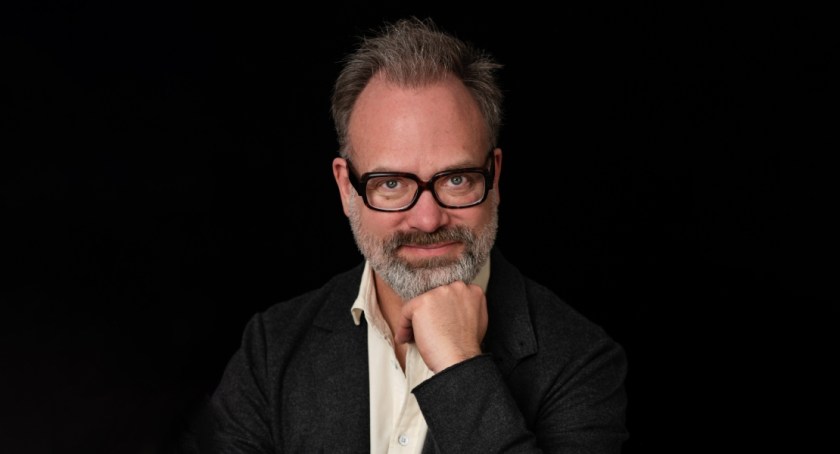
Who or what are the most significant influences on your musical life and career as a composer?
Hard to know where to begin really… I’ve had the opportunity of working with so many incredible people over the years: my teachers – particularly the composer Brian Elias; the conductors of the ensembles & choirs I played & sung with as a kid – particularly Adrian Brown at Stoneleigh Youth Orchestra; collaborators like choreographer Christopher Wheeldon & film director Garth Jennings; ensembles like Conspirare, Tenebrae and the Royal Opera House orchestra who have taken my music and made it their own with such respect and imagination.
What have been the greatest challenges of your career so far?
Writing music is very hard and, in my case, only seems to get harder. I’m not one for staying within my comfort zone but over the last fifteen or so years it does seem that every project has been more challenging than the last. I thought that trying to communicate a complicated, non-musical narrative without recourse to words, as I have been asked to do in my story ballet scores, was about the hardest thing a composer could be asked to do…but that was before I tried to write a guitar concerto as a non-guitarist or embarked on setting 291 lines of complex Mexican surrealist poetry as a non-Spanish speaker.
What are the special challenges/pleasures of working on a commissioned piece?
The main pleasure is that you get to collaborate closely with amazing musicians and your compositional choices can be informed by the mental image of a real-life musician or group of musicians performing your piece. The challenge is to come up with something that will work both for you and for the commissioner, playing to their strengths and providing opportunities for them to shine in ways that differ from standard, existing rep.
What are the special challenges/pleasures of working with particular musicians, singers, ensembles or orchestras?
One challenge that I don’t think gets talked about much is the difference in approach one needs to take when writing for ensembles of different sizes and in different environments. A musical idea that might work brilliantly for a small ensemble like a string quartet might completely fail to land when performed by a full-sized symphony orchestra. And even something that might work for an orchestra on stage might be problematic when that same orchestra is in an opera house pit where one side of the orchestra is often completely unable to hear the other. It’s also interesting (and not a little confusing) to realise that a simple & seemingly clear musical instruction might mean different things to different musicians in different contexts. For instance the instruction ‘p’ isn’t saying the same thing to the 2nd flute at the back of the orchestra as it is to the soprano at the front of the stage who has an orchestra to overcome and an opera house to fill.
Of which works are you most proud?
My two big choral pieces ‘Path of Miracles’ & ‘Piedra de sol’; my four story ballets ‘Alice’s Adventures in Wonderland’, ‘The Winter’s Tale’, ‘Like Water for Chocolate’, and ‘Oscar’ (if I had to pick one probably Winter’s Tale), and my two operas ‘Everest’ and ‘The Diving Bell & the Butterfly’.
How would you characterise your compositional language?
It feels like it’s not really for me to say… I just try to write music that I think I would like to hear and with which (hopefully) others will also connect. I am always aiming to communicate something that is meaningfully emotional for me. I want to take audiences on an emotional and emotionally enriching journey.
How do you work?
If I could I would work late at night, at the piano with a large glass of wine to hand. Sadly I have to get up to take the kids to school.
As a musician, what is your definition of success?
See above re. emotionally enriching journeys. It is also gratifying and educative to have a piece performed multiple times by different ensembles/soloists in front of different audiences.
What advice would you give to young/aspiring composers?
Grab every opportunity that comes your way and try to make sure that whoever you work with wants to work with you again.
What do you feel needs to be done to grow classical music’s audiences?
Sadly, we find ourselves in an age of the screen and the speaker. But an ironic corollary to that is that when people (particularly young people) do find themselves in a room with real musicians playing live music the experience can be seismically impactful. We have to give people access to our beautiful & inspiring temples of culture so that no one can feel that classical music is somehow ‘not for them’. Not everyone will like it but no one should feel excluded from it.
What’s the one thing in the music industry we’re not talking about but you think we should be?
The ongoing lack of opportunities for young people from less privileged backgrounds to learn and experience music & the awkward reality that the only way to remedy that is by making more funding available at a grass roots level.
What next – where would you like to be in 10 years?
With my family – all of us happy and healthy…and if more of my music could find its way from the orchestra pit onto the concert platform that would be nice too.
Piedra de sol (Sunstone), featuring Joby Talbot’s stunning choral setting of Mexican poet Octavio Paz’s epic masterpiece, performed by GRAMMY® Award-winning choir Conspirare and Artistic Director Craig Hella Johnson, is released on digital and CD on August 21, 2026 on Divine Art Records.
Discover more from MEET THE ARTIST
Subscribe to get the latest posts sent to your email.

