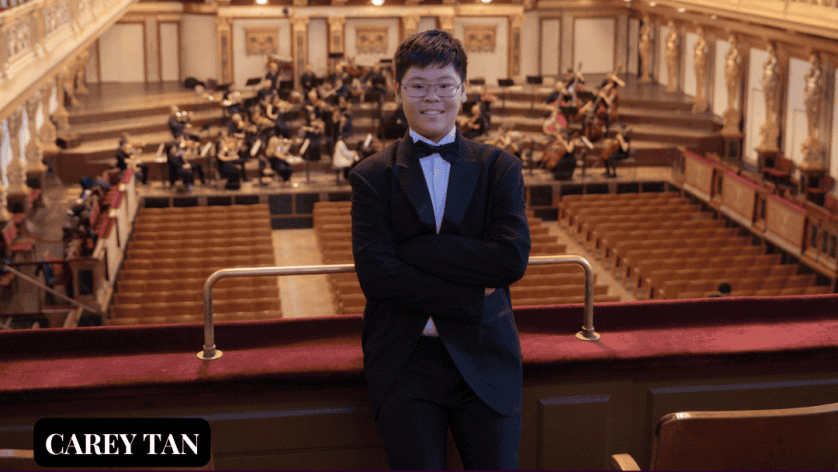
Who or what are the most significant influences on your musical life and career as a composer?
I would probably say my visit to Mozart’s birthplace on my 6th birthday: that experience, despite being very strange, certainly has deeply influenced me. When I was five, I heard my brother play piano and drums a lot, and I got really interested. Therefore I decided to pick up the instruments myself! Also, when I started boarding school when I was 8, my music director, Dr. Price wanted me to write a symphony for the school orchestra to play. I barely knew what a symphony was at the time! I carried on, and through his support, Four Seasons in Summer Fields was born.
What have been the greatest challenges of your career so far?
My greatest challenge in my career so far has probably been trying to find more chances for an orchestra to play my works. I want my music to connect with everybody’s souls, and the best way to do that is in a concert venue with a full orchestra and brilliant acoustics. My parents have helped me search for opportunities to satisfy my goals, however, this proved to be immensely difficult.
What are the special challenges/pleasures of working on a commissioned piece?
I haven’t actually been commissioned to write a piece yet, and I don’t completely know what the experience is like! However, there have been occasions when something – a hidden universal power seemed to ‘commission’ me to write a piece! For example, after a visit to the Changbai Mountain range in China and a very long and peaceful meditation overlooking the Heaven Lake, the spirit of the whole area seemed to divert me to start writing this new symphony – Seven Doors to Eternity. The first movement came from the eternal beauty, yet simplicity of the sky, like a newborn baby – so beautiful yet so innocent. The message came – innocence at the centre of nature, the universe and eternity. I saw an eye in the Heaven Lake, heard sounds across million-year old rocks, and I started to write this new symphony.
What are the special challenges/pleasures of working with particular musicians, singers, ensembles or orchestras?
It always takes some time for all the musicians to come together to make a deeply touching sound – most of the challenges I have with working with orchestras would probably be very minor but quite important issues like tempo, dynamics, phrasing and how each part comes together as a whole. The emotions, the depth and the big moments really change when they get played by an orchestra.
Of which works are you most proud?
I would not call it pride – I would call it immense connection. If you ask me which works allow for the most immense connection not only with others but also into myself, that would probably be Symphony No. 5, Seven Doors to Eternity. It follows the soul through seven realms of existence: from sky and nature to life, the universe, and ultimately Truth, revealing that what it searched for across eternity had always existed within itself.
How would you characterise your compositional language?
My compositional language would be intuitive metaphysical (sometimes spiritual) narrative – driven symphonies. I hear melodies in my head – whole orchestral melodies – and then I see highly profound images. I then blend the two into my symphonies: which always explore metaphysical themes – most recently spiritual ones. My fourth symphony, Journey Through the Universe, is a great example. I strangely always seem to experience that exact journey when I close my eyes and rub them – starting off and then soon getting swept into a black hole before going into a world full of light (The multidimensional meeting point). This happened even before I wrote the piece. The whole symphony and experience came from intuition, spirituality and narrative.
How do you work?
I hear melodies in my mind. I see pictures. For example, I meditated above a holy mystical lake in China, I heard sounds and souls within million year old rocks. Then everything turns into music. In Symphony No. 4, sometimes I close my eyes and I can actually see myself going on that exact journey, leaving Earth, moving through the galaxies and then being swept into that exact black hole, almost like I am there. In Symphony No. 5, I see the blue sky and beautiful clouds, the eye in the water, the spirits in the rock, the land, the soul entering human life, then going into the depths of the Earth and finally finding Truth within. My music has no rules – whatever can directly connect with the hearts of the audience, I write. It is not a mental experience – it is a journey into the depths of each and every spirit within us.
As a musician, what is your definition of success?
Success is not about money, fame or greatness. For me, it is when music creates a genuine connection between people and reaches something deep within them.
I felt this very strongly after my recent performance at the Vienna Musikverein. Almost an hour after the concert had ended, I came out of the hall and found a family of four still waiting for me. I had met them there exactly a year earlier, after performing my Piano Concerto No. 1, The Explorers. Their two daughters loved the sense of adventure in the music, and we took a photograph together.
This year, when they heard I was returning to Vienna, the whole family came back to hear my Symphony No. 2, The Cries of War. They told me that this work moved them even more deeply, especially its feelings of suffering, loss and the hope for peace. They had waited nearly an hour simply to see me again and take another photograph together, one year later.
I experienced something similar in Karlovy Vary after performing my Symphony No. 3, The Rise and Fall of AI Humanity. An elderly lady spoke to me for nearly twenty minutes afterwards. The music’s journey through the rise, disorder and eventual collapse of a civilisation had reminded her of the suffering and turmoil she had witnessed in Europe during her own lifetime. I had written a symphony about an imagined future, yet she heard within it memories of a very real past. That really moved me.
Moments like these mean more to me than any prize. To know that something I wrote can enter another person’s inner world, connect with their own memories and experiences, and stay with them — that is what success as a composer means to me.
What advice would you give to young/aspiring composers?
Compose not only for sound – but to echo the sounds of the divine (most of the time they are probably residing deep in your minds but you don’t realise it!). Dig deeply into the world of music, and the world within yourself (sometimes that is the biggest one to you there is) – and remember – the audience doesn’t care about what your score looks like but they care about what their souls feel like.
What do you feel needs to be done to grow classical music’s audiences?
I think classical music needs to reconnect more with why people actually listen to music, which is mainly to feel something. Everyone cares about orchestral complexity, musical technique and imitating the ‘greats of the past’. Classical music can express huge emotions, stories, nature, spiritual ideas and questions about life that anyone can connect with: create your own. I think we should explain the ideas behind pieces more, make concerts feel less distant, and encourage composers to write what they actually feel rather than what they think they are supposed to write. I really think that if people start to realise this and start to write music less about sound-based compositions or clever mathematics or sequences in music but more about the human soul and the world beyond us, then classical music will grow.
What’s the one thing in the music industry we’re not talking about but you think we should be?
I think we don’t talk enough about whether music is actually saying something real. Lots of people talk about technique, musical complexity, trends, branding or streaming, but not always about whether the music has depth or whether it can genuinely move someone. I think we should talk more about honesty in music — whether an artist is creating something because they actually feel it, or because they think that is what the industry wants. For me, the most important music is music that has a real reason to exist.
What next – where would you like to be in 10 years?
I want to be a multidisciplinary composer, conceptual artist, philosophical writer, philanthropist and truth-seeker. I want to continue exploring the depths of the world, and at the same time I want to help people, see the light in everybody, and provide the rights and comfort that everybody needs and deserves. I am hoping to bring not only my music but my guidance to those in poorer regions of the world and I am wholeheartedly willing to provide housing, clean water and all basic needs to anybody who needs it.
What is your idea of perfect happiness?
Perfect happiness is being able to truly understand oneself and all other people – to be able to live in Eternal Harmony (actually a section from Symphony number four) with all those around us. Happiness is not the possession of goods or status– it is the whole world becoming family.
What is your most treasured possession?
I would probably say my laptop! It contains all of my music, as well as the very many versions of all of my pieces – I could never afford losing all that both physically and spiritually.
What do you enjoy doing most?
First of all, I enjoy riding the most extreme rollercoaster in all of the world! For example, I’ve been on the fastest rollercoaster in the world and many other record breakers. I ride rollercoasters to
receive inspiration – a lot of the time when I ride them melodies just flood in my head. Also, I am quite a passionate chef as well. I always treat food as a work of art; food is not just for nourishment. It’s for expressing deep meanings about the world and also for connecting all of our senses including our sixth one: intuition. I enjoy kayaking as well. Kayaking on a beautiful lake with such wonderful mountains views really gives me a sense of serenity: a lot of the time I just touch the water while floating on my boat. It’s just a really wonderful experience!
What is your present state of mind?
I think I’m quite reflective at the moment. I’ve been thinking a lot about music, philosophy, spirituality and what I actually want my work to mean. I feel quite curious as well, because I’m still changing my ideas quite quickly and trying to understand the true depths of the world.
‘Brothers in Harmony: Where Classics Meet New Voices’ pairs thirteen-year-old British composer Carey Tan with his brother, pianist Kevin Tan, and the Philharmonia Orchestra under conductor Geoffrey Paterson. The concert takes place at Cadogan Hall on 7 September https://cadoganhall.com/whats-on/brothers-in-harmony-where-classics-meet-new-voices/
Discover more from MEET THE ARTIST
Subscribe to get the latest posts sent to your email.

