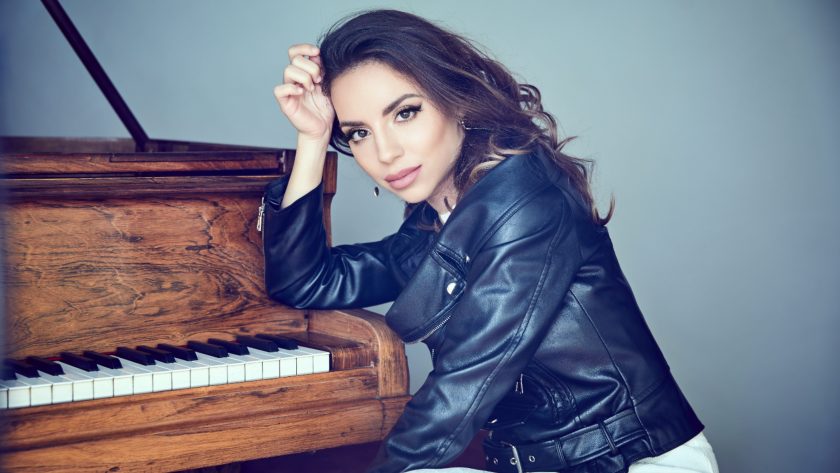
Who or what inspired you to pursue a career in music and who or what have been the most important influences on your musical life and career?
I would name four people who have had the greatest influence on both my decision to pursue music and the musician I have become.
The first is undoubtedly my mother. She was never a professional musician, nor did she aspire to become one. She simply loved music. Although she completed only seven years of music school in a small village in Ukraine, some of my happiest childhood memories are of her playing an old, battered, hopelessly out-of-tune Red October piano. I remember sitting beside her, completely absorbed in the sound. By the age of three, I already knew that I wanted to become a pianist – or, at the very least, that music would always be part of my life.
The person who shaped me most profoundly as a pianist was Dmitri Bashkirov. Around the age of thirteen or fourteen, I began to realise that, although I felt technically secure, I was becoming increasingly fascinated by the subtler aspects of piano playing: sound production, tonal colour, phrasing, pedalling, and all the details that transform technique into artistry. Bashkirov represented the highest ideal of pianism to me. I admired him almost with reverence and wanted to learn every secret I possibly could from him. Over the years, he became much more than a teacher. He cared deeply about his students, and I was incredibly fortunate to experience that generosity and warmth myself.
Another person who profoundly influenced my artistic development was Stanislav Ioudenitch. If Bashkirov taught me the highest standards of pianism, Stanislav encouraged me to look beyond standards altogether. He gave me the confidence to question, to search fearlessly, and not to feel confined by traditions or preconceived ideas about how music should sound. Above all, he encouraged me to discover my own artistic voice. At the time, I admired that philosophy, but I don’t think I truly understood what he meant.
That understanding came unexpectedly when I attended a recital by Claudio Martínez Mehner in Kansas City. From the very first notes, I felt as though the ground had disappeared beneath my feet. I was completely mesmerised. It seemed as if I had taken only a single breath before the concert was already over. I could have listened endlessly to his extraordinary performances of C. P. E. Bach, Brahms, and Debussy, but what affected me most was something far deeper than interpretation itself. His playing was profoundly sincere, alive, and deeply human. He was completely immersed in the music from the first note to the last, and somehow drew every listener into that world with him. Only then did I finally understand what Stanislav had been trying to teach me for years.
Until then, I had always believed that inspiration was unpredictable – something I had to wait for and secretly feared losing. Looking back, I think that fear shaped the way I practised. I spent countless hours refining everything that could be controlled: sound, colour, phrasing, balance, structure – every imaginable detail. Somehow, I believed that flawless preparation could compensate whenever inspiration failed to appear.
Claudio’s recital completely changed that way of thinking. I realised that inspiration is not something we wait for. It grows naturally when we are completely honest – with ourselves, with the repertoire we choose, and with the music we want to communicate. From that evening on, I began to hear music differently and, perhaps even more importantly, to hear myself differently.
That evening quietly changed the course of my artistic life. I realised that what had been missing from my playing was neither more technique nor more knowledge, but the courage to trust my own voice. Since then, I have walked onto the stage no longer waiting for inspiration, but simply hoping to tell the truth through the music.
What have been the greatest challenges of your career so far?
Not so long ago, my answer would have been very different. I would have spoken about competitions, trying to find my place in the classical music industry, chasing an unattainable ideal of perfection, overcoming stage fright and panic attacks before concerts, or dealing with professional hand injuries.
Today, however, my answer is different. Looking back, I realise that the greatest challenge throughout all these years was myself.
Many of us who pursue careers as soloists grow up believing that there is only one legitimate path to success. We become so focused on competitions, recognition, and the idea of a traditional solo career that we sometimes lose sight of our true artistic potential – and, in some cases, even our love for music itself.
Everything changed the moment I let go of my ego, my need to prove myself, and my desire for approval within the classical music world. Instead of asking how I could become more successful, I began asking how I could become a better musician and create something more meaningful than I had ever imagined possible. I stopped trying to fit into someone else’s definition of success and started following my own artistic instincts.
From that moment, my life changed completely. I discovered what genuine artistic freedom feels like. I understood what it means to create, to be happy, to be independent, and to build exactly the kind of career I had always hoped for – not necessarily the one I had once imagined, but the one that truly reflects who I am.
That experience has convinced me that every musician can find their own place and succeed, but only if they have the courage to follow their own path rather than the one the industry tells them to pursue. Very often, it is only when we stop forcing the doors we think are meant for us that entirely unexpected ones quietly open.
Which performances/recordings are you most proud of?
As strange as it may sound, one recording immediately comes to mind: my performance of Rachmaninoff’s Rhapsody on a Theme of Paganini at the Concertino Praga Winners’ Gala Concert in Prague’s Rudolfinum when I was fifteen years old.
It was one of perhaps only two or three performances in my entire life during which I experienced a truly extraordinary state on stage. I remember playing every note, yet I have almost no memory of physically being at the piano. Instead, I remember watching myself from somewhere outside, as if my hands no longer belonged to me and the music were simply flowing through me.
For those few minutes, I no longer felt like someone making music. It was as though the music and I had become a single living organism. I wasn’t creating it – it was emerging from somewhere deep within me, passing through me, and somehow connecting with everything and everyone around me. It is almost impossible to describe in words, but in that moment I understood that music is far more than an art form or a profession. It is a force that can unite people, transcend language, and remind us that we are all part of something much greater than ourselves.
Ever since that evening, I have been searching for that feeling again. It doesn’t happen often, and perhaps that is precisely what makes it so precious.
Which particular works/composers do you think you perform best?
That is a difficult question because I don’t believe performers are necessarily the best judges of their own performances. If I had to answer, however, I would say that I feel most at home in three very different musical worlds: Baroque music, Impressionism, and the great Russian repertoire – from Tchaikovsky and Rachmaninoff to Prokofiev and Shostakovich.
For reasons I cannot fully explain, these are the styles in which I feel the greatest sense of freedom. The process of studying them, living with them, and eventually bringing them to the stage feels especially natural to me, as though I can speak their musical language without first translating my thoughts.
That certainly doesn’t mean I love other composers or styles any less, or that I don’t enjoy performing them. It is simply my own subjective feeling as a performer. These are the musical worlds in which I feel most completely myself.
How do you make your repertoire choices from season to season?
To be completely honest, especially in recent years, my repertoire choices have been almost entirely instinctive. More often than not, I don’t end up performing the programme I had imagined for myself a season in advance.
There have even been occasions when I have completely changed my programme just a few weeks before a concert, whenever circumstances allowed, simply because I suddenly felt an overwhelming desire to perform something entirely different from what I had originally planned.
For me, repertoire is never just a carefully calculated decision. It has to reflect where I am artistically at that particular moment. I have learned to trust that instinct because, whenever I ignore it, I never feel completely honest on stage.
Of course, every artistic decision has to be made responsibly and with respect for the commitments I make. But within those boundaries, I have found that following my intuition almost always leads me closer to the music I truly want to share.
Do you have a favourite concert venue to perform in and why?
This may sound like a rather diplomatic answer, but the truth is that I don’t have a single favourite concert hall.
Over the years, I have learned not to make up my mind too quickly. There have been venues where I initially didn’t feel particularly comfortable, only to return later and discover that they had suddenly become some of my favourite places to perform.
Perhaps every hall has its own personality, just as every audience does. The same space can feel completely different from one evening to the next. Because of that, I would rather say that I have no least favourite venues – and, in a way, they are all my favourites. It simply depends on the moment, the music, and the people with whom I share it.
What do you do off stage that provides inspiration on stage?
This may sound like a rather unexpected answer, but the first thing that comes to mind is yoga.
Learning to observe my thoughts, control my breathing, and become aware of every muscle in my body has transformed the way I perform. It has given me a greater sense of physical freedom at the piano, more natural movement, and the ability to immerse myself in the music through concentration alone – even on days when inspiration doesn’t come easily. Most importantly, it has taught me how to quiet my mind and enter a state of complete presence, allowing the music to speak without constantly trying to control it.
My dog would probably come next. Long walks, playing with her outdoors, and simply sharing life with her fill me with an extraordinary sense of warmth and joy. She reminds me every day that the purest emotions are often the simplest ones, and I think those emotions inevitably find their way into my music.
I also read a great deal. I have always loved classical literature, and in recent years I have developed a real passion for history, historical biographies, educational podcasts, and documentaries. I am endlessly fascinated by learning how people lived, thought, created, and overcame challenges in different periods of history.
Perhaps my most unusual source of inspiration, however, is surgery. I have even ordered surgical practice kits with artificial skin simply to learn how to make sutures. There is something profoundly beautiful about the precision, patience, and absolute control that surgery requires. Watching great surgeons at work reminds me that mastery – whether in medicine or in music – is built from the same combination of discipline, sensitivity, and respect for every tiny detail.
The older I become, the more I realise that inspiration rarely comes from music alone. It comes from life. The more curious I am about the world, the more I seem to discover about music.
What is your most memorable concert experience?
It would have to be the same concert I mentioned earlier: performing Rachmaninoff’s Rhapsody on a Theme of Paganini at the Concertino Praga Winners’ Gala Concert in Prague’s Rudolfinum when I was fifteen.
It remains so memorable not because it was an important milestone in my career, but because it completely changed my understanding of what a concert could be. Until that evening, I believed that performing was about preparation, concentration, inspiration, and, above all, control. That concert taught me that, on very rare occasions, something entirely different can happen. There are moments when the performer seems to disappear and the music takes over completely. It is an extraordinary feeling of freedom – as if you are no longer trying to express the music, but simply allowing it to exist through you.
I have experienced that state only a handful of times in my life, which is probably why that concert has remained so vivid in my memory. Ever since then, I haven’t been chasing only a “perfect performance.” I have been searching for that same sense of complete unity with the music.
As a musician, what is your definition of success?
I think my definition of success has changed a great deal over the years. When I was younger, success meant competitions, concerts, recognition, and building a solo career. Today, I see it very differently. For me, success is finding yourself through music. It is understanding who you are as a person, because only then can you discover what you genuinely have to say as an artist.
Once you know that, success is having the freedom to bring your own ideas to life – to create the projects you truly believe in and share them with people who connect with them. I think that is far more fulfilling than trying to fit into someone else’s idea of what a successful career should look like.
In the end, I don’t think success is something that happens to you. It is something you build every day by staying honest with yourself and with your music.
What do you feel needs to be done to grow classical music’s audiences?
I believe we need to move away from the traditional hierarchy in which the artist is placed on a pedestal and the audience is expected to admire from a distance.
Personally, I don’t want to feel separated from the people sitting in the hall. I want us to become part of the same experience. For me, the most meaningful concerts are those in which the audience doesn’t simply observe the performance, but feels emotionally involved in it.
This belief inspired me to create OFF TUNE with my wonderful colleague, close friend, and exceptional musician Weronika Dziadek. Audience participation is one of the project’s elements. Through conversation, interaction, and shared moments, we want people to feel that they are not just listening to music – they are helping to shape the experience itself.
I don’t think classical music needs to become simpler or more entertaining to reach new audiences. I think it needs to become more human. When people feel genuinely welcomed, included, and emotionally connected, they stop feeling like outsiders in the concert hall. And once that happens, they want to come back.
After all, music has never been a monologue. At its very best, it is a conversation.
What’s the one thing in the music industry we’re not talking about which you think we should be?
I don’t think there is just one thing we are not talking about. If anything, I think there are too many.
We often speak about the beauty of our profession, but much less about its realities. We rarely have honest conversations about the uncertainty of a musician’s life, the financial challenges many artists face, unpaid work, unhealthy educational environments, the influence politics can have on artistic careers and opportunities, or the responsibility institutions, festivals, and teachers have towards the people who trust them.
There are also more subtle issues: the pressure to conform, the temptation to prioritise image over substance, and the belief that success always has to look the same. I think these conversations are just as important as discussions about repertoire or technique.
At the same time, I don’t believe classical music is uniquely flawed. These are human problems, and they exist in many professions. Waiting for a perfect industry is probably unrealistic.
What gives me hope is that change doesn’t always begin with institutions. Sometimes it begins with individuals deciding to work differently. That is something I try to do every day – through the way I treat colleagues, students, audiences, and everyone involved in my own projects.
At the end of the day, classical music is created by people, for people. If we forget the human side of our profession, no artistic achievement can truly compensate for that.
What advice would you give to young or aspiring musicians?
I don’t think there is one piece of advice that works for everyone, because every musician’s journey is different.
But if there is one thing I wish someone had told me when I was younger, it would be this: don’t limit yourself to music alone.
Work hard. Practise with discipline. Dream as big as you can. But don’t forget to build a life outside your instrument. Find something else that genuinely fascinates you – something that would still make you excited to wake up in the morning even if, for some unimaginable reason, you could never play again.
For me, that wasn’t a distraction from music. Quite the opposite. The more I discovered the world beyond the piano, the more freedom I found when I returned to it. There was less pressure, less fear, and much more curiosity.
I think we become better musicians by becoming more interesting human beings. Everything we experience – whether it is yoga, literature, history, science, or simply walking in nature – eventually finds its way into our playing.
Our potential is far greater than we usually imagine. Never be afraid to discover who you are beyond your instrument.
What is your most treasured possession?
For the first time, I think I am going to answer this question publicly. Without any doubt, my most treasured possession is my piano.
It is the very piano that belonged to my late professor, Dmitri Bashkirov – the instrument he played throughout his life and often described as his favourite. After his passing, his son, Kirill Bashkirov, showed me an extraordinary act of generosity by entrusting it to me. It is now part of my home, and I still find it difficult to put into words what that means to me.
I first met Dmitri Alexandrovich when I was fifteen, and I became his student at sixteen. Over the years, our relationship grew into something that went far beyond that of professor and student. He cared for me with remarkable warmth and generosity, and I always felt that I was treated almost like a member of his family.
I believe that is why Kirill felt able to entrust me with this piano. For me, it is far more than an instrument. It carries decades of my teacher’s life, music, and memories. Every time I sit down to play it, I feel that a part of him is still there with me.
I hope that one day it will become part of my own family’s story as well, carrying his legacy on to future generations. That, to me, is a priceless gift.
Discover more from MEET THE ARTIST
Subscribe to get the latest posts sent to your email.

