Who or what inspired you to pursue a career in music and who or what have been the most important influences on your musical life and career?
First musical memory is my mother’s rather lovely singing voice. She had been a member of the Royal Choral Society and always sang with great musicality in a gentle alto. Her great inspiration being Kathleen Ferrier. Apparently around the age of six I asked about the violin and wanted lessons. Enquiries were made and eventually I became a pupil of Mr Lee at my primary school, where my father was the headteacher. Both my parents had a very reverential attitude towards music. My father whose education, like my mother’s, had been disrupted by the war had at one stage I was told, wanted to be a conductor, and though his knowledge of the details of notation was limited he felt music very very deeply. For him it was essential nourishment. I heard much on the radio and on records at home. Through Mr Lee I got to know about all the star violinists of the recorded era and started a collection of my own records of Menuhin, Heifetz, Oistrakh, Stern and so on. I went to concerts and remember vividly Alfredo Campoli coming to our town to give a recital. He was very nice when I was thrust in front of him, I remember! And he played the Fiocco Allegro – a piece I was stumbling through at the time. Soon after my sudden decision in September ’76 to try and do the violin full time – I had actually just started in the sixth form – I started going up to London for twice weekly lessons with a teacher of renown, Bela Katona and practising long hours. I rather ‘owned’ the decision to leave regular education; my parents weren’t keen, though once they saw how determined I was they gave in. Bela gave me the sense that if I worked (‘at least 6 hours practice a day my dear…’), he would guide me and that I would make progress. I started out I’m sure as one of his least promising students, but I worked hard and put in the hours and made some progress I think.
I think I even surprised him a little when I played a Vieuxtemps Concerto at my first proper student concert – next day he even very uncharacteristically praised me rather fulsomely…so I knew I was on the right track. That got me going…..
What have been the greatest challenges of your career so far?
Starting to be serious about the violin rather late has made things a bit challenging for me, I think. I had made a start at six and had a feeling for the sound of the thing but I was as old as sixteen when it suddenly became clear to me that I desperately wanted and needed to play the violin as well as I possibly could. I gave up everything else; cricket and running most especially. Lots of violinists are already doing serious concerts by that age. I was still fumbling around with my playing though I think I could make a decent sound from fairly early on. But to be honest with you, I’ve always felt a little bit like I’ve been playing ‘catch up’ ever since.
Which performances/recordings are you most proud of?
I’m very proud of the recording I made with producer Stephen Frost of Bach’s Sonatas and Partitas ‘Sei Solo’. We got into the enormous space of Abbey Rd Studio 1 on six days between 2013 and 2015 and captured a certain atmosphere I like to think.
And I’m so proud of being the recipient of two very different concertos written by the wonderful Eleanor Alberga. The World Premieres of both are etched into my memory. They were both occasions at which new music really got hold of the audience. Both involved our friend Joseph Swensen who conducted on each occasion. The first was in Edinburgh with the SCO and the second in Wroclaw, Poland.
And now I’m tremendously proud of the Elgar concerto and short pieces. The fact that it includes vital contributions from so many friends and colleagues only increases this.
Which particular works/composers do you think you perform best?
Bach, Elgar, Szymonowski, Alberga, Britten, Walton, Haydn, Paganini, Schoenberg….to name a few. I do love doing the film music I’ve been lucky enough to be part of too. Any film project with music by, inter alia, James Newton Howard, Alan Silvestri, Alexandre Desplat, Gabriel Yared, Alberto Iglesias, Geroge Fenton or Thomas Newman brings out the best in me I like to think. I adore working for any of these fabulously skilled composers.
What do you do off stage that provides inspiration on stage?
Read a great deal. Poetry, novels, biography, even a bit of philosophy …and cricket books. Look at pictures – I’m a ‘friend’ of the National Gallery. Walk in the great outdoors. Sense those around me. People are always so amazing. I’m trying too to develop a wildflower meadow at home in Herefordshire.
How do you make your repertoire choices from season to season?
Apart from a few years in the late 90’s I’ve never had a serious agent or a regular concert diary to speak of so I’ve learnt to make the most of the opportunities that have come along and to be resourceful in making opportunities for myself. My unlooked-for career in the film world has taken up increasing portions of my time anyway. The Bach Pilgrimages I created in 2013, 2016 and 2018 were all generated by playing in places not usually given over to concerts. I do like the fact that with a recording one can create something lasting. So, by recording concertos by Walton and now Elgar I’ve managed to get in the can at least two of the things on my ‘most need to do’ list.
Do you have a favourite concert venue to perform in and why?
I love St George’s in Bristol and have played there many times – most notably with the most splendid non-pro orchestra named after it. It has a warmth of sound and an audience to go with it that I’ve found to be just wonderful. I feel at home there.
Among the many places of spiritual reverberation in which I played Bach in on my Pilgrimages, I remember one tiny church in Cornwall with great affection. It was truly alive and though every seat was taken there were probably not more than thirty souls there. It had no electricity and the day light gradually faded as I played the great Bach Chaconne.
What do you feel needs to be done to grow classical music’s audiences?
Stop being so anxious about it as a marketing problem and start to do more to let people know it’s there for them as it is. There are some wonderful things happening and lots of committed people working away at this but I do get worried when I sense that a piece of any length or one that requires some commitment and reverence from an audience is now treated as a problem. I’ve always felt that Art music is fundamentally not an entertainment or a diversion, though it can be both on occasion, and we should drop the idea that it works in the same way as more openly commercial entertainment. As someone who has worked on so many films and played on numerous pop tracks, believe me, I know what fun these can be and that they have a place in peoples’ lives. But ‘Classical’ music – and I have some problems with this word anyway – has never been primarily about entertainment and never will be. This needs to be owned and we need to get over any embarrassment about this. That way those who come will have as it were ‘bought a ticket’ to something that they know might be beyond their grasp. Running our festival, Eleanor and I had great experiences with those coming to hear things who were absolutely not afficionados, but who told us how moved and surprised they’d been at hearing some heavy weight classical music. I do worry that if we don’t keep the faith with what we do we will lose that sense of depth in art – and life.
What is your most memorable concert experience?
I was thrilled to be asked at very short notice in 2002 to play the Britten Concerto as a substitute for an artist for whom I have the greatest admiration, Janine Jansen. She’d gone down with something the day before the concert. The date was in Bremen and I got the call the night before whilst sitting around in my pyjamas watching Midsommer Murders. I got on a plane first thing the next morning, and – how wonderfully adventurous and glamorous – bought a ticket at the airport! I was rehearsing with the orchestra that afternoon and performed in the evening. Stepping in like that gave me a certain allowance of goodwill from the orchestra at the rehearsal (though, as we all know, this disappears very soon if one is not up to scratch), and at the concert from the audience. I think I was aware of a desire from both audience and orchestra for me to succeed (as I think is often the case in these circumstances). The audience responded to the concerto with its extraordinarily moving ending with a long and heavy silence … and then erupted into cheers and shouts as I emerged from a sort of trance. I’d always felt strongly about the piece – still do – and intuited that I would know how to deliver its message, despite the ridiculously tiny amount of time to prepare. I grabbed hold of a certain sense of mission I like to think, to become Britten’s instrument that day.
As a musician, what is your definition of success?
That those who’ve listened are a little changed.
What advice would you give to young/aspiring musicians?
Find out what it is you really believe in and be persistent. Pragmatic too of course, but if you are entering the ‘classical’ fold be sure what it is you think is there for you to defend, protect, endorse and celebrate.
What’s the one thing in the music industry we’re not talking about which you think we should be?
Depth.
What is your idea of perfect happiness?
Lying in my wildflower meadow on a June afternoon.
What is your most treasured possession?
My violin. It was made by Nicolo Amati in Cremona in 1659 – the year Oliver Cromwell’s son Richard was trying, rather unsuccessfully, to rule this country!
Thomas Bowes’ album with Sinfonia Arcadiana of Elgar’s Violin Concerto and five of his celebrated miniatures in new arrangements by Eleanor Alberga is out on the Rubicon label on 25 September. Watch the trailer below and find out more here: https://www.thomasbowes.com/elgar and lnk.to/ThomasBowes
Sospiri: https://youtu.be/mk6EYC8CJvw
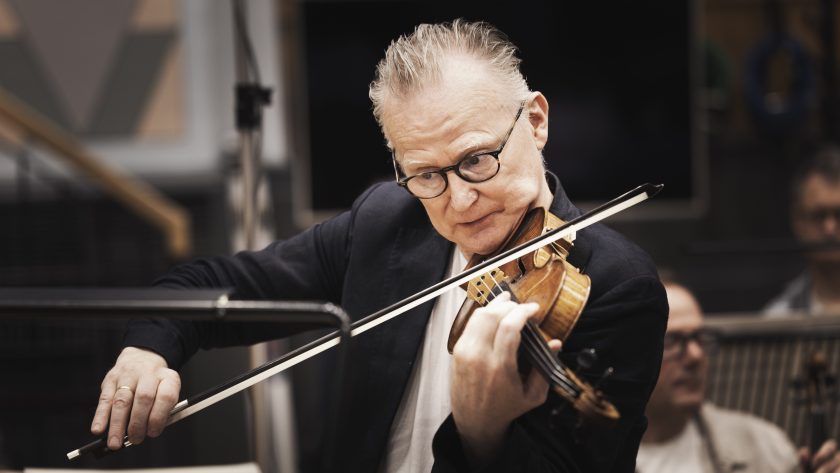
(Artist image: Benjamin Ealovega)
Discover more from MEET THE ARTIST
Subscribe to get the latest posts sent to your email.

