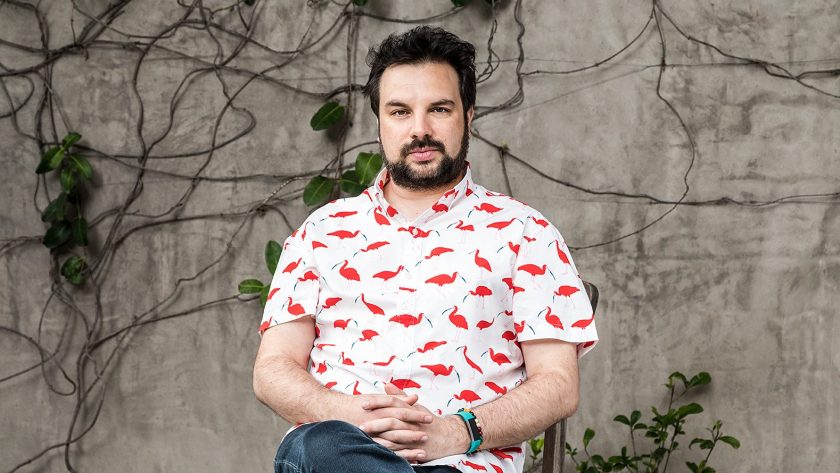
Who or what are the most significant influences on your musical life and career as a composer?
My beginnings as a cathedral chorister have had the most lasting impact on me as a musician and composer. Those years formed the way I hear music and, perhaps more broadly, the way I understand what a musical life can be.
Choral music remained central to me until I moved to the States, and the sounds of those formative years are still part of my musical DNA. I feel particularly connected to Renaissance choral music. If I were to sit down on a quiet evening and actually listen to music, it would almost invariably be sixteenth-century polyphony.
What have been the greatest challenges of your career so far?
Initially, working principally in film and television, the challenge was creating opportunities and establishing some sort of profile. Then, once you achieve a degree of success, it becomes dealing with the grueling schedules and the rather fickle and unpredictable environment around that industry.
More recently it’s been finding time to examine my own instincts as somebody who writes music. I’ve always found it slightly difficult to say my job is “composer”. “Film composer” somehow felt easier, because I didn’t feel I was putting myself on the same pedestal as the greats.
Having recently written an opera and other work outside film and television, I feel more comfortable saying: actually, I write music, and there is a word for that – composer. Part of the challenge is becoming comfortable with that and trying to live up to it.
What are the special challenges/pleasures of working on a commissioned piece?
Being commissioned means somebody has found some value in what you do and how you do it, which is a wonderful starting point.
In the case of Oracle, Jérôme Kuhn was conducting some of my music for The Sandman when, halfway through the recording sessions, he more or less said, “Why don’t you write an opera?” It wasn’t a question I was expecting.
Once I got my head around it, the great pleasure was the freedom. Film and television inevitably involve directors, producers, executives and editors, all potentially with different voices which need to be heard. With Oracle I was essentially told: write me a chamber opera; we need a handful of singers, but we have a big orchestra. The rest is yours.
If you aren’t used to that sort of freedom, you don’t necessarily know what to do with it. But once I did, it was incredibly liberating.
What are the special challenges/pleasures of working with particular musicians, singers, ensembles or orchestras?
You learn so much from other musicians. You can hand the same piece to five different singers, players or orchestras and get five different versions of it.
As a composer, you spend an extraordinary amount of time deciding how something should be. Then you put it into the hands of great musicians and another dimension appears.
Obviously I know when I don’t like something, or when an interpretation has travelled too far from what I imagined. But there are also moments when somebody does something and you think, “Oh wow – I never knew that was how it could be.”
Performers take the static language of notation and make it live. Composers will forever be indebted to them for that.
Of which works are you most proud?
I’d have to say Oracle, partly because it’s the longest continuous piece I’ve written, but also because it touches on things close to my heart. It looks at the modern concerns of AI and technological advancement while keeping one foot firmly in Greek mythology and the world of the old gods.
Courtesy of Stephen Plaice’s brilliant libretto, it brings together two things I’m very drawn to: the comfort and fascination of the old world and questions about where we are now and where we might be going.
Interestingly, I was writing Oracle while also working on The Sandman. In Oracle I was dealing with Apollo; in The Sandman, Orpheus. So I was looking at the ancient world in both projects, but through very modern filters. The Sandman was also one of those relatively rare television projects where what I naturally wanted to write and what the production needed were unusually close together. Those two projects, happening simultaneously, stand out for me.
Listen: Oracle — Spotify
Listen: The Sandman: Season 2 — Spotify
How would you characterise your compositional language?
I think it has a foot pretty firmly planted in tonality, possibly because of my choral roots, although I’ve always enjoyed pushing at its limits.
I’ve been rather obsessed with Messiaen over the years and with the way his music can have a very clear internal organisation while stretching tonality far beyond conventional systems. At the other end, I’m fascinated by music that predates the tonal system we recognise — medieval mannerisms, double leading notes, flattened sevenths, musica ficta and Tudor false relations.
Beyond those technical things, colour and atmosphere are enormously important to me.
How do you work?
Because of my film and television work, I write in a studio at a keyboard, playing in every line. So I’m effectively doing three things at once: composing, performing – albeit digitally – and mixing. At any given moment I can send a director a pretty good approximation of what is in my head. Occasionally people outside film and television regard this as somehow different from sitting at a piano with pen and paper. I don’t really see it that way. It’s simply another means of communicating an idea.
When I wrote Oracle I briefly wondered whether I should suddenly become somebody who sits down with manuscript paper. Then I thought: why? I’ve spent more than twenty years learning to work this way.
I might begin with a small piano sketch, then gradually build the orchestration around it. Samples, however good they have become, are still only an approximation – real musicians will always win the day – but they are immensely useful tools.
As a musician, what is your definition of success?
I think it’s when your music connects with somebody.
I once received a message from somebody going through a very difficult period who told me that one track from a film I’d written had somehow helped keep them going. To me, that is about as successful as one can be. Of course there’s another metric. If I’m putting on an opera, I want the venue full. If it’s a film, I want people in the cinema. That’s the businessman’s definition of success. The musician’s definition is somebody saying, “That hit me. That did something to me.” I’m not sure there can be a greater sense of accomplishment than that.
What advice would you give to young/aspiring composers?
We live in a very crowded world with an enormous amount of noise and sound, so if you’re inclined to create more of it, ask why. Make music because you have something you want to say and a way in which you want to say it.
That doesn’t mean sitting in a room until you invent something nobody has ever done before. You could be in there for quite a long time, and I’m not convinced that’s how art works anyway. We’re all influenced by things around us. The important thing is to understand those influences and make sure they aren’t singular. It’s a bit like cooking: the ingredients aren’t necessarily new, but the way you combine them can still be entirely your own.
And try not to be seduced by other people’s careers. Social media constantly shows you everybody else’s presentation of success. People achieve things in their own time and in their own way.
What do you feel needs to be done to grow classical music’s audiences?
I think there are still plenty of people who see classical music as somehow remote or unapproachable, and instinctively think, “That isn’t for me.” Whether that perception is fair or not is almost beside the point: it exists.
Concerts could sometimes be more digestible. Not everything needs to last three hours. I was recently in Italy and went to concerts of around fifty minutes. You could have dinner before or afterwards, and the concert became part of an evening.
A wonderful forty-five-minute concert can stay with you for a lifetime. Conversely, you can sit through three hours and start looking at your watch after ninety minutes.
That doesn’t mean dumbing anything down. Art should still challenge people. But classical music can adapt the way it presents itself without diminishing the music.
What’s the one thing in the music industry we’re not talking about but you think we should be?
I’m not sure there is one enormous issue nobody is talking about. But something we should never stop talking about is musical education and, perhaps more importantly, musical participation.
I was incredibly lucky. My first school was a state school in outer London with a brilliant music teacher. There were orchestras, choirs and opportunities to learn instruments. Music was simply part of school life.
The point isn’t that every child exposed to music should become a professional musician. Making music with other people teaches things that go far beyond music: you have to listen, understand that your contribution matters but is part of something larger, and adjust to those around you. There’s something profoundly empathetic about it.
We talk a lot about audiences for music, but perhaps not enough about participants in music. Britain has an extraordinary tradition of amateur music-making, and I’d hate to see that disappear.
What next — where would you like to be in ten years?
I’d like a slightly more even balance between the different parts of my working life.
I’ve only really started writing opera and concert music seriously in the last couple of years, while continuing a fairly brutal film and television schedule. At times it feels like having two careers stacked on top of one another. There is something rather strange about trying to remain inside a creative bubble writing an opera while waiting for Los Angeles producers to wake up and give me notes on a TV show.
In ten years I’d like things to feel a little calmer: perhaps one film a year and one substantial concert commission, with enough space around each to do it properly. Really, I’d like to spend more time on projects and therefore do fewer of them.
What is your idea of perfect happiness?
I learned quite young to associate happiness with being busy and making music. As a chorister I was singing seven days a week — weekends, Christmas Day, back again on Boxing Day — alongside tours, broadcasts and services. It was an extraordinarily full musical life at a very young age.
My own children are choristers now and occasionally, when they complain about the commitment, I find myself saying, “If you think this is bad, you should have seen it in my day, when it was just the boys doing all the work,” which never goes particularly well!
So while I genuinely enjoy work and its rigour, as I get older I’m increasingly conscious of wanting a better balance. My work has forced me to spend too much time away from my family, so perfect happiness is probably finding the right balance between a fulfilling professional life and a properly present personal one.
What is your present state of mind?
With Oracle coming to the Queen Elizabeth Hall on 3 October, I’m fairly anxious.
Putting on an opera is still new to me. I want the Queen Elizabeth Hall to be as full as possible so that the singers and musicians have a wonderful environment in which to perform, but more importantly I hope the piece touches people and gives them some pause for thought.
I’m also looking for reassurance that I’ve taken something I know how to do — tell stories through music — and done it in a rather different way, and that it works.
I don’t know the answer yet, but I’m hopeful that it does!
So my present state of mind is probably a mixture of fear and excitement, together with an awareness that I’m extraordinarily fortunate even to be in this position – still discovering things, still trying something I haven’t done before and still being given opportunities to help tell stories.
How lucky am I?
The BBC Concert Orchestra and its Associate Conductor Jérôme Kuhn bring David Buckley’s powerful new opera, Oracle, to the UK for the first time on Friday 3 October at London’s Queen Elizabeth Hall. Find out more
Discover more from MEET THE ARTIST
Subscribe to get the latest posts sent to your email.

