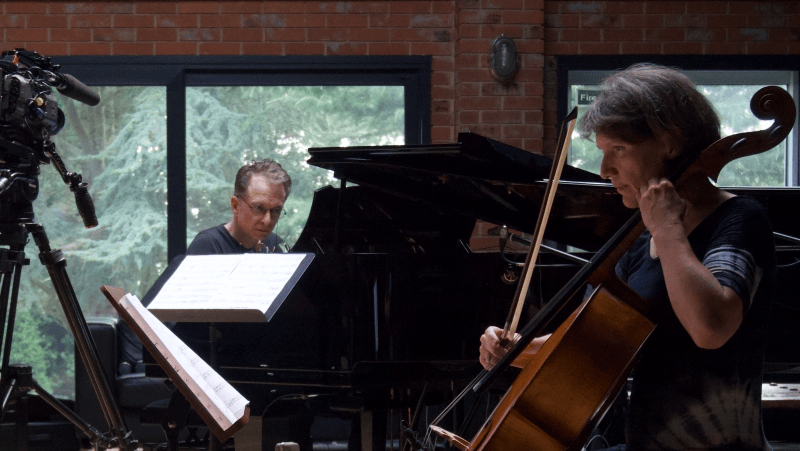
Caroline Dale is one half of the ensemble CLOUD CHAMBER
Who or what inspired you to pursue a career in music and who or what have been the most important influences on your musical life and career?
I first fell in love with the cello when I was about five years old. I heard Jacqueline du Pré playing the Elgar Cello Concerto on the radio and immediately wanted an instrument that could sing in that way. I’d started on the piano, but I never really took to it. The cello felt completely different. I still remember the first time I heard the open strings of my little eighth-size cello. I was completely captivated.
Jacqueline du Pré was obviously a huge early influence. She became my hero, and the fact that I eventually met her and remained in touch with her was incredibly important to me. Later, playing the music associated with her in Hilary and Jackie was an extraordinary experience because I had to imagine her musical life from childhood through to her final years.
My teacher Florence Hooton was another enormous influence. She was a remarkable teacher because, although she had very strong ideas about music, she understood that every student was different. She never tried to force everyone into the same mould. Pierre Fournier was also hugely important. One of the things he taught me was to put the music first and then find the technique necessary to express it. The instrument should never become a barrier between you and the music.
My parents were perhaps the most important influence of all in a different sense. Neither of them was a professional musician, but they loved music and supported me without ever putting pressure on me. They allowed music to be something I chose because I loved it. That gave me a very healthy relationship with it.
What have been the greatest challenges of your career so far?
One of the biggest challenges has been learning not to allow other people’s expectations to define who you are.
After winning the first BBC Young Musician competition’s Strings category at thirteen, my career seemed to have a very clear trajectory. I was suddenly performing concertos, appearing with major orchestras and playing prestigious concerts. But although I loved performing, I eventually realised that being a soloist could feel quite lonely and narrow. I loved so many different kinds of music other than classical—Kate Bush, David Bowie, contemporary music, film music and so on, and I didn’t want to feel constrained by only playing one genre of music.
The challenge was finding the courage to follow those instincts. When I started working with the London Contemporary Dance Orchestra, doing recording sessions, arranging, composing and working with artists from completely different musical backgrounds, some people in the classical world couldn’t understand why I was doing it. There was an assumption that you had to choose one identity.
I’ve never believed that. For me, performing, arranging and composing are simply different expressions of the same musical instinct.
Which performances/recordings are you most proud of?
The soundtrack for Hilary and Jackie is a recording I’ll always feel very strongly about. Jacqueline du Pré had been my inspiration for becoming a cellist, so to be asked to represent her musically through such a large part of her life was incredibly personal. I learned the repertoire in roughly the sequence she would have learned it herself, almost growing with her through the music. It felt like acting on the cello.
I’m also particularly proud of Such Sweet Thunder, my own solo album. That was probably the first time I felt that all the different parts of my musical life had come together. It combined my own compositions with music that had inspired me, and brought together classical and contemporary music, performance and composition, solo work and collaboration. For the first time I wasn’t choosing between different parts of my identity. They all belonged together.
Which particular works/composers do you think you perform best?
I’ve always felt most at home with music that has a strong sense of line and allows me to think vocally. I tend to imagine the cello as a voice. Whatever instrument a composer writes for, there is ultimately a musical line that wants to sing.
So rather than thinking in terms of a particular composer or period, I think I’m at my best when the music has something to say and I can concentrate on its phrasing, shape and emotional direction.
How do you make your repertoire choices from season to season?
As I said, I’ve never been particularly comfortable with the idea that a musician has to stay inside one repertoire or one category.
My musical life has always developed through curiosity and opportunity. I’ve followed things that interested me, whether that meant contemporary dance, recording sessions, film music, arranging for popular artists, composing or performing the great classical repertoire.
I think the same principle applies to repertoire: if something makes me curious, I want to explore it. I’m interested in the connections between different kinds of music rather than the boundaries between them.
Do you have a favourite concert venue to perform in and why?
I think the venue matters less to me than the connection with the audience. One of the most rewarding things about performing with Cloud Chamber has been discovering that people really understand what we’re trying to do and connect with it. That’s ultimately what matters most to me.
What do you do off stage that provides inspiration on stage?
I’ve always needed a life outside music.
When I was young, my parents made sure I had a normal childhood. I went to a comprehensive school, played hockey and other sports, explored different interests and spent time with people who weren’t musicians. Later, when I was at the Royal Academy, I lived at International Students House, surrounded by students from all kinds of disciplines. At Banff I was able to work alongside composers, artists and musicians from completely different backgrounds.
I think that breadth is incredibly important. If your entire world is music, your musical world can actually become quite narrow. Having other interests and experiences gives you something to bring back to the music.
What is your most memorable concert experience?
That would have to be the Meltdown Festival with David Gilmour at the Royal Festival Hall.
As a musician, what is your definition of success?
For me, success isn’t about how prestigious the concert is, how many people are in the audience or what other people think your career should look like.
It’s about being able to make music that genuinely reflects who you are and to connect with other people through it.
For a long time I had what, from the outside, looked like a very successful career. I was performing major concertos and appearing with important orchestras, but I still felt that something was missing. Later, when I began bringing together performing, composing, arranging and collaborating across different musical worlds, I felt much more fulfilled.
So I think success is ultimately about authenticity—and about connection. If you can make something that feels true to you and it reaches somebody else, that’s success.
What do you feel needs to be done to grow classical music’s audiences?
I think we need to stop assuming that people have to choose between classical music and everything else.
There are enormous numbers of people who love music but don’t necessarily identify themselves as “classical music audiences”. They might love film music, contemporary music, pop, electronic music or singer-songwriters, and there are opportunities to create bridges between those worlds.
I’ve spent much of my career moving between those different musical environments, and I’ve never felt that they were mutually exclusive. In fact, I think each world can make you hear the others differently.
We also need to make audiences feel welcome rather than making them feel that they need to understand a particular set of rules before they’re allowed into the room. Music should ultimately be about communication, and that means finding ways to make that communication as open as possible.
What’s the one thing in the music industry we’re not talking about which you think we should be?
I think we’re not talking enough about the damage that can be done by pigeonholing musicians.
There is a tendency to decide what somebody is—a classical cellist, a composer, an arranger, a pop musician, a conductor—and then expect them to stay there. But musicians are creative people, and creativity doesn’t necessarily respect those categories.
I’ve experienced that throughout my career. When I started arranging and composing, some people assumed I’d stopped performing or abandoned classical music. In reality, I was simply exploring another part of the same musical instinct.
I think the industry would benefit enormously from allowing musicians to be more complicated than their job title suggests.
What advice would you give to young or aspiring musicians?
Stay curious.
Don’t assume that there is only one route to having a successful musical life, and don’t be frightened of opportunities simply because they don’t appear to fit the career you originally imagined.
I’ve always believed that if an opportunity comes along, it’s worth being curious enough to give it a go. You never know where it might lead. Working with a contemporary dance company eventually led me into film music. Working with Nigel Kennedy opened the door to arranging and composition. Those things led to entirely different collaborations and ultimately helped me understand what kind of musician I really wanted to be.
I’d also say don’t sacrifice the rest of your life for music. My parents were wonderful in that respect. They supported me completely, but they never made music my entire identity. I had sport, friends, school and other interests. I think that made me a much more rounded person and, ultimately, a better musician.
And don’t be afraid to be yourself. You don’t have to become somebody else’s idea of what a successful musician should be.
What’s next? Where would you like to be in 10 years?
What excites me now is the freedom to explore.
Cloud Chamber feels like a natural continuation of everything I’ve done before: classical music, contemporary music, composition, collaboration and a love of melody and storytelling. It feels as though the different strands of my musical life are finally coming together again.
So rather than having one very fixed destination in mind, I’d like to still be curious in ten years’ time—to still be making music that surprises me, collaborating with interesting people and finding new ways of communicating with an audience.
What is your present state of mind?
I’m excited and curious.
Looking back over my career, I can see how all those apparently separate experiences—being a classical soloist, playing in contemporary ensembles, recording film music, arranging, composing and collaborating with musicians from completely different worlds—were actually leading towards the same thing.
That’s why Cloud Chamber feels particularly exciting. It doesn’t feel like abandoning one part of my musical life for another. It feels like bringing those parts together and finally having the freedom to explore them without worrying about which category they belong to.
For me, the most important thing now is the connection: between the musicians, between different musical traditions, and ultimately between the music and the audience.
The debut album from Cloud Chamber with Caroline Dale (cello) and Gavin Greenaway (piano) – is out on Friday 9 October: http://cloudchamber.lnk.to/skylines
Cloud Chamber will tour the UK from October, beginning with a concert at Kings Place, London on 12th October 2026. Tickets and more info here: https://www.cloudchamber.music/
Discover more from MEET THE ARTIST
Subscribe to get the latest posts sent to your email.

