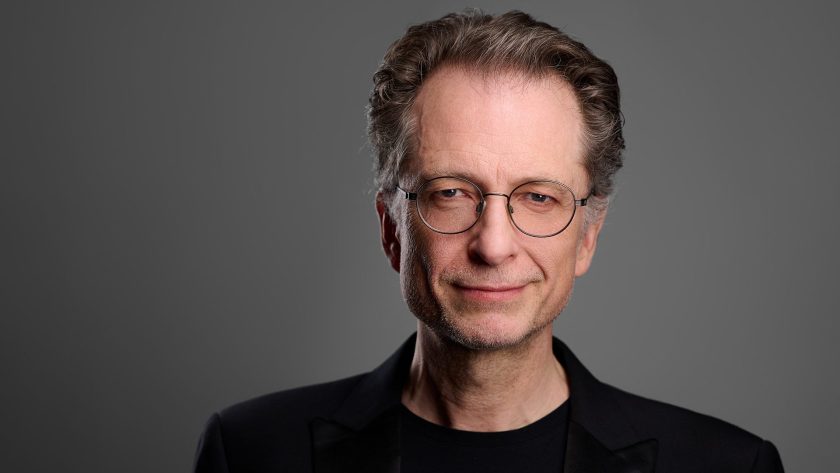
Who or what are the most significant influences on your musical life and career as a composer?
I had piano lessons from the age of around 6 (this is the 1970’s for context), studying very standard classical repertoire. My first ‘hero’ composer was Beethoven, especially the piano sonatas and symphonies. My father was a successful pop songwriter at this time and collected a number of song books of popular songs, including a Beatles collection, with most of their songs, notated as melody with chord symbols. Although I had only heard a few of their songs on the radio, I enjoyed discovering these tunes and their very different approach to harmony and melody. I still think that a good tune, one that can still work without the harmony, is one of the most direct ways to connect with a listener. And surely if your music doesn’t connect with others, what’s the point?
Then through my teens I discovered Debussy, Ravel (his Piano trio is still one of my all time favourites), and Steve Reich. I was late to jazz, which I only really got into in the last 10 years. Coltrane was a closed book to me until one day, at my son’s insistence, I listened to A Love Supreme and it finally clicked.
What have been the greatest challenges of your career so far?
The hardest part of being a working musician with many interests is balancing work which pays the bills against projects which are creatively more under my control. As enter my 60s I have been trying to rebalance my time so that I spend more of it on projects where I have complete creative freedom. In a way my composing has been impacted by my accidental success as a studio conductor. I didn’t set out to conduct, it was something a fell into, but I learnt how to run a session well and consequently have conducted over 200 films. The financial security this has brought me is offset by the lack of time for my own projects. I’m not complaining though, I am truly grateful for the work I have.
What are the special challenges/pleasures of working on a commissioned piece?
I recently completed a commission for Anna Noakes, a trio for flute, viola and harp (we can thank Debussy for that line up, I think). I was given carte blanche to do whatever I wanted. Of course, this brings its own problems. It took me about 3 weeks to get started. I would get a few bars into an idea and then scrap it. Over and over. I only started to enjoy the process once I found the harmonic and rhythmic language for the piece. That’s the problem with a blank canvas – too many possibilities. I’m going to record an album with a Kenyan choir next year, and the composing for that is coming much more easily – the constraint of having words to set is just enough to narrow down the choices.
What are the special challenges/pleasures of working with particular musicians, singers, ensembles or orchestras?
I’m always struck by the difference between conducting choirs and orchestras. They are very different beasts. I always use a baton with an orchestra, but it feels like for choirs it’s often better without. The biggest challenge is to conduct a piece for orchestra and choir – sometimes I’ve had to say to the orchestra to ignore me for a few bars (maybe they already are!) while I give the choir the help they need in order to get everything to sound together.
Of which works are you most proud?
My favourite thing I ever made by myself was the album Woven. I almost abandoned it 3 or 4 times. Trying to write, record, engineer and mix an album at home with multi-tracked felt piano (and other prepared-piano techniques) and to tell a story with just music and titles, turned out to be at the limit of my abilities at the time. I’m proud of not giving up on it.
I’m proud of my new album, Skylines, with the cellist Caroline Dale (under our new ensemble name Cloud Chamber) for different reasons. Working with an artist of her calibre inspired me to write music that I think other performers will also enjoy playing. I love writing tunes and Caroline really makes them sing. In the few concerts we’ve done so far (we have another 5 planned for October) it’s been great to feel the audience really connect with us and the music. We both have worked extensively recording film music and I think that has influenced the way we play and communicate the music – there’s a story telling element which is very strong.
How would you characterise your compositional language?
Unremarkable. A little too consonant to be taken seriously by the classical establishment, a little bit too complex to be in the “Classical Crossover” camp!
How do you work?
My favourite way of composing is at the piano. My upright piano has a midi output which is great for notating quickly into my computer (I use Sibelius, Dorico is also very good). When I worked on manuscript the handwriting was so messy I often couldn’t read it the next day, and I’d end up with bars scattered all over the page with arrows from one to the next. With Sibelius I can reorganise easily, and always read what I’ve written. It’s great for transposing instruments too – you can flip between a C score and a transposing score – and the playback feature is very useful for finding mistakes.
Once I have a piece on the go I’ll spend more time away from the piano working on it in my head. A long drive is great for composing and fine tuning things like rhythm and structure.
When I worked in Hollywood I would write and orchestrate directly into Logic Pro, and I got very good at making believable orchestral mock ups, but the amount of time spent making them sound good was disproportionate to the time spent composing. Now, if I’m making an arrangement for orchestra using a neat plug in called “NotePerformer” in Sibelius gives a very passable rendition as a demo for others to hear. It just reads the Sibelius file and interprets phrasing and dynamics without me having to perform each part myself.
As a musician, what is your definition of success?
Success as a musician can’t be separated from how you live the other parts of your life. There’s no shortage of amazing music already. There seems to be a shortage of empathy and humanity at the moment though. Connecting people through music is a wonderful thing, but that doesn’t absolve you from genuinely connecting with people in everyday interactions.
What advice would you give to young/aspiring composers?
Write more, worry less about what other people think, listen to music from every ‘genre’ – classical, jazz, folk, pop, rock, music from other cultures… it has never been easier to listen to a diverse range of music. Go to concerts as often as you can.
What do you feel needs to be done to grow classical music’s audiences?
I think that film and games music has the potential to bring new listeners in. But the lack of exposure to what is traditionally called classical music during children’s formative years is a serious problem. If I was a concert programmer, I’d sneak a couple of non-movie pieces into every film music concert – the original influences, like Holst’s Mars or Rimsky-Korsakov’s Scheherazade.
What’s the one thing in the music industry we’re not talking about but you think we should be?
I assume we’re all talking about the threat of ai, too many graduates chasing too few orchestra positions, lack of proper music education (and the arts in general at school), mental health, taking care of your hearing etc. The ‘music industry’ is changing. It is always changing. We have no idea where it will be in 10 years time. The invention of radio, the phonograph, television, streaming, social media, ai… all changed and are changing the musicians’ lives radically. So the thing we’re not talking about is most likely something that we can’t even imagine, that will change things in ways we can’t be prepared for.
What next – where would you like to be in 10 years?
I would love to have expanded Cloud Chamber to include more musicians and it to be my full time focus. Also for us to have played at the Edinburgh Festival and the Temppeliaukio Church in Helsinki.
The debut album from Cloud Chamber — Caroline Dale (cello) and Gavin Greenaway (piano) – is out on Friday 9 October: http://cloudchamber.lnk.to/skylines
Cloud Chamber will tour the UK from October, beginning with a concert at Kings Place, London on 12th October 2026. Tickets and more info here: https://www.cloudchamber.music/
(Image: Oliver Wagner)
Discover more from MEET THE ARTIST
Subscribe to get the latest posts sent to your email.

