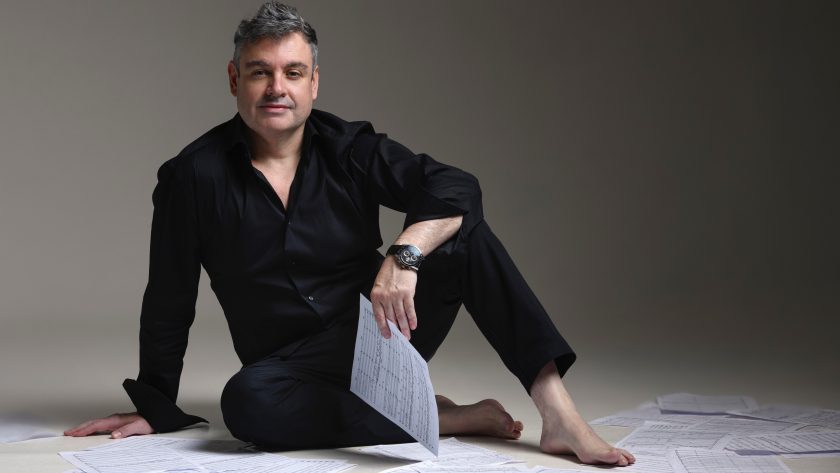
Who or what are the most significant influences on your musical life and career as a composer?
It is something very special to me, because music has been with me for as long as I can remember. When I was a child, before I even knew how many keys a piano had, I was already experimenting with a keyboard. I must have been about six years old. Later, there was a piano at a friend of my mother’s house, and I would secretly sit down at it and experiment. At that age, they were simply black and white keys to me, but somehow I could already feel that each one had its own sound, its own identity. I would play with them, combine them, and create my own little pieces.
That relationship with music has never really changed. Throughout my life, whenever I have had a piano in front of me, I have sat down to talk to music. In many ways, that is what composing means to me: having a conversation with music.
I feel incredibly fortunate to be able to create music. Sometimes it feels almost like having access to a universal language, one that does not need translation because, in one way or another, we all understand it. As a composer, I have the extraordinary privilege of using that language to communicate something and, hopefully, to make another person feel something.
For me, that is what being a composer is really about.
If we talk about the career itself, of course it has its difficulties. Finding your way, establishing yourself, and continuing to move forward are never easy. But I think every dream requires you to believe in it. And when something is also your passion, the sacrifices you make every day somehow become much easier to accept.
What have been the greatest challenges of your career so far?
So far, I would say the greatest challenge has been reaching the point in my career where my music is being recorded at Abbey Road Studios with orchestras of the highest level. I recorded my Suite No. 1 with the Philharmonia Orchestra, and more recently Persephone, my first concerto for piano and orchestra, with the Royal Philharmonic Orchestra.
I would not describe those experiences as difficult, but they come with an enormous sense of responsibility. There is a moment when you realise that extraordinary musicians are sitting in front of your score, ready to bring something you created to life, and that it is going to be recorded and remain there forever. You want every note to deserve their commitment.
At the same time, you have to trust the people around you. I have been incredibly fortunate to work with exceptional musicians and with extraordinary teams at Abbey Road and within the orchestras. That trust allows you to let go.
Because when you compose, eventually you have to stop. At some point you have to write the final bar and decide that the work is finished. For me, that is almost an act of faith: the final step before the music stops belonging only to you and you set it free, allowing the musicians to give it life and, ultimately, the audience to make it their own.
What are the special challenges/pleasures of working on a commissioned piece?
First of all, it is always very rewarding when someone trusts you enough to commission a piece, because in some way they are choosing your musical voice.
As I also compose for film, some of my most recent commissions have been soundtracks. In that context, you are free, but within certain boundaries, because you are one part of a much larger production. I usually like to offer my own musical vision before listening to references, and so far I have been fortunate that directors and producers have given me that freedom. Seeing their reaction when they first hear the music with the images, sometimes without needing to say a single word, is incredibly rewarding.
With orchestral commissions, the experience is different but equally special. My most recent one was for the Madrid Symphony Orchestra, for which I composed a movement from Íbera for orchestra, choir, baritone and mezzo-soprano. After the performance, receiving the congratulations of the musicians, soloists, choir and conductor, and then hearing the response of the audience at Madrid’s Auditorio Nacional, made it an unforgettable night.
For me, that is perhaps the greatest pleasure of a commission: someone begins by placing their trust in you, and in the end you have the privilege of seeing what that trust has become.
What are the special challenges/pleasures of working with particular musicians, singers, ensembles or orchestras?
For me, the main challenge is making sure that every musician understands and feels the emotion I want to communicate. With an orchestra, it is different because every section and every instrument has its own role within the whole. I am very fortunate to work closely with conductor Alberto G. López, who knows my music, my style and the sound I am looking for extremely well. He has an extraordinary sensitivity and an instinctive understanding of the music, as well as the ability to make something difficult feel easy. Through him, the orchestra very quickly understands that pulse, and then you can simply allow the music to lead them.
Working with a soloist is more intimate and usually requires more time. On Suite No. 1, for example, Hilary Summers was the soloist on the fourth and sixth movements. It was wonderful to talk with her about the meaning behind the music and the text, which I had also written, and about what I wanted the listener to feel.
With Persephone, Isabel Dobarro was the piano soloist, and working together was a beautiful process. Through each rehearsal we explored the meaning and direction of the work, although, to be honest, with Isabel I rarely needed to explain the emotional intention of a passage in great detail. She has that extraordinary ability to understand almost immediately what is behind each note.
So I have never really experienced working with great musicians as a difficulty. When you are surrounded by that level of talent, one of the greatest pleasures is actually letting go: allowing everything to flow and hearing how the music grows through the people performing it. Very often, they give something back to the music that you could never have written on the page.
Of which works are you most proud?
It is a difficult question to answer, because I feel proud of all my works, even the most experimental or the simplest ones. Each of them belongs to a particular moment in my life and represents something I wanted or needed to express at that time.
But if I had to mention two, I would probably choose Suite No. 1 and Persephone, my two most recent large-scale works. Both were recorded in Studio Two at Abbey Road with extraordinary musicians and professionals, and seeing works that once existed only in my imagination grow into something of that scale has been very special.
Ultimately, though, what makes me most proud is not where or how they were recorded, but knowing that people listen to them, connect with them and feel something through the music. That, for me, is the greatest reward.
How would you characterise your compositional language?
I think I have developed a recognisable musical identity, although with every new work I try to step outside my comfort zone and continue evolving. I never want to feel that I am simply repeating what I have already done.
Minimalism is inevitably part of me, and from time to time it finds its way into my music. When it does, I let it appear naturally rather than trying to avoid it.
At this point, I would describe my musical language as predominantly tonal and symphonic, but also quite varied. There are moments of intimacy and simplicity, others of great orchestral intensity, and sometimes more experimental elements. I like having that freedom. For me, maintaining a musical identity does not mean always speaking in exactly the same way.
How do you work?
I work in my studio, but I do not really have a fixed system or method. Everything usually begins at the piano, perhaps inevitably because I am a pianist. I do not structure a piece completely before I start, and I do not necessarily work from beginning to end. I try not to impose too many rules on the process.
I sit at the piano and, in a way, I begin to talk. I let inspiration take over and follow wherever it leads me. Once I begin to see the structure and the different layers and colours of the music, I start writing a first draft while orchestrating at the same time, again quite intuitively, following my inner voice rather than a predetermined formula.
I also use orchestral sample libraries as part of the process. They allow me to hear how the different elements are developing, and very often the piece continues to evolve as I listen and work. Once the composition is finished, I begin the much more precise process of preparing and transcribing everything into the final score for performance and recording.
One thing that is very characteristic of the way I work is that I compose at night. There is something about those hours when the world is asleep but my creativity feels completely awake and full of energy. I can happily spend hours in my studio, late into the night, creating and enjoying the music as it comes into existence. And if one night the inspiration simply is not there, I do not force it. I go to bed, rest, and continue the following day.
So perhaps that is my system after all: the night, my piano, my studio, and allowing the music to emerge from within.
As a musician, what is your definition of success?
For me, success is the possibility that my music becomes a legacy, that it continues to be listened to and performed, and that people can emotionally connect with what it is trying to say.
I see music as a universal language, one that can reach people beyond words. If my music can make someone feel, dream, travel somewhere in their imagination, or experience an emotion that stays with them after the final note has disappeared, then I feel I have achieved something meaningful.
That is my definition of success.
What advice would you give to young/aspiring composers?
Listen to your own voice and be faithful to it. Do not compose in search of the audience’s approval; first, search for your own sense of truth when you create.
I believe the best composition you can write is one created with the freedom to feel that it genuinely belongs to you, whatever your style may be. There will always be opinions, expectations and trends around you, but your own musical identity is something only you can develop.
And beyond creativity, I would say three things are essential: sacrifice, discipline and faith in yourself. Talent matters, of course, but believing in your own voice and having the discipline to keep developing it are what allow you to continue moving forward.
What do you feel needs to be done to grow classical music’s audiences?
I actually think we are living at a very interesting moment for classical music. I see a great deal of curiosity among younger generations, perhaps more than we sometimes assume. Today, almost any piece of music is available to anyone, anywhere, at any time, so the opportunity to discover classical music has never been greater.
For me, one of the most important things is for orchestras and concert halls to continue making space in their programmes for living, emerging and new composers. New music needs the opportunity to stand alongside the great works of the repertoire, not in competition with them, but as part of the same continuing story. That is how new composers become visible and, more importantly, how audiences have the chance to discover their music.
I believe today’s audiences are much more open to new works than we sometimes think. We simply need to give those works the opportunity to be heard.
What’s the one thing in the music industry we’re not talking about but you think we should be?
I think one of the most important conversations right now is the growing use of AI as a tool for musical creation. For me, this is an issue of enormous importance, and one that needs to be addressed urgently if we want to preserve and respect human creativity.
Technology will inevitably continue to evolve, and AI will be part of that evolution, but we need to establish very clear boundaries. Artists should have the right to decide whether their work, their performances and their creative identity can be used to train or develop AI systems.
I believe major corporations, record labels, cultural institutions and governments all have a responsibility to address this seriously and to create effective regulation that protects past, present and future works from being used without the knowledge or consent of their creators.
This is not simply a question about technology; it is a question about authorship, ownership and the value we place on human creation. It is a conversation that concerns musicians everywhere, and I think we need to have it now, while we still have the opportunity to define the rules.
What do you enjoy doing most?
There are many moments I enjoy as a composer, but one of the most special is being in the studio recording my music. There is something extraordinary about seeing all the pieces finally come together, watching the team respond to the music, and seeing every musician and professional involved giving the very best of themselves.
As the recording sessions move towards the end and I begin to hear what we have created together, I feel an enormous sense of happiness. It is a very emotional moment for me. After all the months of composing, imagining, writing and preparing, suddenly the music is real and alive.
In those moments, I genuinely feel like the most fortunate person on the planet. I simply look around, take it all in, and feel grateful to life for allowing me to experience something like that.
Discover more from MEET THE ARTIST
Subscribe to get the latest posts sent to your email.

