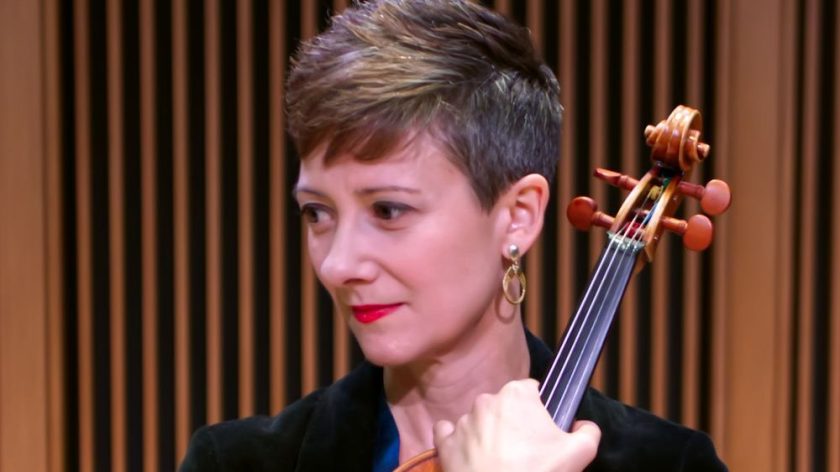
Who or what inspired you to pursue a career in music and who or what have been the most important influences on your musical life and career?
I come from a family of amateur musicians, and I’m lucky that my parents were adamant that music lessons be part of my education. I started on violin when I was five and took weekly lessons for years. I grew up in Maine, which has a lot to recommend it, but a robust childhood music education program was not one of these things. When I was 11 we spent the year in Albuquerque, NM, and suddenly my middle school had three orchestras! I quickly made friends with violists and cellists, and the way the orchestra was scheduled, violinists ate lunch together and violists and cellists ate lunch together. This was all the encouragement I needed to switch to viola, and I truly believe that if I had not switched instruments to eat lunch with my friends, I would be a paleontologist (or something) now and not a musician.
After returning to Maine I began studying with Julia Adams, violist of the Portland String Quartet. I also attended the quartet’s summer program the year I turned 13. At this festival, I played my first string quartet (Beethoven op. 18 no. 6, talk about trial by fire) and I was hooked! This was the first moment I thought I might want to pursue music as a career. I still love this piece and I can smell the room we rehearsed in every time I hear it.
During my undergrad at the University of Illinois I worked with my first serious, long(ish) term string quartet. It was with this group that I first worked with a composer on their music. This was another revelatory experience. It was definitely the hardest thing I had played to date, and I really enjoyed the process of learning and interpreting a piece without a recording and with the guidance of the composer. Since then, I have commissioned over 20 new works and have recorded 11 of them. Premiering a piece of music that no one has heard before is a heavy responsibility. If my performance is poor, the audience might decide that the piece is poor. On the other hand, it is immensely liberating because there is no precedent for how it “should” be played. I have complete freedom to find my way to the interpretation that speaks to me. It is also vital to the health of classical music. Without new music, the art form stagnates. I am proud of the new music I have commissioned, and am bashfully excited about my own foray into composition.
Recording is another very meaningful aspect of my musical life. My first album (besides orchestral section work) was with the Larchmere String Quartet in 2014. Through clarinettist Wonkak Kim, we had an invitation from NAXOS to record the string quartet and clarinet quintet by Stephan Krehl. We had no experience with this, but Daniel Stein (my boyfriend at the time) had been producing albums for Indiana University (our Alma Mater) for several years. He helped us find an engineer (Bill Maylone of Cedille Records in Chicago), and he produced the album along with composer Francisco Cortes-Alvarez. The boyfriend became the husband in 2017, and we just finished our fifth album with Bill. Recording is hard. It takes time, resources, and immense vulnerability. It also makes me better every time I do it, especially working with a producer that is as good as Daniel. I think differently about repertoire and programming, I think about what story I want to tell and how it relates to our moment in time, and I emerge from the process a better violist and musician.
What have been the greatest challenges of your career so far?
Balancing work and family as a musician is a challenge. This is truly a 24/7 job, I’m never not thinking about it (and often not talking about it), and finding time to unplug completely and exist with my family is incredibly important to me.
Which performances/recordings are you most proud of?
I am particularly proud of two of my albums. One is my 2022 release LOOP: Ligeti’s Inspiration & Legacy. This was my pandemic project. I had learned the first three movements of György Ligeti’s Sonata for Viola Solo during my doctorate at Indiana University. I got to the fourth movement and realized that it would take me probably a year of practicing it for hours a day to be able to play it well enough to perform, so I put a pin in it. In summer 2020, I suddenly had nothing but time and decided it was then or never. I started working on the sonata in earnest, and thought more and more about the influences present in Ligeti’s writing. This led me to arrange a baroque companion piece for each of the movements, highlighting the early music influences in Ligeti’s sonata. Once I had these pairs, I asked five composers to write companion pieces that drew inspiration from each of the pairs. There are 6 movements of the sonata, and I was complaining to Melia Watras that I didn’t know who to ask to write the 6th piece. She, logically, said I should do it. This is something that had not occurred to me, but she gave me the permission I needed to go for it! The album was released in late 2022, and my husband and I joke that this was my post-doc and also our second child (he was the producer). I’m proud of the performance, and also of the concept. It felt like a gamble to present the sonata the way I did (each movement bookended by a baroque piece and a new piece), but I think it is an effective and unique way of listening to Ligeti’s masterpiece.
The second album is Becoming America (released October 2026). I began working on this album in 2023, and that year I got a grant from the Sparkplug Foundation to commission the music. The premise of the album is that the rhetoric about America (the land of opportunity, the American dream, a melting pot) is not equally true for everyone living in America. I asked five composers to write a piece about their American experience. This could be about them, their family, their ethnic or religious group, as broad or narrow as they wanted. The composers are Francisco Cortes-Alvarez (Alabanza), Rene Orth (Today I Remember), Cris Derksen (Declaration of Interdependence), Nailah Nombeko (Illumination Amidst the Darkness), and Tamuz Nissim (Our Collective Heart). I am thrilled with the pieces they wrote. I think it makes an extremely compelling story as a whole, and I hope that each piece has a long life being performed by me and by others.
Which particular works/composers do you think you perform best?
I like things that are off the beaten path. This is part of why I like working with composers so much, but it’s equally true with the hidden-gem older music. I love Brahms and Beethoven, but I don’t necessarily feel like I have insights and a unique interpretation to contribute to these pieces of standard repertoire in a meaningful way. I think I am at my best figuring out how to bring something new to life.
How do you make your repertoire choices from season to season?
I will usually have a big project that I am working on, and that is the backbone of my repertoire for the season. I like the puzzle of programming a concert (or album), and I plan the repertoire carefully to tell what is (hopefully) a cohesive and compelling story. I usually have full programs to offer, and not individual pieces.
Do you have a favourite concert venue to perform in and why?
It depends on what I am playing and why. I know when I am on my home stage at Colorado State University, I will have a crowd of friends and we will have fun. The bar we played in Paris, where we met rappers who did an improvised set with us, was unforgettable. The acoustics at the Krannert Center at the University of Illinois are spectacular and also bring me back to orchestra concerts with my friends during my undergrad. Venues have nostalgia and personality, and the experience you have in any given place colors your perception of it forever.
What do you do off stage that provides inspiration on stage?
I really like physically creative things. For a long time I was a social dancer, mostly Swing and Lindy Hop, but also Tango and some Salsa. Interacting with music in this way, where I’m not producing the sound but instead interpreting it with a partner, is very inspiring to me and helps me listen and create music in a different way.
What is your most memorable concert experience?
Mahler 6 at the KKL in Lucerne, Switzerland with Pierre Boulez conducting!
As a musician, what is your definition of success?
Success is hard to define, because there is no moment that feels like “Aha, now I have made it!” I think success is continuing to improve as an artist, an instrumentalist, and a colleague. If the next thing always builds on the lessons of the previous, that is success for me.
What do you feel needs to be done to grow classical music’s audiences?
I think the classical music world needs to be more open and welcoming. There is a lot of protocol involved in classical music, and if you don’t know how to act (when to clap being a prime example) it can be very intimidating. We need much more of a “we welcome you as you are” attitude. We also need to stop performing the same 12 pieces over and over. The Mozart Overture or Brahms Concerto should be the token old piece on a program of music by living composers! Bring the art form into the present day, support the people creating music now, and make people want to chase the novelty of a new piece of music!
What’s the one thing in the music industry we’re not talking about which you think we should be?
That we need to know our worth. Music is part of the human experience and if we devalue it monetarily, we devalue it culturally. Movies, podcasts, your morning commute, all happen to music, it is part of the fabric of our lives and we should value it as such!
What advice would you give to young or aspiring musicians?
Bring yourself to everything you do. If I just wanted Brahms, I would play the midi file. I want to hear what YOU think this music means. Be brave with your interpretation. Don’t be a slave to the score. Music notation is crude and imprecise, the magic lives in what the performer brings to the page.
What’s next? Where would you like to be in 10 years?
In ten years, if I can be doing what I am doing now, I will be happy! I am just finishing up an album, with another one in the pipeline for next year. I’m waiting for 2 new commissions from composers whose music I admire. I have a studio of students that are curious, smart and hard working. I have colleagues who are inspiring and push me to be better. I live in a beautiful place with my family that I love and who love me. I feel exceptionally lucky, and if this is still true in 10 years I will be thrilled!
Discover more from MEET THE ARTIST
Subscribe to get the latest posts sent to your email.

