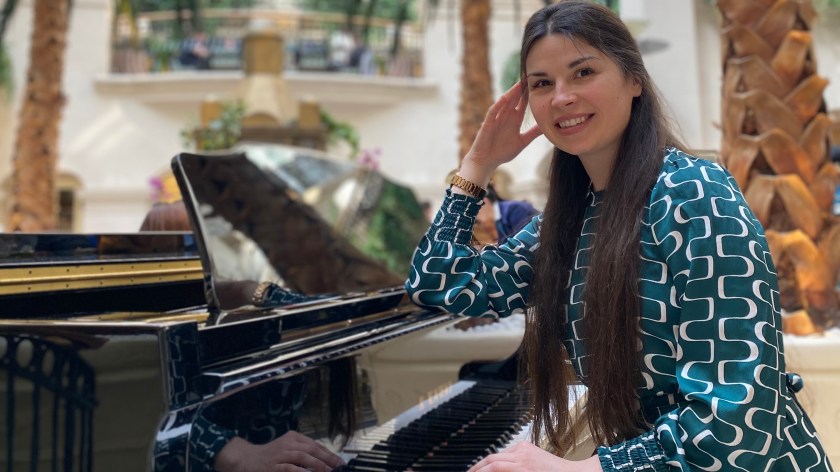
Who or what are the most significant influences on your musical life and career as a composer?
Every great musician has a unique story about their journey into music, and mine begins with my grandmother. At just 5 months old, while she was cooking, the sound of a metal spoon hitting a pot caught my attention, sparking my fascination with music. This early connection led my grandmother to enroll me in music school at the age of 7, setting the foundation for my lifelong passion.
I enjoy listening to J.S. Bach and Mozart along with Brahms and Chopin. Additionally I enjoy playing music by Debussy and Grieg.
What have been the greatest challenges of your career so far?
One of the greatest challenges I faced was writing a fugue in a modern style for my polyphony exam. Fugue writing demands precision akin to higher mathematics, and crafting it in a contemporary context was particularly daunting. However, despite the difficulty, I persevered and successfully passed the exam.
What are the special challenges/pleasures of working on a commissioned piece?
Crafting a commissioned piece requires thorough study and exploration of the chosen theme from various musical perspectives. While this presents its challenges, it also offers the pleasure of delving deep into a musical concept and creating something unique tailored to the commissioner’s vision.
What are the special challenges/pleasures of working with particular musicians, singers, ensembles, or orchestras?
Collaborating with musicians, singers, ensembles, or orchestras brings the opportunity to enrich my music with diverse voices and instruments. Their interpretations breathe life into my compositions, adding layers of depth and emotion. Additionally, modern technology allows for immediate feedback and experimentation with different arrangements, enhancing the collaborative process.
Of which works are you most proud?
I take pride in all my compositions, but some hold a special place in my heart. Among them are “Way,” “Distant Dreams,” and my arrangement of the Ukrainian folk song “Oy Khodyt Son Kolo Vikon” titled “The Dream is Coming.”
How would you characterize your compositional language?
My compositional style leans towards neoclassical, characterized by light harmonies and vibrant melodies. I strive for simplicity and clarity in my compositions, aiming to evoke emotions and convey narratives through music.
How do you work?
My creative process often begins with improvisation, playing with different melodies and harmonies until I discover something that resonates. Once I find a compelling motif or idea, I delve deeper, refining and shaping it into a complete composition.
As a musician, what is your definition of success?
For me, success in music is about following your heart and creating authentically. It’s about connecting with audiences, evoking emotions, and leaving a lasting impact through your music.
What advice would you give to young/aspiring composers?
Listen to your own music with an open mind and heart. Embrace your unique voice and talents, and never stop exploring and experimenting with different musical ideas and styles.
What do you feel needs to be done to grow classical music’s audiences?
We must showcase the beauty and power of classical music to wider audiences. By breaking down barriers and making classical music more accessible and inclusive, we can foster a deeper appreciation for this timeless art form.
What’s the one thing in the music industry we’re not talking about but you think we should be?
I believe we should talk more about the holistic benefits of classical music. Beyond its artistic value, classical music has profound effects on the human psyche and can promote mental well-being and emotional resilience. It’s essential to highlight these aspects to garner greater appreciation and support for classical music.
Anna Stasiuk is a refugee from Ukraine, now living and working in London
Discover more from MEET THE ARTIST
Subscribe to get the latest posts sent to your email.
 MEET THE ARTIST