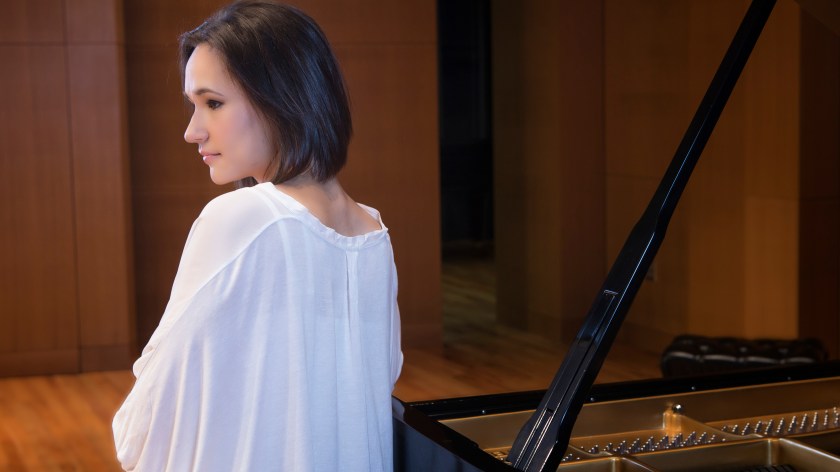
Who or what inspired you to pursue a career in music and who or what have been the most important influences on your musical life and career?
I started playing the piano at the age of seven, which is considered to be an average age to begin music education in Hungary. I asked my parents to enrol me in piano lessons, as the piano was the only instrument that I felt attracted to. Fortunately, my first piano teacher gave me a solid foundation, introduced me to my future mentors, and took me to as many concerts as she could. Jenő Jandó soon became my piano idol, and when I auditioned to the Liszt Academy in Budapest, he accepted me in his studio. His persona, teaching, and musicianship left a strong impact on me.
What have been the greatest challenges of your career so far?
The greatest challenge I have faced has been not to compare myself with other artists. Recognizing that I don’t have to chase other people’s dreams and that my life and career unfold in their own natural way helped me to focus on my craft and calling. Identifying who I am as a pianist and educator, and what are the gifts that only I can share with my audience, have also been an ongoing quest in my career. Overall, I enjoy presenting my cultural heritage in creative recital formats and through multidisciplinary projects.
Which performances/recordings are you most proud of?
I am most proud of my album “Liszt: Harmonies patriotiques et religieuses”, because I was able to materialize my vision for all aspects of the CD including the repertoire, the art work for the booklet, and the paper case design. The art work and the music have special links to each other and personal references to me. For instance, one of the images in the booklet depicts two birds – the original image can be found as a decorative element in the side wing of the church where I have been going to Sunday service since I was a little child. These birds are associated with a particular piece on the album, Legend No. 1, St. Francis of Assisi preaching to the birds.
Which particular works/composers do you think you perform best?
The music of Hungarian composers such as Franz Liszt, Béla Bartók, and Zoltán Kodály are especially close to my heart. There is something magical about being a musical descendent of Liszt through generations of artist-teachers; and to be able to take piano lessons in the same studio where Bartók used to teach at the Liszt Academy. We have a living tradition in Hungary of how to perform their pieces authentically, and I am extremely fortunate that I may be someone who can pass this “torch” on to the next generation of pianists. Besides performing traditional keyboard repertoire, I look for every opportunity to perform contemporary repertoire as well. I find working with living composers highly stimulating. Most recently I premiered the second volume of piano preludes by American composer Andrew S. Lloyd.
What do you do off stage that provides inspiration on stage?
I watch sunsets, practice yoga, and spend time in nature. When I travel for concerts I try to carve out time to explore museums and historical sites in the cities that I visit.
How do you make your repertoire choices from season to season?
I usually combine pieces that I have on repertoire with new ones that I want to learn. I always consider the venue, audience, composer anniversaries, themes that need special programming. For instance, we have developed a program with Hungarian classical pianist László Borbély and jazz pianist Gábor Varga titled Carpathian Impressions. This particular theme determined our repertoire choice of folk-music inspired solo and duo pieces that were also suitable to improvise on. We introduced our program with great success at Carnegie Hall in New York City and at the Kennedy Center in Washington, D.C. in 2022. After our first tour together we began to build a website for our group and look for new performance opportunities. In other cases I rely on the program request of an organizer or a venue. https://www.facebook.com/gabor.varga.1253/videos/860147249107679
Do you have a favourite concert venue to perform in and why?
To perform at Carnegie Hall and at the Gewandhaus in Leipzig mean a lot to me because of their rich history of legendary artists who appeared on these stages. Whenever I return to these concert houses I feel like I return home. The Vigadó Concert Hall in Budapest is another favourite venue where Franz Liszt played and conducted on multiple occasions. I have conducted several television broadcast concerts as a host and performer in that stunning environment.
What do you feel needs to be done to grow classical music’s audiences?
I believe in Zoltán Kodály’s words according to which music education should start nine months before a child’s birth. When listening to classical music from early childhood is part of one’s upbringing, they will breathe it in like oxygen till they live. I am always positively surprised when I hear classical music from the speakers in a waiting lobby or on an airplane while boarding. Imagine how many people are reached by music subconsciously in these situations. I wish to experience more instances like these.
What is your most memorable concert experience?
I associate my two most memorable concerts with overcoming obstacles, and practicing extreme focus and discipline. Leading up to my solo debut in Weill Recital Hall, I had a difficult academic semester and I could not dedicate as much time to practicing as I hoped for. At the end of the semester I had four days left to polish my program before traveling to New York. During those four days I practiced ten hours a day without getting tired or giving up. I felt such victory after playing the last chord in the recital. A similar event happened recently, when, due to a family tragedy, I wanted to cancel my concerto performance in Budapest. But instead, I collected all my inner strength, learnt and performed Grieg’s piano concerto in one month. Before this experience I considered myself a “slow” learner, and to my satisfaction, I proved myself wrong.
As a musician, what is your definition of success?
Success is when my audience feels moved by my performance, and when my students experience success in their musical progress.
What advice would you give to young/aspiring musicians?
I would remind them gently that cultivating music at a high standard requires time, dedication, and perseverance. Finding instant result and gratification in our profession is impossible. Self-care should also be a priority; as especially pianists spend a lot of time alone in the practice rooms. I would encourage young musicians to take care of their emotional, mental, and physical well-being, because those are the foundation of any healthy professional activity.
What’s the one thing in the music industry we’re not talking about which you think we should be?
I am enthusiastic about universities offering entrepreneurship classes for young classical musicians. For instance, recital and project funding, honorarium and royalty, and career management are all crucial topics to discuss if someone aspires to become a concert artist. There is no one path that works for all, and for this reason I find it essential to nurture one’s creativity as a thinker. I would also be interested in talking more about what is the role of a music agency today, how has it changed over time, and what are the pros and cons for a young musician to joining one.
What is your most treasured possession?
I am the happy owner of one of Mme. Lívia Rév’s Steinway grand pianos. Lívia Rév is one of the most celebrated Hungarian pianists who lived in Paris until her passing in 2018. She was a contemporary of György Cziffra and Annie Fischer. I used to visit and take private lessons with her at her home in Paris. Over time we developed a strong friendship, and I remain an admirer of her piano legacy. I purchased her piano from her family when I was still pursuing my doctoral degree at the University of North Texas. To be able to acquire a Steinway was a dream come true, and to have such a precious piece is a blessing.
Discover more from MEET THE ARTIST
Subscribe to get the latest posts sent to your email.
 MEET THE ARTIST