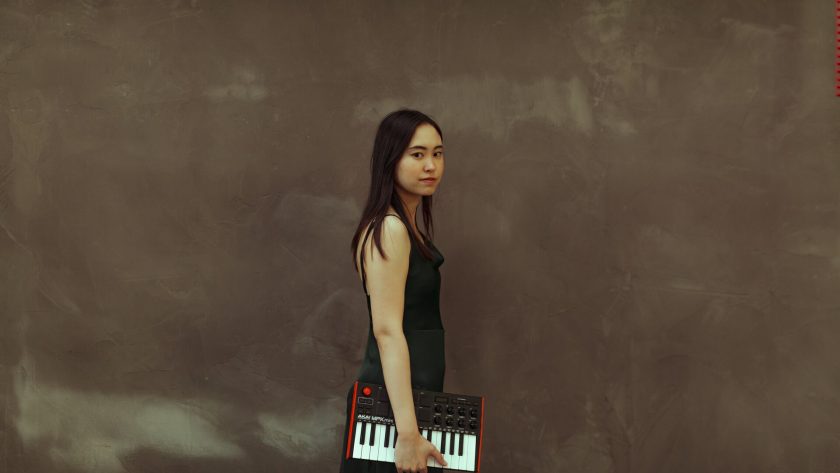
Who or what are the most significant influences on your musical life and career as a composer?
My first biggest influence was my mother, who plays piano and taught me the basics. I was lucky to have a piano in the house since I was born, and once I started playing it, I never looked back. I
also owe so much to my teachers over the years, both in piano and composition, who were very
encouraging and supportive of my sometimes rather odd musical endeavours.
There are multiple musical performances that have inexplicably stuck with me. When I was
probably 11 or 12, I went to a Maurizio Pollini recital in Tokyo, where I grew up. He played
Beethoven’s 21 st Piano Sonata, and that performance, especially the third movement, has stayed with me to this day.
Outside of classical music, I was also enthralled by the Japanese Noh and Kabuki performances that I attended on school trips when I was in junior high school. Japanese music and aesthetics have been an eye-opener for my artistic development.
Inspiration for me comes from musicians and composers of course, but I also rely heavily on
different art forms, especially literature. When I was still studying for my undergraduate degree, I
wrote a piece for six pianos and solo oboe based on Oscar Wilde’s “The Ballad of Reading Gaol”,
and having thoroughly enjoyed working on that project, I subsequently composed a trio loosely
based on Albert Camus’ “L’Étranger”.
What have been the greatest challenges of your career so far?
I sustained an injury to my right wrist when I was in high school, from which I have never fully recovered. It was a frightening few weeks as I thought for a moment that I would never make music again, at least not professionally. It turned out to be a turning moment for my career aspirations, however, as it motivated me to start composing more rather than practising piano pieces composed by other people. During that time, I very quickly found that I enjoyed composing a lot more than I had anticipated.
What are the special challenges/pleasures of working on a commissioned piece?
This may be slightly different from a commissioned piece, but I like to work on film scores and
ended up scoring three short films during my Master’s in composition. I do think that music and
sound can make or break a film, as any part of such a large-scale project can, and I also really
enjoy the process of collaborating with other artists in general. While I try to look for inspiration
daily, there’s something about the intentional creative tension that I find to be very vitalising.
What are the special challenges/pleasures of working with particular musicians, singers,
ensembles or orchestras?
As a composer-pianist I often play my own works, especially if there is piano involved, but when I
do have the pleasure of working with other musicians, I love the feeling of the music developing a
life of its own. I once wrote a piece entitled “Ma” (meaning “space” in Japanese), in which I explored the use of silence and so-called “negative” space in music. I was very grateful to have a
professional ensemble workshop with me for this piece, as it contained long silences of 10 to 20
seconds, and it was fascinating to see how the musicians responded to the wait.
Of which works are you most proud?
It’s definitely hard to point to one or two pieces that I am most proud of, but in general, I find that I am most proud of my more recent output. I can definitely say that, as of now, I am in the final
stages of completing my debut solo piano album, “ICHI”, and I am very happy with how it has
turned out. I think it has a level of personal emotional vulnerability and intimacy that differentiates it from my previous works.
How would you characterise your compositional language?
I would say that I am drawn to music that is somehow cinematic but also intimate. I find that having some sort of narrative in my music is very important, and I love it when listeners can find
something that resonates in the musical story.
I don’t particularly like the idea of being tied down to a particular type, style, or genre of music
(which can be quite difficult for marketing purposes!). I like to find inspiration in everything, and that means that I could theoretically be influenced by and would want to work with pretty much
anything. For example, my debut album is definitely classical-adjacent, but has influences such as
jazz, new age, ambient, pop, film music, and much more.
What do you feel needs to be done to grow classical music’s audiences?
I believe that accessibility in education and the industry is extremely important. Seeing multiple
universities cut or attempt to cut their music departments is very disheartening, as if music doesn’t play a huge part in all of our daily lives. As a music graduate and musicologist myself, the
experiences I had during my studies throughout my education have been invaluable, and I really
hope that more people get to experience that in the future. But for that, funding is crucial.
What’s the one thing in the music industry we’re not talking about but you think we should be?
Diversity and representation have been a large part of many art industries, but the classical music and composition industry seems to still be quite behind in that regard. There aren’t many people who look like me in this industry, and that is certainly not very motivational or uplifting.
What next – where would you like to be in 10 years?
My album, “ICHI”, is coming out on the 28th of February, 2026, with two lead singles out already, “In A Haze” and “Oil On Canvas, 2000”. I am very happy with how the album has turned out, and I am really excited for it to be released into the world. My hope is that it can find its people and resonate with them!
After that… as my first album was a solo piano album that I also produced myself, it was quite a
lonely ordeal at times. I would love to go back to making music with other musicians soon!
Ryoka Hagiwara
Spotify Artist Profile
Discover more from MEET THE ARTIST
Subscribe to get the latest posts sent to your email.
 MEET THE ARTIST