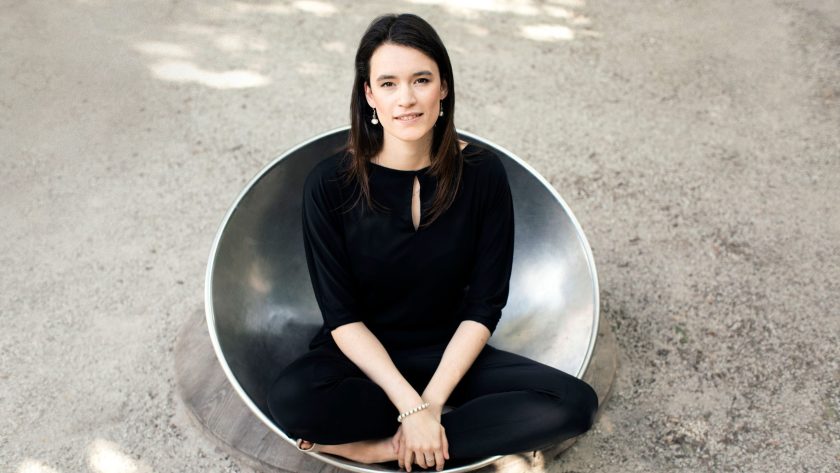
Who or what inspired you to pursue a career in music and who or what have been the most important influences on your musical life and career?
I was fortunate to grow up in a household full of keyboard instruments: three harpsichords, a clavichord or two, an upright piano and eventually a house organ. My father is an early keyboard specialist, performing for a long time with London Baroque and then Florilegium, as well as holding professorships at the Royal Academy of Music and the Royal College of Music. Summer holidays were often spent at whatever European festival happened to be paying, and my brother and I enjoyed bringing the average age down in concert audiences all over the world!
That said, I was pretty sure I wasn’t going to go into music. Or at least it took me a long time to admit that I wanted to. Singing had become my mode of expression from a very early age, and as a chorister at St Albans Cathedral realised that I needed to keep singing for as long as I could in some form or other; however the idea of committing to trying (and possibly discovering I was useless at) a career in music was pretty scary. I nearly found my way into a biology course at university, but fortunately my wonderful science teacher suggested I might end up regretting not finding out what music could do for me: the science can always wait, he said and I have a feeling you might need to sing now. I’m eternally grateful for him being open minded enough to go against the “get a proper job and keep music going on the side for a while…” approach to life that so many adults around me seemed to espouse. In his mind, the world would always need and train scientists, but it was possibly less likely to see people jump forward and want to give their life to music. I don’t know what he saw that made him think that was me, but I needed to hear someone say those words. And fortunately, he was right – I really needed to sing.
What have been the greatest challenges of your career so far?
I feel that I have spent much of my career so far learning to trust my instincts and be patient with the career I am building! However often one reminds oneself that Rome wasn’t built in a day, sitting patiently to see the hard work you have sown slowly come to life can be a frustrating process as times. Ambition and imagination of what’s possible is such a vital part of making music, but to learn to see the bigger picture and build a career of decades is the bigger (and always on-going) challenge.
Which performances/recordings are you most proud of?
I’m most proud of something, which at time of writing at least, has yet to be released! My newest album A Poet’s Love, with Sholto Kynoch (piano) arrives into the world on 8th May on BIS records. At its centre is a Schumann Dichterliebe, a magical song cycle that Sholto and I have spent the last few years working on together. This album is the first of three exploring Schumann song cycles and each of the upcoming recordings aims to shine a slightly new or unexpected light on the cycle in question as the result of my programming choices on the rest of the album. For A Poet’s Love, the entire album sets poetry by Heinrich Heine (the poet to whom Schumann turned for his texts of Dichterliebe). Settings by Schumann’s contemporaries are complimented by an amazing new set of songs by Heloise Werner: Knight’s Dream.
It’s been a real delight to record my version of an iconic cycle like Dichterliebe and a particular privilege to have been given the trust to do so in my own way and with such a special partner in Sholto. It’s a special recording and I can’t wait to watch it take flight this year.
A little taster here:
Which particular works/composers do you think you perform best?
The answer to this is almost always what I just sung or what I’m currently obsessing over in the practice room. Recency bias! That said, I always feel a sense of homecoming when I return to Bach’s music: one of the rituals of my performing year is returning to his John and Matthew Passions with wonderful frequency. I feel a similar sense of belonging and ease whenever I sing Mahler’s music – I know I am exactly where I should be.
How do you make your repertoire choices from season to season?
A small number of repertoire choices are active choices, but most are opportunities that come your way and have the good fortune of filling time in an open diary. Sometimes things can’t work out for one season and you just have to trust they will come back for another.
In my recital work, I aim to be very disciplined to have just one programme on the go for the season – next up for Sholto and I is Schubert Die Schone Mullerin, for example – and often promoters are keen to programme what you have to offer. Other times people come to me with very specific collaborative ideas and are looking for new programmes (or things you have done before) to be part of their programming. That’s also a great joy and often the start of new and wonderful things – my album with Toby Carr called Battle Cry came about as one such collaborative idea from the Sound Unbound Festival at the Barbican. We were asked to present something new for voice and theorbo but hadn’t got any modern repertoire, and so began an exciting commissioning project with Owain Park that ended in a wonderful album and a BBC Music Magazine Award and a Gramophone Award.
Opera roles are dependent upon what people are looking for and how you can fit into those plans. I return to Dido with great regularity, but so far that is the only role that keeps coming back. I hope that Sesto in Handel Giulio Cesare will return a lot in years to come (I debuted the role last year the Gran Teatre del Liceu in Barcelona) and most recently I created the role of Marianne in Michel van der Aa’s Theory of Flames at Dutch National Opera, which will be revived at the Bregenz Festival and other houses over the coming years.
With orchestras there are pieces that I return to annually: Bach Oratorios, Handel Messiah, Mendelssohn Elijah and Elgar Dream of Gerontius to name but a few, and there are so many things that are on the want to sing list which one has to hope will find their way to you in their own time. (Mahler 3 has just made it into my calendar for the first time in 2027, so will move from one list to the other!)
Do you have a favourite concert venue to perform in and why?
Different venues live in the memory for different reasons: the beautiful acoustics of the Kölner Philhomarnie, mixed with the perfectly timed arrival of a small Kölsch into your hand as you step off stage, and the fact that it’s necessary for the building (amazingly designed and cleverly underground) to have security guards on the pavement above to stop people walking over the roof when a concert is happening, make it a favourite. The extraordinary statues of the Graces all around the stage at the Palau de la Musica in Barcelona, staring down out you rather wildly whilst on stage, mixed with the brilliant tapas approximately 30 steps from stage door, is also high up there. Versailles Opera House has a special place in my heart, because I sang my first Dido there, and have never forgotten the feeling of that first real life Dido’s Lament. The Holywell Music Room in Oxford is completely addictive because you can sing the quietest notes ever and hold the audience in the palm of your hand by just the smallest of smiles.
What do you do off stage that provides inspiration on stage?
Spending time with and chatting to people that I love, reading books, trying to go to see as many concerts/productions as I can (but never getting quite getting to see everything I want to!) and taking time to think about things other than music, if at all possible. Slow days at home, running, cooking for friends and enjoying the space my husband and I have made for ourselves (and the endless consideration of a new paint colour or reorganisation of furniture for some room or other) always rejuvenate me!
What is your most memorable concert experience?
One of the most ineffable concert moments – where magic just happened – was at The Opera City Concert Hall in Tokyo, for a (very jet-lagged) performance of Bach’s John Passion with Bill Christie and Les Arts Florissants. It has the most extraordinary (perfect?) acoustic, and the most attentive of audiences were in attendance. For 2 hours the stars aligned and for some reason that performance was like no other. It was also the end of a long trip and we went to the airport straight after the concert to endure was one of the worst flights home ever, with a freak snowstorm in Europe on the way home, and I spent an unplanned night in Frankfurt airport trying and failing to get back to Heathrow. From the sublime to the ridiculous…
As a musician, what is your definition of success?
To always be growing and learning. Nothing is static in music: there is always more to be found and enjoying the shifting sands is the place I hope to always be.
What do you feel needs to be done to grow classical music’s audiences? What’s the one thing in the music industry we’re not talking about which you think we should be?
I’ve tied these questions together, because I think the same answer applies. I recognise it isn’t necessarily practical advice for bums on seats, but I do think there is a sense of urgency to really make sure we have music and the creative need for it at the forefront of our minds always. As an industry, we need to have the bravery to trust the music itself to be its own biggest advocate. Not everything needs contextualising – and certainly nothing should be pre-emptively apologised for – music speaks and we are the conduit for its message. People will (and do) listen and they will respond in the way they want to respond!
What advice would you give to young or aspiring musicians?
Listen to as much as you possibly can, go and see as much as you possibly can. There is so much music and so many amazing artists out there so keep your ears and eyes open to what is possible. Find out what you have to say and say it.
A Poet’s Love is released on 8 May on BIS records
Discover more from MEET THE ARTIST
Subscribe to get the latest posts sent to your email.

