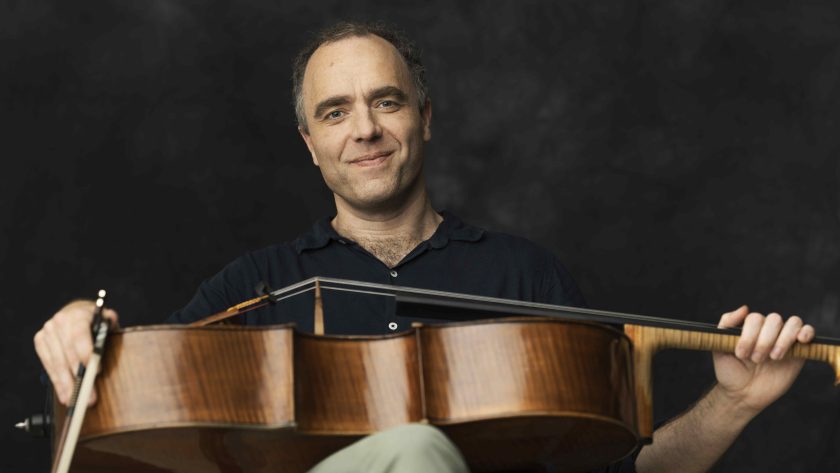
Who or what inspired you to pursue a career in music and who or what have been the most important influences on your musical life and career?
I grew up in a musical family and was exposed to it from a very young age. My father, Alfred Brendel, was a famous concert pianist who practised a great deal. I loved going to his concerts as a young boy and indeed until he retired in 2008. Eventually I took to the cello after an abortive attempt at the piano. My mother had been an accomplished organist and was involved in musical circles in London. Performing was quickly intoxicating for me, as was the sense that I had found something to give me a distinctive voice.
As a teenager my listening branched out into other genres. I was very happy listening to a record by Pablo Casals followed by some Sonny Rollins or Herbie Hancock. I had some wonderful cello teachers too who shaped my playing immensely, including William Pleeth who was a kind of musical grandfather to me.
What have been the greatest challenges of your career so far?
Finding your own niche with a famous parent is a challenge for everyone in that situation. It took me quite a while to figure out what that was and how to do it. I have ended up balancing performing with teaching and programming and creating festivals which has become a fulfilling life for me. Being a performer is a very strange profession in general – you live cheek by jowl with disaster but it pulls you back again and again.
Which performances/recordings are you most proud of?
In recent years I have recorded a lot with Nash Ensemble, one of my regular groups, that gives me great pleasure.
Which particular works/composers do you think you perform best?
I’ve tried to be as versatile as I can! There is so much great music to explore. I guess I might be better known for the Central European classical and romantic repertoire, and also for contemporary music. I’ve been lucky to work closely with some fantastic composers such as György Kurtag and Harrison Birtwistle.
How do you make your repertoire choices from season to season?
It’s a mix of impulses that inspire those choices – something you have recently found that has really lit a fuse, something you are asked to do, and things different creative collaborations can yield. I like to be open to new work and ways of doing things wherever possible.
Do you have a favourite concert venue to perform in and why?
In no particular order: Carnegie Hall, Teatro Colon Buenos Aires, Wigmore Hall (which is a home from home these days), and too many smaller venues to mention. For me, performances in intimate spaces are often the most personal and memorable.
What do you do off stage that provides inspiration on stage?
Hang out with my family and switch off from things. Recharging is essential. Teaching is a fantastic way to explore a work from a different angle. You can learn so much from your students and without the instrument in hand.
What is your most memorable concert experience?
It’s impossible to narrow it down to one highlight. I remember appearances at Carnegie Hall and Teatro Colon Buenos Aires in past years with great fondness. In other contexts, playing a duo with Patti Smith was an out-of-body experience. As was being on stage with Baaba Maal in Senegal.
As a musician, what is your definition of success?
Loving what you do, and bringing that across.
Tell us more about the Tree of Strings festival in Dorset.
This is an ambitious project that my partner Ellie and I have thought about for a long time. We are cross-pollinating three principle aims: bringing music educational projects into local schools that need them, providing performance and educational opportunities for talented young musicians at the start of their careers, and bringing established artists to the south west to perform and work with our young artists and schools. Our first festival in Abbotsbury in July is s snapshot of how we are working in this way.
What was the motivation for creating this festival and what do you hope musicians and audiences will take away from it?
We hope to connect new audiences in spaces where everyone can feel welcome. Music can be very tribal and exclusive. There is so much great classical music that people feel alienated from because they don’t feel it’s for them. The same can be true of jazz and improvised music. The idea is to have a variety of interesting and contrasting musical events that cross genres and expand people’s musical horizons. It’s just music, and should be there for everyone to listen to on their own terms.
What’s the one thing in the music industry we’re not talking about which you think we should be?
The increasing shortfall of music education in schools. This is of course a subject in the profession but hasn’t registered nearly enough on a larger scale.
What advice would you give to young or aspiring musicians?
Be open; learn to listen; be aware of what your peers are doing; and delight in the small details.
What’s next? Where would you like to be in 10 years?
Specifically, I’d like to help grow Tree of Strings into an entity that can benefit as many people as possible in the south west through more educational projects and performances. The way we live online now makes live music like this feel almost like counterculture. In my view, we need it more than ever to balance our lives healthily and inspire us to slow down sufficiently to really listen and be.
The inaugural Tree of Strings festival takes place in Abbotsbury, Dorset, from 3 to 5 July.
Discover more from MEET THE ARTIST
Subscribe to get the latest posts sent to your email.

