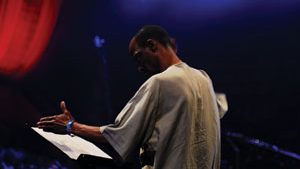
Who or what are the most significant influences on your musical life and career as a composer?
My musical influences are numerous and varied. They range from my local background, upbringing, some of the musicians/composers I have worked with and admire, to my educational encounters.
I was born and bred in Soweto and my home in Orlando West was about 400 metres from one of the notorious single-sex hostels in the country, the Mzimhlophe Hostel. Before gaining notoriety, the hostel was a home to several national groupings such as the Bapedi and Amazulu. The Bapedi had weekly traditional dances on Sundays. Their traditional dance called KIBA was in full displays and that unconsciously created a permanent sonic ‘watermark’ in me. The inherent hocket technic of Kiba has become part of my compositional identity.
Motsumi Makhene, one of South Africa’s resilient cultural activists, student of African music and composers, introduced me to the idea of including MBIRA figurations as part of my compositional armoury. He also heightened my consciousness and love for the late Phillip Tabane of the Malombo Jazz Men. The latter demonstrated a refined fusion of Bapedi traditional music and jazz. It is that stylistic confluence that has become central to my compositional approach.
Growing in a township like Soweto exposes you to diverse musical styles. Chief amongst those is jazz, gospel and western art music. As a result, I have composed music that reflect my embrace of these styles.
What have been the greatest challenges of your career so far?
Being a Black composer, born in apartheid South Africa, is your first hurdle. From the onset of your compositional career, you are confronted with structural and systemic barriers. In terms of choral music, you will soon realise that the South African choral fraternity is racially divided and central to that division is the issue of ‘sound’ or tonal quality. In addition to that, you will be confronted by compositional choices that further define or amplify this division. Composing for a Black choir demands you to understand and embrace sonic experiences and stylistic elements of Black choralism.
You will also have to understand that at the core of this choralism is the dominance of the operatic and oratorio(ic) choices Black choirs have made. Black choirs would easily embrace a composition of a Black composer that infuses these ‘classical’ influences. The more a Black composer mimics Mozart and Haydn, the greater the chance of his works getting performed. The more western composition-education he gets eclipses his chances of his works getting performed.
I have had my choral pieces performed by choral groups that reside outside your typical Black South African choir. The same, to a small extent, can be said with instrumental music. The only difference is that we have fewer Black instrumental groups like string quartets, piano trios, duets.
In essence, Black composers in South Africa, who compose in styles that are not typical to what the broader Black community expects, chances of them getting performed in their communities range from slim to none.
What are the special challenges/pleasures of working on a commissioned piece?
Working on a commissioned piece means that the commissioning agency has made an intentional decision to commit resources to you to create a work. The agency approaches you because they have faith and trust in your compositional abilities and possibly know that you will have something new or different to offer. What adds to the pleasure of this situation is when the artist who will be performing your work will let you know that they love challenges or expect something different.
The only challenge that I have experienced was when the commissioning agency implores you to composition that reflects a particular style. This is scenario that I refer to as ‘outspiration’ instead of inspiration.
What are the special challenges/pleasures of working with particular musicians, singers, ensembles or orchestras?
Establishing creative collaborations with musicians is one of the most exciting experiences. The closer the relationship with the musician/s, the more open and safer it becomes for the composer to try out new ideas. You have the confidence of getting honest feedback on you work.
My relationship with musicians like Xandi van Dijk of the Sigmund String Quartet and Richard Cock of Apollo Music is organic. With Richard Cock, my relationship started in 1999 when he commissioned me to write a short piece for the then National Symphony Orchestra of the SABC. This was followed by a commission for the Nation-Building Massed Choir Festival. My composition for the latter, was out of the stylistic range of what Black choirs normally sing, but he embraced the work and his support, in the midst of resistance from some notable figures, was unwavering. He has since premiered most of my compositions.
Xandi van Dijk was the leader of the Sontonga String Quartet, the quartet that performed my first and not-so-successful attempt in string quartet writing. His comments were encouraging and when I was commissioned to compose Komeng, his comments gave me insights and my understanding of string quartet writing was significantly better.
Of which works are you most proud?
Komeng (string quartet) and Cantus in Memoria ’76 (choir and orchestra)
How would you characterise your compositional language?
My compositional language is eclectic and reflects my musical journey and experiences.
How do you work?
I am a bit haphazard due to my other professional activities like teaching and working with community and church choirs. However, I do deliver on agreed times, with occasional negotiations for a day or two extensions.
As a musician, what is your definition of success?
Expanding my network and maintain professional relationships.
What advice would you give to young/aspiring composers?
Respect for the profession and musicians. Listen more (diverse styles) and compose ‘less’.
What do you feel needs to be done to grow classical music’s audiences?
Obliterate elitism and be inclusive of diverse musical styles in our compositions. However, this should not necessarily mean compromising an individualised compositional style.
What’s the one thing in the music industry we’re not talking about but you think we should be?
The erasure and exclusion of composers of African descent in mainstream concert programmes, symphony seasons, curricula. This is firmly fixed to the periphery of universities and concert/festival platforms.
What next – where would you like to be in 10 years?
I am currently 63 years old. It would not be a bad idea to retire into full-time composition.
What is your idea of perfect happiness?
Seeing young people thrive. Giving support to my wife and kids (two).
What is your most treasured possession?
My family.
What do you enjoy doing most?
Teaching
What is your present state of mind?
Unhappy with geopolitical developments and how they affect ordinary people.
The African Concert Series returns to London’s Wigmore Hall on Saturday 27 June with Freedom Songs – a day of concerts dedicated to the 50th anniversary of the Soweto Uprising. Music by Mokale Koapeng will be performed by Leon Bosch and the Ubuntu Ensemble. Find out more
Discover more from MEET THE ARTIST
Subscribe to get the latest posts sent to your email.
 MEET THE ARTIST