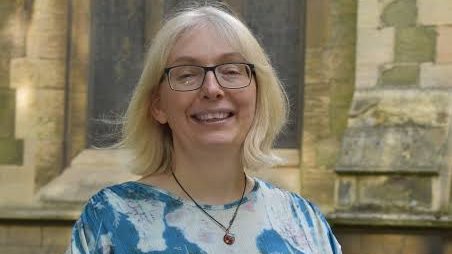
Who or what are the most significant influences on your musical life and career as a composer?
I owe a lot to the late Dr Isobel Preece, who taught me counterpoint, and who sparked my interest in Josquin and other Franco-Flemish composers. This has been foundational to the development of my own style.
What have been the greatest challenges of your career so far?
I am autistic, but did not know until I was diagnosed in my forties. The diagnosis has helped me to deal better with the social and emotional sides of working as a musician.
As a composer, the hardest initial hurdle is to get music performed, and performed well. You learn so much from observing how your music is rehearsed and how it comes over in performance, but like many other composers obtaining that experience was not easy. A breakthrough for me was to crowdfund the recording of an album of my pieces. Of a Rose was a motley combination of one-man-choir recordings made by Matthew Curtis and other recordings, but it provided a demonstration of my music that has opened up doors. I am deeply grateful to the kind support others gave me for that project!
Again, like many other composers, I am highly familiar with the ‘Dear composer, thank you for your submission. We were excited to receive more entries than ever before…’ kind of rejection letter. They tend to arrive many months after you have forgotten about submitting a piece for a particular call or competition, and always when you’re feeling a bit down anyway. It can indeed be hard to pick yourself up and keep trying. But then you learn that there are other ways to achieve success…
What are the special challenges/pleasures of working on a commissioned piece?
It’s motivating to know that the piece is going to be performed and at a specific occasion. It’s very flattering to receive a commission, since it is an expression of liking for one’s style and confidence in one’s ability to get the job done.
I like to get started early on, making sketches and working out the overall shape of the piece. The best part is when I have completed a first draft, because that means I will definitely be able to deliver. After that, I can spend many hours making the piece just so, until I am fully happy with it. I absolutely love the process of editing and refining pieces once the initial composing phase is complete.
What are the special challenges/pleasures of working with particular musicians, singers, ensembles or orchestras?
If I’m writing for a specific musician there can be a tension between wanting to show off their abilities to the full while respecting the needs of the composition. The ‘money note’ or signature technique has to sound like an integral part of the work.
Of which works are you most proud?
Definitely, Noel: Verbum Caro Factum Est. I am also pleased with Ikon of the Innocents, and my organ Toccata in A minor, which seems more than the sum of its parts. Of course, there’s Alleluia! Immortal Babe, which has just been published by the RSCM. It was thrilling for me to hear the final page ring out in Wells Cathedral and sound just as I had imagined it. I think any composer feels happy when they try a gambit and it pays off.
How would you characterise your compositional language?
I call my style ‘ancient and modern’ because it combines techniques and language drawn from early music with more contemporary attitudes. The important thing for me is that the diverse elements must support each other. I am not interested in ‘mash ups’ or the ironic juxtaposition of styles. I want to create something new by bridging the language of the past with forward-looking trends. This can be done in many ways. For example, Noel: Verbum Caro Factum Est was initially inspired by Busnois’s Noel, but probably owes something of the kind of funky pop music I sometimes like to listen to!
I value counterpoint highly and try to give each part something interesting to do. I often prefer a slightly spare, clean harmonic soundworld, but it is fun if I can contrive a really biting chord as independent contrapuntal parts collide.
How do you work?
I start with sketches and move on to drafts. I often like to come up with a rough complete draft and then refine it obsessively. I use paper and pen for the messy act of initial creation, but find scoring software useful for the refining stage. Pens are good for the first stage because you can’t easily erase what you write, so you just have to write something, anything. Often, that sparks flow, and it’s better to have something written than nothing, because even the most threadbare ideas can be improved.
As a musician, what is your definition of success?
If I can write a piece that achieves my aims, then I am satisfied. If my music is programmed, I feel gratitude and pleasure, and if the music is well-received then that feels wonderful. It’s especially satisfying to hear that people enjoy performing my work. But, to reiterate, success means writing the music you want to write.
What advice would you give to young/aspiring composers?
Be very determined and put a lot of thought into it. Don’t be disappointed if things don’t always work out the way you had hoped, but rather learn what you can. Be kind and supportive to other composers and musicians.
Work hard to obtain mastery of the technique. You should study counterpoint even if you plan to focus on melody plus accompaniment textures. Counterpoint teaches one to be inventive and skilful with patterns—if you look at a piece by J.S. Bach you will often find he bases it on a highly restricted set of basic (and I mean basic!) figures or motivic cells, but how rich and involving the world he created! Studying technique gives you full power to say what you want to say, and stops you from falling into so many pitfalls where the music doesn’t sound quite the way you wish, but for reasons unknown. It’s fine to write a consecutive 5th if you know you’re doing it and want the sound, but it’s amateurish to do it by accident.
If possible, learn to improvise music that sounds like composed music. This is a good way to get a musical language into your bones. I have been practising organ improvisation over the last year, focussing on such things as cadences, circle of fifths progressions and sequences, and making simple fughettas. It doesn’t have to be anything special, but improvisation can help you to develop fluency. Put another way, do you really know what a Neapolitan 6th or a cadential 64 is if you can’t produce one readily at the keyboard? I’d say 90% of composing is knowing the ordinary stuff inside out, so that you can expend more energy on coming up with something special when you need to.
Only enter calls for scores and competitions that ask for pieces that you want to write, as it’s a waste of time trying to compose something in a genre that isn’t a good fit for you. The chances of rejection are between very high and near certain, but if you can compose a piece that satisfies you then you have achieved something. Be wary of exploitative calls that ask for larger-than-token entry fees or for long pieces for unusual combinations. I don’t like to see so-called opportunities that turn out to be a way of obtaining composers’ work for free.
When I was young, a lot of emphasis was placed on being original and speaking to the present time. I disagree with much of that. The best way to be original, if it’s possible, is to compose the music that expresses what you want, which can be anything: a fascination with particular harmonies or rhythmic structures, a melodic turn that pleases you, or something outside of music such as a religious or political conviction. What could be more authentic as a creative voice than to write what you think to be beautiful? As for writing for the time, it’s the fastest way to become dated. Honestly, to me Vivaldi sounds fresher than a lot of electroacoustic music!
What do you feel needs to be done to grow classical music’s audiences?
Don’t try too hard to be trendy. Let classical music be welcoming and accessible for sure, but for heaven’s sake let’s not sacrifice the best of concert traditions and etiquette.
I think good programme notes or an engaging compère can be of enormous value. However, these should speak less of the composer’s life and times, and much more about what to listen for. If people can feel that they have understood the music, they’re more likely to want to come and hear more.
What’s the one thing in the music industry we’re not talking about but you think we should be?
Music needs to be open for all. I don’t have the answers, but it’s a pity that music lessons and good musical instruments tend to be out of reach for many young people.
What is your idea of perfect happiness?
I have been blessed in many ways, but a special memory is of Sarah MacDonald and the choral scholars of Selwyn College singing my carol Tomorrow shall be my dancing day to me on the college lawn after their BBC Choral Evensong in April 2026. To see people taking delight in something that I created felt simply wonderful. Happiness comes from what you can give to others.
What do you enjoy doing most?
Composing or playing music! Away from music, I like puzzles and games very much. I also love animals, especially birds and cats.
Discover more from MEET THE ARTIST
Subscribe to get the latest posts sent to your email.

