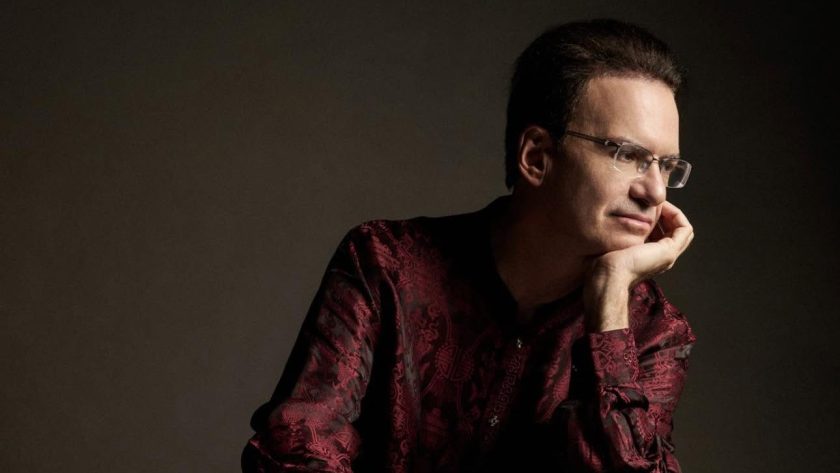
Who or what inspired you to pursue a career in music and who or what have been the most important influences on your musical life and career?
I come from a musical family. My grandfather, Pinchas Hollander, was a lyrical tenor. My mother, Aviva, was an avid and imaginative flute player and teacher. She placed a recorder in my hands as I turned four. The recorder must not have been my cup of tea, and group piano lessons commenced the following year. I remember these early musical experiences not as boring or indifferent pastimes, but as profoundly engaging events.
As a child, I often went to practice at the house of my grandmother Frieda. I never met my grandfather Pinchas, but I certainly became well familiar with his Steingraeber & Söhne grand piano from the 1910s: a lyrical, sensitive, and soulful instrument. That instrument was built in Bayreuth, with considerable differences in the timbre of each of its registers. I believe, in retrospect, that much of my current interest in historical keyboards is rooted in the experience with the Steingraeber piano, markedly different from some of the mass-produced pianos I later encountered.
My father, Dan Tsalka, was a well-known writer and intellectual, who published more than twenty-five books. Among these were long novels and numerous collections of essays, short stories and poetry. Dan was highly passionate about music, particularly the compositions of W. A. Mozart and J. S. Bach, which we often heard and discussed at home. It was very common for painters, philosophers, sculptors, architects and writers to visit Dan. The dialogues I overheard at home were always fascinating, stimulating my curiosity.
By the time I was fourteen, I was a somewhat extravagant and romantic adolescent. I began practicing at five in the morning, and carried a pendant everywhere with the picture of my favorite pianist, Dinu Lipatti. I spent magical hours with my parents’ collection of old LPs and music scores. I dressed wildly, skipped school to enjoy the sea shore and to read Nietzsche, Plato and Tolstoy. I spent the nights roaming with friends, sustaining vehement and improbable conversations.
During the University years, I was not known for my docility. I had strong concepts, which on occasions provoked conflicts with my professors. Later on, as I pursued virtuosité studies in Germany and Italy, I ran into various sorts of trouble. I found that it was not as simple as I imagined to be a foreign student, a free-lancer and economically independent at the same time. There were many times that I went to bed rather hungry. Still, I was determined to become an artist and a professional pianist, and no sacrifice seemed too large to achieve this.
Following these adventures in Europe, I continued and concluded my studies in the USA. Highly important professors and mentors there were Prof. Joyce Lindorff, Prof. Lambert Orkis, the late Prof. Harvey Wedeen. I shall always be highly grateful for their humanistic, highly detailed and excellent mentorship. During those six years at Temple University, another inspiring, brilliant Professor was Michael Klein, who taught me the rudiments of composition and how to think in a deeper fashion.
What have been the greatest challenges of your career so far?
Interpretation, which is an exercise full of contradictions! It demands, on the one hand, a rigorous mastery of the technical, expressive and stylistic details of the score, and on the other hand the expressive generosity and communicative gregariousness of the interpreter’s free, artistic spirit. As an interpreter one must have the flexibility to react on the spot to the subtleties of each individual performance, taking into account, among other things: the acoustic characteristics of the space, the peculiarities of the instrument and the disposition of your audience. When early keyboards are involved, weather and intonation can also can play a key role. To achieve a perfect balance between all variables at hand is next to impossible. The true interpreter must convince himself/herself that all of them are a part of his/her own nature if s/he is not to be inhibited during the performance.
Which performances/recordings are you most proud of?
I have always been attracted to uncommon, unique repertoire, with a strong belief that one should explore unknown works in depth. As a young freelancer in the 1990s, I played several recitals of Mendelssohn’s piano music, performing many of his lesser-known works (not the few- gorgeous and essential as they are – compositions that we hear constantly). My desire was to play them with conviction and spirit, inviting the audience to listen and reconsider their beauty and value.
During the last two decades, I have made a humble contribution to our understanding of the diversity of keyboard repertoire during the Classical and Early Romantic Eras by locating, editing, publishing articles and recording CDs of unknown compositions by Daniel Gottlob Türk, Carl Ditters von Dittersdorf, Ferdinand Ries, Joseph Anton Steffan, Eucharius Florschütz, Ignaz Moscheles and Johann Baptist Vanhal.
Another cherished project involved the recording of Viktor Ullmann’s seven piano sonatas, released by the Paladino Label in 2014. When I first played these works, I was struck by how immediate and contemporary Ullmann’s musical language felt under my fingers. Here was a composer who in the 1930s and 40s had already found a convincing, personal balance between the innovations brought by the atonal and dodecaphonic systems of the Second Viennese School and the rich heritage of Western Art music since the time of J. S. Bach. The compelling narratives and abundant rhetorical gestures of Ullmann’s music resound, for me, an artistic world enriched by compromise, imagination and diversity; a world, which unfortunately for the composer and thousands of other European artists of the period, was far away from the political and social agenda of the Nazi regime. Ullmann’s sonatas are thus rare surviving representatives of a rich and open course of development for Europe’s music, regretfully obliterated by the savage violence of World War II and its aftermath. If the sonatas of Viktor Ullmann feel contemporary to me, it is also due to the fact it has taken more than half a century for European art music to recover from the impoverishment brought by the “cleansing” cultural and ethnic practices of those times.
More recently, I am delighted with CD releases, which I would like to enumerate:
· Violets are Blue (2026), Full Moon (2025), Last Dance (2024):
These CDs were released by the excellent Australian label Wirripang, in collaboration with harpsichordist and fortepianist Dr. Diana Weston. In each, one can find duo works from the Baroque and the Classical Eras, intertwine with contemporary compositions, often times dedicated to us by fabulous women composers, among them Prof. Diana Blom, Elena Kats-Chernin, Ann Carr-Boyd, Prof. Violeta Dinescu.
· Aurora Borealis (2025): a CD released by the Mexican label Tempus Clásico dedicated to the early keyboard compositions by the extraordinary Mexican composer Prof. Leonardo Coral (b. 1964).
· La Escondida (2026): a CD released by the New Zealand label Rattle, presenting Franz Schubert’s hypnotic first dances and his monumental final Piano Sonata in B-flat major, D. 960.
· J. S. Bach’s The Art of the Fugue, BWV 1080 (2026): a double CD released with the extraordinary label Da Vinci Classics, and, of course, a grand challenge for the modern pianist!
· Bachian Elegies (2025): a CD released by the Viennese label Paladino, presenting a thematic project conceived during the darkest days of the pandemic. La Escondida, Bachian Elegies, Aurora Borealis, and The Art of Fugue were supported by a grant from CUHK-SZ, for which I am thankful!
· A series of video recordings dedicated to four-hand works by Franz Schubert, in collaboration with Japanese fortepianist Megumi Tanno, and released on YouTube in June 2026. Ms. Tanno and I performed the works on an 1830 Rosenberger Romantic Piano in mint conditions. These videos were watched over 300 000 times!
Which particular works/composers do you think you perform best?
In each of my performances, I attempt to provide my very best, and most serious of my interpretations. My highest admiration, at the moment (and thus much attention) is provided to J. S. Bach, W. A. Mozart, F. Schubert and J. Brahms.
How do you make your repertoire choices from season to season?
I am considered, at present, a specialist of J. S. Bach, the Classical Period and the Early Romantic Era; a reputation, which I relish, but does not cover the variety of my interests. I love to perform on the modern piano and on historical keyboards (i.e. the harpsichord, fortepiano, clavichord, chamber organ and square piano), presenting solo and chamber repertoire from Antonio de Cabezón to our days (circa 500 years!). Since this versatility is rather rare, I have considerable freedom to choose the projects which I wish to pursue – for which I am thankful.
I also relish modern or contemporary music: I have had the pleasure of collaborating with numerous composers worldwide in a variety of circumstances. More than 90 works were dedicated to me, and I have been privileged in performing their world premieres.
Do you have a favourite concert venue to perform in and why?
I consider each concert a new, exciting event. Of course, each performance also bears a grave responsibility. That is regardless if I play for an audience of five, five hundred or five thousand individuals. I have been fortunate in performing in great halls, such as the Hall of Central Harmony in Beijing Forbidden City, Bellas Artes Theater in Mexico City, the Hermitage Museum in St. Petersburg, the Metropolitan Museum in New York, Museo de la Música (Barcelona), the Mozarteum in Salzburg, Kunsthistorisches Museum in Vienna, Concertgebouw in Amsterdam and the ElbPhilharmonie in Hamburg, yet some of my favorite venues have been small and intimate, for example the Eisenstadt Musikhochschule, the Muenster Theatre, and the Collection of Early Keyboards at the School of Music at Auckland University. Perhaps what I most relish is to perform with extraordinary musicians such as flautist Bridget Douglas, cellist Yiqiu Chen, and mandolinist Alon Sariel.
What do you do off stage that provides inspiration on stage?
I am an admirer of reading classic literature and visiting museums. I enjoy wandering around beautiful cities for hours, discovering the immense beauty of their different neighborhoods. I love long walks in parks and woods. A hobby of mine is to listen to recordings from the early twentieth century, as I stroll. I feel humbled by their variety, level of imagination and unique expressivity; they bring my own musical thoughts into deep perspective.
What is your most memorable concert experience?
Performing in concert halls with a glorious musical tradition and history, where many of my musical heroes were celebrated, such as: The Hermitage Museum in Saint Petersburg, The Grosse Saal of the Mozarteum in Salzburg, Bellas Artes Theatre in Mexico City, ElbPhilaharmonie in Hamburg, Metropolitan Museum of Art, etc.
As a musician, what is your definition of success?
Having sufficient time to practice (a cause of marvellous contentment!). Becoming slightly better every day as a musician, a pianist and early keyboard performer, an educator, a thinker. Finding the few persons who can truly understand what I am endeavouring to create, and teaching the next generation the true meaning of music.
What do you feel needs to be done to grow classical music’s audiences?
Since 2019, I teach in Shenzhen, China during the academic year, and tour the world for the rest of the time. My strong commitment as a performer and educator (not only in China but also in a vast majority of Western countries) is to challenge audiences and students – to reach a higher level of enlightenment and confidence, to hopefully learn to embrace again the incredible beauty and truth contained in Western Culture and Classical Music.
What’s the one thing in classical music we’re not talking about but you think we should be?
The undeniable importance of Classical Music for the future of our societies, for our happiness and advancement as individuals, and also for our ability to understand ourselves, and have a more sensitive and generous perception of each other.
What advice would you give to young or aspiring musicians?
Here are some points I urge young or aspiring musicians to consider carefully:
· Learn all that you can about music.
· Find a Professor who can teach you with excellence and detail. A mentor who can see your potential, appreciate and cultivate it. That, in my opinion, is many times more important than a famous name of a conservatory or a music school.
· Play and listen to not only your instrument, but to other instruments, as well, and not less importantly, to great singers.
· Become a fantastic sight-reader. This will serve you marvellously on many fronts.
· Read musical treatises and letters from each musical period! Musicians from the past share with us many stylistic and artistic truths and secrets that we have forgotten.
· Listen to great recordings from the past. Follow along with the score and learn how musical tastes have changed (sometimes not for the better) and the limits of musical notation! And possibly most importantly: Love music. Then all shall be solved, and fulfillment shall ensue!
What’s next? Where would you like to be in 10 years?
I love teaching: It is a highly important part of my life. At the School of Music of CUHK-Shenzhen, we have at present an outstanding piano and keyboard department, led by the distinguished pianist, Prof. Krzysztof Jablonski. It is a large department, which includes outstanding performers and pedagogues from Mainland China, Italy, Korea, Russia, and Japan/U.K. CUHK-SZ now offers doctoral degrees in piano performance. I am looking forward to supervise the projects of piano doctoral students in Shenzhen, and hope to be of service to the next generation of musicians.
I wish to keep my concert activities in full swing. Each new project is a challenge, providing me with renewed energies. I also intend to record 7 or 8 CDs, at least. All projects are already living in my mind. I wonder if God will be as generous as to permit these visions to come to full fruition!
My commitment to the world of historical keyboards shall continue. At CUHK-Shenzhen we now have a Double Manual Mietke Harpsichord, built by Bruce Kennedy – one of the finest harpsichords in Mainland China. We also have a clavichord by Akihiko Yamanobe (Japan), and a Baroque organ, built by one of the finest builders in Austria. I hope to achieve much with these instruments on campus. Words can hardly communicate the emotions one experiences when approaching a historical keyboard for the first time, particularly one that has been restored by masterful hands, or that has somehow survived the multifarious indignities of time. Humility, curiosity and excitement, mix with a sense of privilege and fascination as one discovers with each new musical phrase the unique personality of the instrument. For example, I had the pleasure of playing at the European Fortepiano Museum and Academy (EFM) in Germany, led by my friend Pooya Radbon. An invaluable experience! I hope to repeat this pleasure many times. And on a similarly important note: I hope to enjoy more precious time with the people I love and with dear friends.
Discover more from MEET THE ARTIST
Subscribe to get the latest posts sent to your email.

