Who or what inspired you to pursue a career in music, and who or what have been the most important influences on your musical life and career?
My parents claim I was making a frightful racket on a toy fiddle before I could properly read. I suspect they encouraged me in the hope that one day the racket might become music!
I can’t remember making a conscious decision to become a musician; by the time such decisions were expected of me, music had already occupied too much of my life to contemplate abandoning it.
I’ve been fortunate in my teachers, and Mr Hines has influenced me considerably too. He may be a pianist, but his wisdom is by no means confined to the piano. He has taught me a great deal about phrasing, structure and, above all, the importance of listening.
Playing with other musicians has probably taught me as much as anything. Theo [Browne, pianist] and I have played together since school, and I honestly can’t imagine making chamber music with anyone else. I also played in the orchestra while at university. You learn very quickly that having a fine technique is only the beginning…
What have been the greatest challenges of your career so far?
Learning patience. The violin rather encourages impatience when you’re young. You want brilliance, speed, a great sound – all the things that make people notice you. It takes rather longer to discover that music is not improved simply by drawing attention to oneself. Chamber music has been very good for me in that respect. One has to listen, compromise and occasionally concede that somebody else’s idea is better.
What are you working on at present?
The Franck Sonata in A, Brahms D minor Sonata, Saint-Saëns’ D minor Sonata, Beethoven Opus 96, various bits of Kreisler – and persuading Theo that audiences occasionally enjoy hearing something cheerful.
What do you enjoy most about performing?
Everything. The atmosphere backstage, the audience settling into silence, the feeling that anything might happen. It’s gloriously unpredictable.
Do you suffer from performance anxiety?
Not particularly. Theo worries enough for both of us!
Which performances are you most proud of?
I’m not sure pride is quite the right word. The performances I value most are those in which one feels unusually free – when all the preparation has done its work and you cease to be conscious of it. That happens particularly in chamber music. There are evenings when everybody seems to breathe together and the music acquires a life of its own. One spends a great many hours practising in the hope of achieving a few minutes like that.
Which particular works or composers do you think you perform best?
Beethoven suits me very well. His duo sonatas for violin and piano demand a genuine partnership between the instruments, which I enjoy enormously. The ‘Spring’ Sonata (Op. 24) has been part of my life since I was a boy, and I don’t think I shall ever tire of playing it. Brahms too. There is such richness in the violin writing, but one must resist the temptation to make it excessively rich. (Mr Hines is very severe about what he calls “wallowing”!)
I enjoy Bach enormously. Bach rather exposes one’s bad habits, which is probably why every musician ought to return to him regularly.
What do you do off stage that provides inspiration on stage?
Anything that gets me out of doors. I walk and sail when I can. Dorset, where my family live, is particularly good for restoring one’s sense of proportion. After several weeks of rehearsals and concerts, a day on the coast reminds you that the success or failure of a semiquaver is not a matter of national importance.
I like company too. Musicians can become terribly enclosed if they’re not careful. I enjoy meeting people who know nothing whatever about sonata form and have no wish to learn.
As a musician, what is your definition of success?
To become the musician you are capable of becoming. The important thing is to continue improving – to acquire better judgement as well as better technique.
And to retain one’s pleasure in music. If playing becomes merely a means of securing the next engagement, something has gone badly wrong.
What advice would you give to young or aspiring musicians?
Learn to listen.
We are all taught to listen to ourselves, but that isn’t quite the same thing. Listen to the other musicians around you. Listen to singers. Listen to orchestras. Listen to the difference between a phrase that is merely correct and one that actually means something.
Practise intelligently. Technique matters enormously, but it is a means, not an accomplishment in itself. Play chamber music whenever you can; nothing exposes selfish playing more quickly.
And find musicians you trust. You don’t have to agree with them all the time – in fact, it’s probably better if you don’t. But when the performance begins, the argument must be over – then you play together.
What is your most treasured possession?
My Bergonzi violin. Without question.
I realise that’s the obvious answer for a violinist fortunate enough to own one, but I should be an extraordinary fool to say anything else. It’s a magnificent instrument. Of course its age and provenance make it valuable, but one doesn’t think about that when playing it. What matters is the sound. I’m still discovering what it can do.
My family in Dorset are very precious to me.
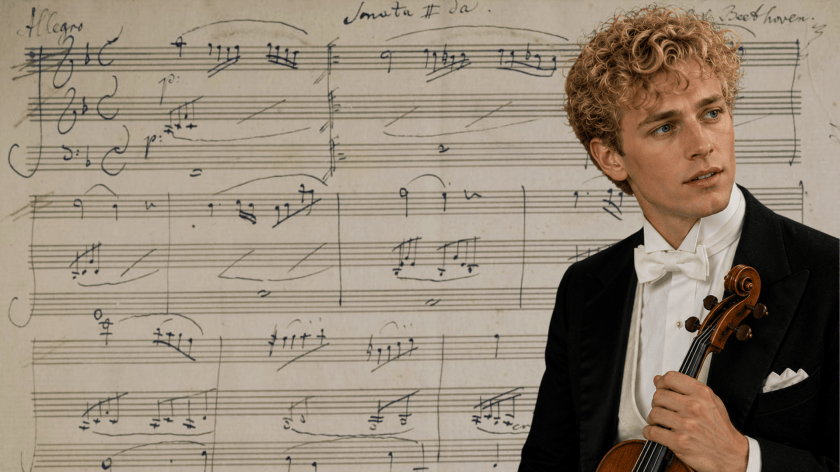
Jonathan ‘Jonny’ Lane-Fox is a fictional violinist and one of the principal characters in Facing the Music, the debut novel by F M Wilson (AKA The Cross-Eyed Pianist). Gifted, sociable and irrepressibly good-humoured, Jonny has been making music with pianist Theo Browne since their schooldays. Their close musical partnership and friendship lie at the heart of the novel.
(Artist image generated by AI)
Discover more from MEET THE ARTIST
Subscribe to get the latest posts sent to your email.

