Who or what inspired you to pursue a career in music, and who or what have been the most important influences on your musical life and career?
Federica: My father taught me to read and sing notes when I was three. I still remember the feeling very clearly: I was not learning something new, but rather recognising something I already knew. I began piano lessons straight away and gave my first public performance at the age of five. As I grew older, however, I began to feel the need for a freer and more complete way of experiencing music, and this gradually became my personal search.
Riccardo: I began playing the piano at eleven. It felt as though I were entering unknown sound worlds and bringing them to life with my own hands. What fascinated me most was music as a form of knowledge.
When we met at the École Internationale de Piano in Lausanne, both drawn by the magnetic personality of Fausto Zadra, we immediately recognised that we were on a shared path of enquiry. Through him, we were introduced to the piano tradition of Vincenzo Scaramuzza, whose pupil he had been, and to a technical approach grounded in the physiology of movement. Neither, however, was an end in itself: both were tools for freeing each person’s unique artistic voice and expressive potential. He constantly encouraged us to explore our inner world more deeply and to seek a transcendent dimension in music. He did so within an atmosphere of cooperation and exchange that was highly unusual in a piano school — and still is.
Since then, this enquiry has become the guiding thread running through all our musical work.
What have been the greatest challenges of your career so far?
Our greatest challenge has been developing and pursuing a multidimensional view of the musician at a time when such an approach was still largely absent from traditional music education. This meant exploring different fields — body-based techniques, meditation, practices of awareness and inner exploration — and integrating them into our work as performers and teachers, despite the scepticism we encountered in the musical world. Paradoxically, an equally significant challenge arose when our work began to spread: it became part of higher music education in Italy and brought us into contact with hundreds of students — instrumentalists of all kinds, singers and conductors.
Riccardo: A major personal challenge was losing the hearing in one ear following damage to the auditory nerve. Many expected the consequences to be severely disabling, psychologically as well. Yet the personal work I had done and the tools I had acquired over the years helped me through the experience and allowed me to turn it into a source of greater confidence in the path I had chosen. It was also a very concrete lesson in the extraordinary human capacity for adaptation.
Which performances/recordings are you most proud of?
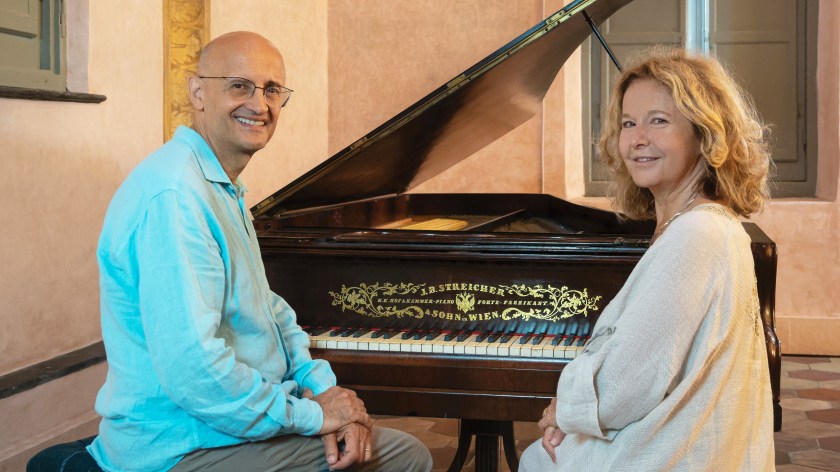
We are particularly pleased with our recent CD, devoted to Brahms’s own four-hand piano versions of his two String Quintets. It is striking that music by such a widely performed composer should have remained so neglected, both in concert and on disc. Recording these works on an 1860 Streicher piano opened up a distinctive sound world and gave us a sense of entering Brahms’s compositional thinking almost from within. We hope the recording has helped bring these transcriptions back to light and reveal them as more than simple reductions: they offer a different and valuable way of understanding and hearing the works.
Which particular works/composers do you think you perform best?
In recent years, we have felt particularly drawn to four-hand piano transcriptions by composers such as Brahms, Mendelssohn and Schumann. In the nineteenth century, piano duet playing was one of the principal ways orchestral and chamber music reached listeners and circulated more widely. When a transcription was made by the composer himself, or by a distinguished musician closely associated with him, it could become a genuine reworking of the original. We are also keen to bring this repertoire back into view, and with it a sense of the important place it held in nineteenth-century musical life.
It feels particularly natural to us as a duo: it demands very close listening, a clear sense of the different layers of sound, and the imagination to evoke on the piano the colours and relationships originally conceived for very different instrumental combinations.
How do you make your repertoire choices from season to season?
Our recording projects lend themselves particularly well to long-term planning, while concert programmes are more responsive to the moment, the venue and the opportunities that arise. Recording gives us the freedom to develop a more coherent, long-term artistic line of enquiry. This involves a good deal of research: searching out scores and source material, comparing different versions, playing through a wide range of music at the piano and discovering which repertoire we find most interesting and stimulating.
Do you have a favourite concert venue to perform in and why?
We particularly love venues where we can feel close to the audience and where there is room for interaction, for example by introducing the concert programme. We feel very much at home in relatively small spaces, with a natural acoustic and a sense of intimacy. Performing music from the past always entails recreating expressive and cultural worlds distant from our own. The concert then becomes a meeting point between past and present. And when a venue with a strong historical identity houses a well-preserved period piano, the experience becomes even more vivid and immediate for us
What do you do off stage that provides inspiration on stage?
Inspiration often seems mysterious and elusive. Over time, however, we have discovered that various practices can help create the inner conditions for inspiration to arise more naturally, making it less dependent on chance and, in a sense, more familiar to us. We mean meditation and the many practices that help us understand and work more effectively with the body, our emotions and our states of consciousness. Many things can then become sources of inspiration: being in nature, reading, the people we meet, discovering new music, or listening to performers we admire.
What is your most memorable concert experience?
In the late 1980s, in Milan, we heard Sergiu Celibidache conduct the Münchner Philharmoniker. It felt almost like witnessing a sacred rite. We had never experienced such a powerful performance, one in which every note and every phrase seemed to grow out of the one before it, like parts of a single living form. We could not even think, “I liked this more, that less,” as one often does even at the finest concerts: the music did not seem to be driven by a personal interpretation, however brilliant, but to unfold according to an inner necessity of its own. It is often said that sound emerges from silence and returns to silence; in that concert, for the first time, we truly experienced what that means.
As a musician, what is your definition of success?
For us, every small moment of fulfilment, every result we achieve — even in the practice room — is a success in itself, something to recognise and appreciate. Ambition can certainly be a powerful driving force in a musician’s life. But if we come to believe that only one particular achievement will make us truly successful, expectation can easily turn into attachment and eventually into a prison. As musicians, we need to remain free to explore different directions and redefine our goals as we go.
What do you feel needs to be done to grow classical music’s audiences?
The music industry often asks how to attract larger audiences and capture people’s attention. Musicians, too, can easily find themselves seeking recognition and success, and the pressures of marketing and competition only reinforce this tendency. But perhaps we need to turn the question around and focus first on what we are actually offering audiences, both as an industry and as musicians.
We live at a time of fragmented attention and constant overstimulation. Classical music can therefore offer something increasingly rare: unhurried time, depth, concentration, attentive listening and emotional intensity. Perhaps we could do more to present it as a valuable resource in responding to some of the challenges of contemporary life.
Benjamin Zander is one of the musicians we particularly admire in this respect. His work shows that it is possible to communicate the depth and excitement of classical music to very wide audiences without simplifying the music or lowering artistic standards.
What’s the one thing in the music industry we’re not talking about which you think we should be?
Perhaps the power of individual action. Today, culture and entertainment are increasingly dominated by large organisations, platforms and market forces. This can easily lead us to believe that change can only happen on a large scale. The result is often a false sense of powerlessness, and a failure to recognise something very simple: culture also changes one person at a time.
We have far more power to influence our immediate environment and the people we meet than we often realise. Talking to someone about music, playing in an informal setting, helping someone discover a more attentive way of listening, inspiring a young student through music — these are simple acts that can have a far greater impact than we imagine.
What advice would you give to young or aspiring musicians?
Don’t just work on becoming a better musician; work on yourself as a person too. The pursuit of recognition, the struggle to make a living and establish yourself professionally, but also music itself — so absorbing and all-encompassing — can eventually make you lose sight of yourself.
Of course, technique, repertoire and musical culture are essential, but never forget that your first instrument is you. Everything else comes to life through you. Your body, emotions, attention and beliefs, the way you respond to difficulties and relate to other people — all of this inevitably becomes part of the way you practise, listen and express yourself through music.
Johannes Brahms – String Quintets in the Composer’s Own Four-Hand Piano Version is released on the Da Vinci Classics label
Discover more from MEET THE ARTIST
Subscribe to get the latest posts sent to your email.

