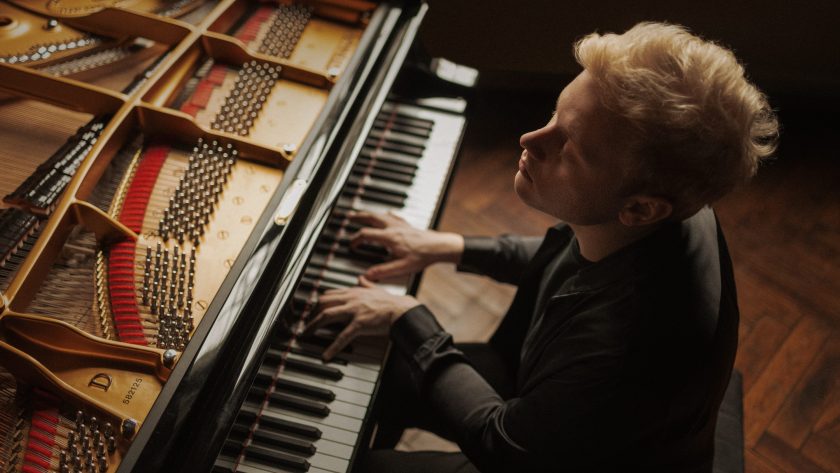
Who or what inspired you to pursue a career in music?
Well, I’ve been a musician as long as I can remember myself, so I think music itself inspired me a lot and after some years of being in music already, I started to think about a career in music because music has never entirely been a career of mine, it’s more like a way of life. Only after I started to go on stage quite a lot already at the age of 11 or 12, I figured out that maybe that’s already a career choice at some point. Of course, there are musicians of the past who have been inspiring me always, like Rachmaninoff and Glenn Gould, for example, but I think the career most likely happened just by itself. I think sometimes about it, because I firstly started playing concerts and then decided to become a musician. It’s a quite rare order.
Who or what have been the most important influences on your musical life and career?
Well, honestly speaking, probably my teacher with whom I studied for 15 years when in Russia. Her name is Yelena Berezkina and of course, you know, we had lessons there far more often than an average teacher or student in a German Hochschule; we had lessons at some point every day. Of course, my influences are unbelievably huge. Talking about other people, there are some conductors like Leonard Bernstein – when you look at any video, it’s just fascinating how he holds music in his hands, in his fingers, how you can see the waves of music in the air and no matter the instrument that they use, the piano or conducting or any other instrument, I always think of it as if the instrument should ultimately disappear. It should be the continuation of the music and in a sense, with great conductors of the past like Bernstein, Abbado and Kleiber, for example, you know, the orchestra is always a continuation of a musical thought which appears in their mind.
What has been the greatest challenge of your career so far?
The worst thing I have had to adapt to in my career is 10-hour flights and every day changing hotels. That’s been quite challenging. Other than that, it’s been quite nice so far, because once you go on stage, you forget about anything else. I did feel quite challenging to play concerts at the age of 11, but after the first 100 and the next 100, you just start to feel comfortable on stage, because it’s a space that you learn to control and you don’t have such control in any other part of your life, because after so many concerts, I can literally feel the air in the room. I can feel every audience member. I can feel every moment of a concert, feeling the time, and it’s so satisfying. Of course there are some challenges musically, but it’s like we’re not quite existing when we go on stage. On stage, it’s just as if I’m having a nice time and that helps to deal with any kind of challenges outside of the stage environment.
That’s not something you can get with every job, that specific experience of performing.
Yes, indeed. However, I would love once to try some other job, anything else, just to see how it is, because of course it feels so normal for me, being a musician for me, when in reality, it’s not really normal. There are so many ‘not normal’ things in my life, so one day I’d like to try something else. There is definitely some charm in the idea of having weekends off and paid vacation time.
- Of what in your career so far are you most proud?
Very little. Very little, because – possibly something from my childhood – I don’t entirely love how I play. However, in general, when I go to a concert and the first second is played well with some kind of spiritual connection with an audience, then that’s an amazing concert because I’m just having a good time on stage and people in the audience are also having a good time sometimes. In a sense, I’m not necessarily proud of it, it’s just how I spend evenings.
However, the album I recorded, I can definitely say I’m proud of it (‘Forgotten Melodies’ on Sony Classical). I’m proud of the result and of the featured music, which I love so much. It became such a defining part of my life for my first album, so I can say I’m proud of it.
How would you characterise your musical style?
I like my music being casual. I feel always that the glamorous, luxurious and so-called ‘golden days’ of classical music are way behind us and what we do now as musicians is basically only needed by us. I always discuss this with other musician friends of mine: I make recordings and they listen to them; they make recordings and I listen to them and sometimes it feels as if we are just making recordings for each other and playing concerts for each other. So, in a sense, I don’t quite believe in a saving role for music or a healing role for music or in music being able to change the world but I do believe that we all can have a good time with music and therefore I always try to create this kind of sound experience in concerts so that audiences can experience something very different from what they can have in their normal lives, in their regular routines, or in their job. I try to let them get as far away from all that for an hour and a half and then they can come back to family or work and if I’m successful in that, then I’m happy.
Do you have a favourite concert venue to perform in and why?
Of course, I every audience is important and every hall has its own special qualities, but I do adore the Concertgebouw in Amsterdam. That is totally my number one for the feeling in there and the sound is kind of rich – in a way, it’s a very Soviet sound – very full in a good way. I have a real soft spot for it.
What is your most memorable concert experience?
Probably the early ones, when I played the Grieg Piano Concerto. It was my first big competition in Kazakhstan. That’s where everything started, my first time playing with an orchestra and actually realising it, because when you play in a classroom alone, you don’t quite know what it is for and why you are doing it. It’s because your mom brought it there to practice music!
Being a part of it all, with all of these other musicians, it was quite a strong feeling for someone only 11 years old. I was a co-creator with 100 other people of a sound – and the sound in a romantic piano concerto is so glorious. So that was very memorable. My teenage try was the Tchaikovsky Piano Concerto No. 1. You know, it’s quite hard in the first rehearsal to play the famous chords of a Tchaikovsky concerto, because it just feels like you’re not quite interpreting Tchaikovsky, but you’re interpreting all the interpretations and all the performances which happened before! I grew up with Kleiber and the recordings from Moscow Tchaikovsky competition and it really feels as if you alone are not pressing the keys but rather together with all the people you adore.
As a musician, what is your definition of success?
I think success is being fulfilled because it can be said there are quite a lot of musicians around who are successful by any means, but they are not fulfilled enough.
I guess for me, my passion is for rare repertoire which I love to interpret, perhaps for the first or second time in history, something which the audience has never heard before and if I can do this and people can relate to it, then to me it is a success. When I build a concert programme which works well and I feel every second of it and didn’t lose any of it, then that is also a success. Currently I’m taking a month off without any concerts and that it also something of a success, so I’m feeling quite fulfilled and successful in that way.
What do you consider to be the most important ideas and advice to impart to aspiring musicians?
I studied a little bit with a very famous professor, Dorenski, at the Moscow Conservatory and he always told me, before every concert, “play well, don’t play badly” . It was good advice because music can be mind-blowing and you can really lose yourself in it, so every time I’m feeling that I’m overly mind-blown before a concert, I remember those words, just to play well. It’s very nice advice, which I remember quite often.
Another piece of advice was given to me by Yefim Bronfman. We were once having dinner after a concert and he told me: “if you’re a nice person, people will forgive any wrong notes”. I also think of this often. Play well and be a nice person are good words of advice to share but more generally though, I think the most important thing is to love music. In my life, I feel like the biggest love of music is when I listen to it, not when I play it. In order to learn a piece, you need to spend a lot of time in it. You need to work so much on it and there are limitations on how much music I can play in a season, but there’s no limitation on how much music I can listen to. I love listening to music so much – different musicians, different ideas, different interpretations. Many people come and tell me that they want their child to become a musician and what would I advise. I personally think it’s really worth studying music when it’s enjoyable, but it’s not really worth becoming a great musician if it’s not enjoyable anymore. I think it’s not worth it, so my main advice is to love music.
What is the most important issue we should be talking about in classical music that is not currently being addressed?
I think everything is being addressed but I think the issue of snobbery is still quite annoying in classical music and it exists in every layer, for example, many people hate Rinaldi but a wide range of people adore Tchaikovsky, Rachmaninoff and Bruckner.
Then there is the next layer of people who think that Tchaikovsky is also not real music, or Rachmaninoff. A large amount of people think that there are just three great composers in history: Bach, Beethoven and Brahms and everyone else is just worse. Or that Russian music is basically pop music, Or performers who are, for example, playing Bach with a pedal, who are basically considered to be sacrilegious. There are so many layers of snobbery that it just ends up harming the music and the concert experience. I think it’s important to be open-minded at a concert and to have a positive attitude.
Again, there are so many people who hate applause between movements, to the point that if someone applauds in the middle of a movement, for them the whole concert is ruined. However, it happens and honestly, it’s not a big issue. There are some people who hate particular composers, situations, musicians but it’s just easier to say that they just hate music. It’s unrealistic for an environment for music creation to be perfect. I can play Bach without a pedal but realistically, I’m not going to do it my whole life. There are many other things which I adore about music but the issue of snobbery and academic privilege over regular concert goers does not help classical music to evolve. There is some evolvement, for sure but there are also people against it and I find it annoying sometimes.
Tell us about your debut album, Forgotten Melodies, and how it came about.
It’s a beautiful double CD of music of four favourite Russian composers of mine: Medtner, Glinka, Rachmaninoff, and Glazunov. It’s called Forgotten Melodies, first of all, because there is a gorgeous cycle written by Nikolai Medtner called Forgotten Melodies, which, in my point of view, is the best Russian cycle of miniatures, which has been ignored by many musicians, and it’s been my favorite for ages, but in general, I wanted to dive in as a listener into this universe of this music, which feels quite nostalgic to me. It’s also very abstract, because all of these composers found themselves in very difficult life circumstances when writing this music and they had to leave Russia at some point for different reasons. Basically, to escape in Russia in a way, and using music, using the music notebook as an imaginary vault, you know, as a safe space in which to escape. Now, being able to sculpt it in two hours on the album, felt like really a beautiful time in the studio, also listening to the edits, which I’m happy to share with people, because it feels to me like a very safe castle of music, built of sound.
What’s next in your career?
I’m still playing concerts, preparing recording projects and I have lots of fun repertoire ideas. Next in my career, I’m going home and practicing in my practice room. I never know how to answer the question ‘what’s next’ because for 15 years my life has been very stable, which feels so nice. Obviously we had the COVID time, but I got through because my profession in reality is not playing concerts or recording, it’s sitting at home alone with a piano and just having a good time. Playing concerts is such a tiny percentage of my music world, although a hugely important one, of course. However, in terms of hours, it’s nothing, so for now, I’m going to learn some nice music and hopefully present it on some stages.
It’s also fascinating how different it looks from outside: from the outside, it looks as if I travel every day, see new countries and play concerts and meet audiences, but in my life, in my mind, my job is sitting at home or in some other piano room again and again. That’s how I see it and it’s very fine. I like it.
Alexander Malofeev is winner of the Gramophone Young Artist of the Year Award 2026
Discover more from MEET THE ARTIST
Subscribe to get the latest posts sent to your email.

