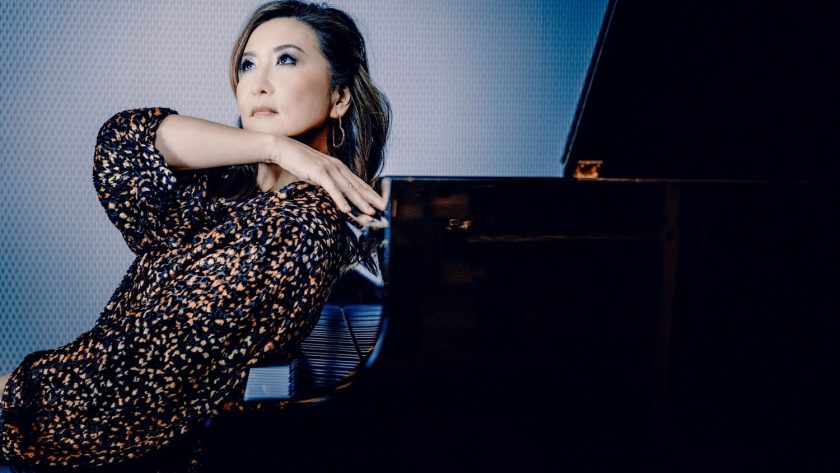
Who or what inspired you to pursue a career in music?
I grew up in Korea as an only child for the first nine years of my life, and my mother was a piano teacher—truly the most passionate musician I know. Even now, at 84, she continues to teach students of all ages, entirely for free—not only piano, but also violin, cello, and the beautiful Korean instrument called the kayagum.
While she was teaching in the other room, I would entertain myself by sight-reading anything I could find—not just piano music, but Korean lieder, Western popular music, classical orchestral repertoire…we had volumes of sheet music, anthologies and miniature scores at home. I remember conducting symphonic music with chopsticks to recordings on the radio. I was completely obsessed with music from a very early age. I loved playing with cassette players, any kind of recording devices, more than toys or dolls!
But there was indeed one defining moment. The Los Angeles Philharmonic came to Seoul under Carlo Maria Giulini, and at one of the concerts, its assistant conductor at the time— Myung Whun Chung, who is now the most important Korean maestro—conducted Mozart’s K.488 from the piano. My parents could only afford one ticket, so just shy of 12, I sat there alone at Sejong Cultural Center, while my mother waited in the car.
I can still remember that sound; that night that changed my life. I immediately asked my mother to buy me the score of the Mozart and began practicing and conducting it myself, with my chopsticks. That was the moment I knew I would become a pianist. (I did try conducting while a student at the Curtis Institute of Music, but it didn’t quite work out!)
What have been the greatest challenges of your career so far?
When I was younger, I thought the greatest challenge was technical—my limitations at the piano, my frustrations about not improving quickly enough.
Now, I believe the true challenge is finding quiet, uninterrupted time to be with the music itself. Life asks so much of us. I am constantly balancing many roles: teacher, head of piano, nonprofit director, mother, wife, daughter, and of course, performer.
The challenge is not the music itself, but protecting and making the space for it and hoping to make it a priority.
Which performances/recordings are you most proud of?
Shortly after the pandemic, several young artists from my nonprofit, the Center for Musical Excellence, stayed in our home or nearby. Together, we created the album Art of Transcriptions, later released on MSR Classics.
It was a true labor of love. Each piece was chosen with great care, and many were arranged by the young artists themselves. In a time that was incredibly difficult for everyone, this collaboration created something deeply meaningful and left us with memories filled with warmth and connection. I remain incredibly proud of those artists, each of whom has gone on to build meaningful and successful careers.
And of course, I must mention my most recent release, America/Beautiful—a five-CD set featuring five hours of new music written for me. The journey was filled with unexpected challenges, including the death of my producer Adam Abeshouse shortly after recording. He was such a champion of both the project and of me as an artist. Losing him was deeply difficult, and I had to find the strength to rebuild, not only the project, but also my own conviction. I am proud that it has finally come to life.
Which particular works or composers do you think you perform best?
I believe my strength lies in versatility, which comes from an unquenchable curiosity. I am always searching, listening, discovering, and therefore always learning.
For a long time, I felt most at home with Bach, Mozart, Schubert, and Schumann. But through my America/Beautiful project—working closely with over 76 living composers, I have now come to feel equally at home in music that is 300 years old or 3 days old.
Each composer offers a distinct language and way of thinking. Engaging deeply with them has transformed not only what I play, but how I listen. All this is to say that my “best repertoire” is not defined by composer, but by my ability to inhabit many musical worlds authentically.
What do you do off stage that provides inspiration on stage?
I go to concerts as often as I can.
For me, there is nothing more inspiring than sitting in a concert hall. I am always elated by the experience of the surround sound, music being made in real time. I also spend a lot of time in conversation with composers, collaborators, and audience members.
Listening, both in and out of the concert hall, shapes everything I do on stage.
How do you make your repertoire choices from season to season?
In recent years, much of my programming has been shaped by America/Beautiful, which has been central to my artistic life since 2020.
At the same time, I continue to perform multiple concertos each season and remain deeply committed to chamber music. Collaborating with other musicians feels completely natural and essential.
Do you have a favorite concert venue to perform in and why?
I love intimate spaces, such as house concerts. As director of CME, I have produced many of these for young artists, and now I host them in a small but beautiful barn at my home.
I also enjoy the venues where I can talk to the audience. Being able to look directly into the eyes of each audience member and feel their energy so close is incredibly meaningful. That immediacy and connection are deeply rewarding.
What do you think needs to be done to grow classical music’s audiences?
The increased use of visuals, especially through social media, is helping to bring new and
younger audiences into the concert hall. At the same time, I worry that music may be judged too quickly, without the time or depth of engagement it truly requires.
Still, when used thoughtfully, these tools can make classical music more inviting and accessible.What I personally believe in though is a way to invite listeners into a living, evolving artistic conversation that bridges past and present, storytelling, and relevance to our lives today.
What is your most memorable concert experience?
Perhaps my debut in Korea, when I was about 12, performing the Mendelssohn’s Piano Concerto No. 1. It was overwhelming, both on stage and afterwards. So many friends came, and when they congratulated me, I burst into tears. I was completely moved, by the power of the shared, communal experience, the resulting emotion of giving and receiving a concert.
As a musician, what is your definition of success?
Success is when something I believe in musically reaches or touches someone else.
That can happen in many ways—through a concert, a lesson, a masterclass, or even a conversation. Sometimes the impact extends far beyond the immediate moment.
If your art touches someone, on any level, that is success.
What advice would you give to young or aspiring musicians?
Know why you are doing this, and keep asking that question.
I once asked my doctoral students: “Why are you here? Why do you need a doctorate?” Many couldn’t answer, and later told me no one had ever asked them so directly. Without clarity of purpose, passion can fade quickly, as well as joy and meaning.
What’s one thing in the music industry we’re not talking about enough?
Again, asking the question, why are we doing this?
Loving music is not, by itself, enough—you don’t have to be a performer to love music.But on the other hand, I feel that everyone in this field—not just performers, but also administrators, presenters, and managers—should also genuinely care about the art itself. I’ve seen people working in music school during the day, for example, never go to hear the music in the evening. When it becomes simply a job, that disconnect is something we need to confront. I believe the music industry needs people who love music.
What’s next? Where would you like to be in 10 years?
In 10 years, my daughters will likely be independent, which will give me more time and freedom.
I would love to dedicate more of that time to the Center for Musical Excellence—raising funds to support more young artists—and to projects like America/Beautiful. Both are rooted in the same mission: supporting artists, fostering creativity, and building meaningful artistic platforms.
I hope to continue expanding these efforts, bringing new music, new voices, and new ideas into the world.
What is your most treasured possession?
When I look at my daughters, I feel that bringing them into this world and watching them grow into such beautiful human beings gives my life its deepest meaning. So they are indeed my treasures.
And in music, perhaps they are my ears, my open mind, my always hungry soul, and my emotional heart, all of which allow me the ability to truly hear and feel music.
Min Kwon‘s new album America/Beautiful – variations on “America the Beautiful” from 76 leading and rising composers – is releaed on 8 May on the Delos label
(Artist image: Andrej Grilc)
Discover more from MEET THE ARTIST
Subscribe to get the latest posts sent to your email.

