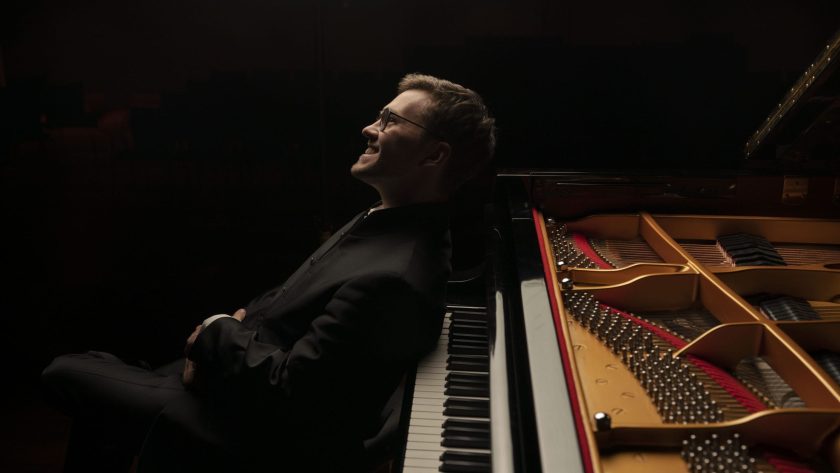
Who or what inspired you to pursue a career in music and who or what have been the most important influences on your musical life and career?
Music has always been the most important thing in my life. To be honest, I never doubted that I would one day pursue a career in music. The much more difficult question for me was: Who do I want to be as an artist? Shall I become rather a drummer, a pianist, a conductor, maybe even a composer or a teacher? Of course, my professors guided me in all these areas, as were the great idols, such as Leonard Bernstein. I’m very glad that I had the opportunity to explore such a wide variety of musical activities and that I’m still able to bring them to life on stage today – whether at the conductor’s podium, in piano concertos with an orchestra, or in jazz with my own trio. I love the diversity of music!
What have been the greatest challenges of your career so far?
Haha! I think I’m currently working on the biggest challenge of my career: Rachmaninoff’s Piano Concerto No. 3. Ever since I was a teenager, I’ve dreamed of performing this masterpiece. Every now and then, I’d play passages from it just for fun. However, there were so many other piano concertos on my schedule that I never got around to finishing it. A year ago, I made the decision and said, “Now it’s time for Rach 3.”
Which performances/recordings are you most proud of?
Over the past 6 years, I have recorded all 6 piano concertos and many other works by the Ukraine-born soviet composer Nikolai Kapustin — virtuoso pieces no less complex than Rachmaninoff’s, with a strong jazz influence, composed for piano with big band and/or symphony orchestra. To date, no one has performed or recorded all 6 piano concertos, and I felt a deep urge to take on this challenge. This fall, on 6 November the complete CD box, including several world premiere recordings, will be released on the Capriccio label. The entire project was only possible because so many people believed in my idea and supported me with their expertise, above all my two friends from my jazz trio, double bassist Jakob Kurpp and drummer Obi Jenne. I’ve lost count of the many hours we’ve spent playing Kapustin’s music… If you’re not yet familiar with Kapustin, you should definitely have a listen here:
Which particular works/composers do you think you perform best?
I love rhythm and groove! So, it stands to reason that I really enjoy playing or conducting the works of composers like Gershwin or Bernstein. Jazz makes my heart beat faster, with its blue notes and syncopations. In contrast, I can also really immerse myself in Beethoven’s compositions, or those of Brahms. I also find it exciting to discover unknown works or new compositions and bring them to life. Most recently, I recorded the piano concertos by Austrian composer H K Gruber and Icelandic composer Daniél Bjarnason, both of which were written within the last 10 years. Imagine having a score in front of you and not being able to simply go to your CD shelf or Spotify, as you would with the standard repertoire, to compare different interpretations? The piece is just written on paper, and I get to bring the work to life. It’s so exciting!
What do you do off stage that provides inspiration on stage?
It’s people who interest me. Without people, there is no art. Every person tells a very personal story and expresses themselves in a wide variety of ways. I really enjoy meeting up with friends and spending time with my family. And let’s not forget nature! When I really have a day to myself, I head out into the countryside. I live near the Black Forest in Germany. Going for a walk there and breathing in the fresh air does me a world of good. (By the way, Brahms used to go for walks there often, too!)
Do you have a favourite concert venue to perform in and why?
Oh, I can’t decide. There are so many incredibly beautiful concert halls: the KKL in Lucerne, Wigmore Hall in London, the Concertgebouw in Amsterdam, the Philharmonie in Paris, or even the halls in Wuppertal, Wiesbaden, or Frankfurt. What matters much more is the atmosphere in the hall, which is created by the audience. How does the audience react? Are they all listening intently? Can I connect with the audience through the music and touch the hearts of the listeners? That’s more important to me than the colours painted on the wall.
What do you feel needs to be done to grow classical music’s audiences?
Making music yourself, experiencing music, learning an instrument! Anyone who has ever played an instrument and experienced the joy that making music can bring, doesn’t just want to listen to music through headphones. They want to experience a live concert. Being a musician is a wonderful profession; I wouldn’t trade it for anything. It’s also wonderful to make music as a hobby. As a young boy, I had my first experiences as a drummer in a brass band. Several times a week, music lovers and amateurs would get together after work or on the weekends to make music, simply for the love of it. There are countless studies showing how healthy music is for the brain and the nervous system. It’s good for the soul, too. Making music ourselves should definitely be integrated more into our everyday lives again. So put away your cell phone and pick up an instrument!
What is your most memorable concert experience?
There are thousands of stories to tell! How about this one…my friend and conductor Patrick Hahn invited me and my trio to perform Gershwin’s Piano Concerto in F in our arrangement for jazz trio and orchestra with the Frankfurt Radio Symphony Orchestra. We’d been discussing over the phone what we could play as an encore. Patrick is an outstanding chansonnier who loves to perform Fritz Kreisler songs while playing the piano. My two colleagues; Jakob on bass and Obi on drums, had taken their places at their instruments, and Patrick took over the piano part. Patrick simply said to me, “You’ll think of something!” So, the piano was already taken – which instrument should I play? One thing upfront: I was definitely more nervous before the encore than before the piano concerto! Here is the result:
As a musician, what is your definition of success?
Step by step, always moving forward. When I picture a career symbolically, I see a tree (with deep roots!). The roots underground represent the hours spent practicing, working, learning, despairing, sweating, and expanding your repertoire. Eventually, a small, delicate plant emerges after some time. The tree grows upward – and just as much downward. And it takes patience before you can harvest the first fruits.
What advice would you give to young/aspiring musicians?
Always keep your eyes, ears, and heart open. Broaden your horizons. You can learn so much from so many experiences. I’d say I learned the most about playing the piano when I wasn’t sitting at the keyboard. That sounds illogical! Let me try to explain: Anyone who has ever composed a piece themselves has a completely different perspective on a composition. Anyone who has ever played in an orchestra can play with an orchestra as a soloist in a completely different way. Anyone interested in the visual arts and well-versed in art history can contextualize and appreciate music and its era much better, and so on.
What’s next? Where would you like to be in 10 years?
In the music world, we plan many months, even up to 2–3 years ahead. During the next year I’m already looking forward to many upcoming concerts in the UK with outstanding orchestras, including a Gershwin Piano Concerto in F on 20 November 2026 with BBC National Orchestra of Wales in Cardiff and a recital of piano quartets on 22 March 2027 at Wigmore Hall, London. In the next few years I hope to make some debuts in the United States! My head is always buzzing with ideas for repertoire that hasn’t been heard before. Ideas I’m eager to bring to life. The last five years of my life have been so exciting. I’m really curious what the next 5 or 10 years will bring.
Kapustin Eight Concert Etudes, arr. by Frank Dupree, performed by the Frank Dupree Trio, is out now
Artist image: Marco Borggreve
Discover more from MEET THE ARTIST
Subscribe to get the latest posts sent to your email.

