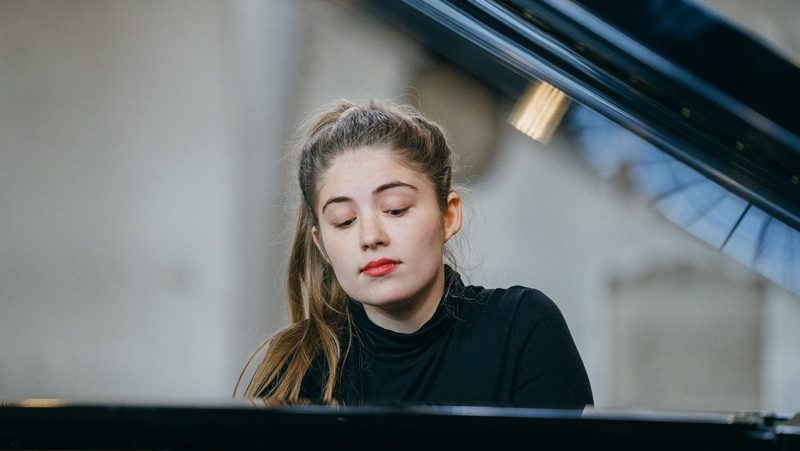
Who or what inspired you to pursue a career in music and who or what have been the most important influences on your musical life and career?
I was 5 years old when I decided firmly that I wanted to become a ‘professional pianist’. Although I did not know exactly what that entailed, I felt a strong connection to playing the piano and the instrument as a whole, and knew that no other career would be suitable for me. It was purely by accident that I discovered the piano; I was at kindergarten, waiting for my parents to pick me up, and I remember while I was waiting, having fallen truly in love with the sound of the piano coming from behind the board. It was a magical invention for a 5 year old – you press the keys and a sound is suddenly made.
What followed were 21 years of a lot of hard work, ambition and great opportunities, always supported by my parents who pushed me always to carry on even when it was difficult, or boring to practice. Like any other kid, I wanted to play with my dolls or with my friends outside, but looking back, I am grateful I practiced instead and learned many skills through playing the piano: resilience, patience, discipline.
My other mentors were my two teachers who I worked with during my childhood, Mrs Adriana Bocaneanu and Mrs Ana Pitis. They both belonged to the old-school, traditional piano method which was based on research, great technique and philosophy. I became a pianist with an individual voice because of them!
What have been the greatest challenges of your career so far?
Although getting into the Royal College of Music was a big achievement for a young Romanian girl coming from a modest background, the greater challenge was graduating with distinction in both my Bachelor and Master degrees. We were told at the beginning of our studies that being accepted into a prestigious conservatoire is just the first step, and actually making it out the other way with high accomplishments would be truly difficult.
Another challenge followed by my years of studies has been the period after graduation, when you start to realise there is a very small pool of work opportunities for musicians, and the fact that you need to continue to perform, promote yourself, teach and stay relevant all at the same time. In this period it dawned on me that the work is only getting harder from here.
Which performances/recordings are you most proud of?
A year ago I released my first album, “Ravel, Granados and Copland”, wanting to put together well known repertoire (Ravel’s Jeux d’eau and Granados’ El Amor y la Muerte) with a quirky, less well-known piece called “El Salón México” from Aaron Copland and arranged by Leonard Bernstein, which brings me so much joy to perform.
I wanted to bring awareness to diverse repertoire which can be fun, intriguing and entertaining for both the performer and the audience, and step out of the traditional classical repertoire that is often repeated in other CDs/albums. “El Salón México” remains an audience favourite every time I play it and I look forward to premiering it in New York this September at the DiMenna Centre for Classical Music.
Which particular works/composers do you think you perform best?
I am really interested in exploring folk music within the classical spectrum and composers like Ginastera, Granados, Copland or Manuel de Falla bring me a lot of joy. I also like to include Romanian folk music (often my own compositions) and Arabian- and Latin-influenced pieces in my recitals which always stir curiosity in the audience.
I discovered that the music I am most passionate about performing are those that are very accessible, emotional and which reach a wider range of audiences. When I rearrange works by Maria Tanase, Surorile Osoianu (both sacred Romanian folk artists), or jazz pianists such as Aziza Mustafa Zadeh (an Azerbaijani jazz musician), I often attract a younger crowd – I believe we, as musicians, have the power to attract new public to our concerts, and concepts like a piano recital which includes classical, jazz and folk music can better stand out to audiences.
How do you make your repertoire choices from season to season?
I love discovering new repertoire by listening to inspiring performances on YouTube, both from world-renowned artists and from musicians who are just beginning their careers. Sometimes I come across a piece performed by a student whose video may have only 50 views, yet the musicality, sincerity, and artistry of the performance captivate me instantly. Those unexpected discoveries are often the most memorable.
Ever since I was a child, I have kept a running list of works I dream of performing one day. Each season, I revisit that list and choose the pieces that I feel ready to bring to stage, having matured enough, both technically and musically.
For my upcoming recital in the Weymouth Concert Series on 21st October, I am preparing Schumann’s Fantasie in C major, Op. 17. It is one of the most profound and emotionally rich works in the piano repertoire, and I have dreamed of performing it for many years. This concert will mark my debut with the piece, making it an especially meaningful milestone for me.
Do you have a favourite concert venue to perform in and why?
For me it is always a great joy to come back home and perform at the Romanian Atheneum, Bucharest, as well as in both the larger and smaller halls. The Romanian Atheneum was the first large hall I ever performed in, first as a singer in my school’s choir, and then invited as a soloist to give piano recitals and performing with the orchestra. I loved seeing my family and friends come to the evening recitals and concerts I gave on numerous occasions. It remains a beautiful place full of magic, history and elegance and my favourite hall in which to perform. It also hosts many of the concerts from the George Enescu Festival and Competition – not to be missed this September!
What do you do off stage that provides inspiration on stage?
Recently, I started prioritising my health which was long overdue. In a world where there is no time for self care because work is all you know, I was struggling with finding the right time to workout and eating healthy. Such a small habit of incorporating a short workout routine and having balanced healthy meals throughout the day have become my source of energy and inspiration. I started feeling much more confident, productive and inspired after I changed my diet and started engaging in more physical exercises.
I also strongly believe that breaks are essential for our minds and bodies, especially as musicians. I like to escape to warmer climates or book a spa day here and there, when time allows, just to give myself a reboot and head back to practice with a clear and relaxed mind.
What is your most memorable concert experience?
I would like to share a concert that I attended rather than one in which I performed. When I was 15 and living in Bucharest, the Romanian Atheneum was almost a second home to me. At the time, high school students could attend concerts free of charge, so I went almost every week, listening to outstanding soloists, orchestras, and chamber ensembles. Those evenings played a huge role in shaping my musical identity.
One concert has stayed with me ever since. Conducted by Misha Katz with the George Enescu Philharmonic Orchestra, the programme was anything but conventional: Kaddish by Mihail Gluz, Douleur de la Terre by Igor Levin, and Beethoven’s Fantasy for Piano, Choir and Orchestra.
The unusual programme immediately captured my curiosity, but what made the evening unforgettable was the intensity of the performance itself. From the moment Misha Katz raised his baton, I was completely absorbed by the music. I have never experienced such complete stillness in a concert hall before or since. I remember sitting in exactly the same position from the first note to the last, so captivated that I hardly even moved my head. Time seemed to stand still.
That evening taught me how transformative a live performance can be. Misha Katz possesses a rare ability to communicate the emotional essence of the music so powerfully that the audience cannot help but experience it with him. It remains one of the most profound musical experiences of my life.
As a musician, what is your definition of success?
For me, success as a musician is not defined by prizes, prestigious venues, or external recognition. It is the feeling of fulfilment that comes after overcoming a meaningful challenge, not by choosing the easiest path, but by staying true to your artistic mission, your passion, and your instincts.
I don’t believe success comes easily. In fact, we, as musicians, are often our own toughest critics, always striving for something greater and rarely feeling completely satisfied with what we have achieved. That constant pursuit of growth is part of what drives us forward.
At the same time, I think we can be successful without even realising it. If we are fortunate enough to spend our lives following a path that brings us purpose, joy, and a sense of fulfilment, despite all the inevitable challenges, then that is already a remarkable achievement. Success is not a final destination but an ongoing journey, and I believe it is important to recognise and celebrate those moments along the way.
What do you feel needs to be done to grow classical music’s audience?
Living in London, you never face a lack of concerts, shows, musicals or plays. I have noticed a growing number of people who choose to go to immersive classical music concerts, where there is a performer, or a video of a performer, live music and an installation displayed. People love seeing experiences on stages, especially when there is a theme or a combination of sound and images that make you remember a certain feeling or emotion, or even simply a unique experience you are unlikely to forget.
Additionally, bringing music from different backgrounds (Latin, folk, jazz) and actually presenting these pieces with a verbal introduction and background, helps better engage the audience and makes them want to come to the specific concert again. I love seeing performers talking about their repertoire choices, it provides a meaningful connection and breaks the wall between the audience and the performer.
At the same time, I believe shorter concerts would be an alternative to grow our classical music audiences. I often think classical music concerts are too long especially as they start and finish very late. That does not always attract younger audiences, whose attention span has changed over the years. More colours and a diversity of styles in our concerts, underpinned by a sense of entertainment, within a shorter time frame is needed in my opinion.
What’s the one thing in the music industry we’re not talking about which you think we should be?
One thing I believe we should talk about more is the importance of community within the classical music world. Speaking from the perspective of a pianist, I often feel that our profession can be surprisingly isolating. From an early age, we are taught to compete, to secure opportunities before someone else does, to compare ourselves with others, and to constantly prove our worth. While a certain level of competition can be healthy, I sometimes think it comes at the expense of genuine connection.
I believe we have much more to gain by supporting one another, celebrating each other’s achievements, and collaborating to create meaningful musical experiences for our audiences. Some of my greatest inspiration comes from listening to fellow musicians in concert, and I often leave wanting to start a conversation, exchange ideas, or explore future collaborations.
Yet, I have found that this can be surprisingly difficult. There is not always a strong culture of reaching out, building relationships, or creating a sense of community among colleagues. Of course, I have also met generous and open-minded musicians who have been enthusiastic about sharing ideas and working together, and those experiences have been incredibly rewarding. I simply wish they were the norm rather than the exception.
I believe the classical music world would be stronger if we viewed one another less as competitors and more as colleagues. We need to become more supportive of each other and create a safe, friendly and fair-play environment for ourselves and our audiences.
What advice would you give to young or aspiring musicians?
It is a very hard world where people will tell you that what you are doing is meaningless, difficult to succeed and not a money-bringer, and they are not necessarily wrong, but are just afraid and perhaps ignorant of what it means to be in our profession. Do it anyway and do it your own way, no matter who tells you otherwise! It is always better to try and see where this journey takes you, rather then regretting not even taking the first step.
What’s next? Where would you like to be in 10 years?
I am very fortunate that I have built an extensive list of collaborations in the past years and I have future projects including a Masterclass I will be leading in New York City, followed by a piano recital, a chamber recital in Singapore and many solo recitals in the UK for the following season including my solo recital at the Weymouth Concert Series. One thing I miss dearly and would love to explore more would be performing with an orchestra in the UK and worldwide. I am working currently on Gabriela Montero’s Latin Piano Concerto which matches perfectly with my passion for folk, Latin and traditional music within the classical genre and would love the opportunity to perform it with an orchestra.
In 10 years from now I would love to be an established pianist with a busy performing schedule, a piano Professor at a Conservatoire and explore more opportunities coming from my calling for bringing traditional folk music into the classical music sphere.
What is your idea of perfect happiness?
I would love to be less aware of my mistakes, failures and more focused on the goal – to bring joy through my performances to the audience and to myself.
My happiness comes from the moments when I am truly free on stage, when I am not thinking “what if I am being judged right now”, “what if I do not know what comes next after this bar”. However, it is very difficult to reach the state when I can extract those thoughts effortlessly. Happiness comes with confidence for me and as a musician I am trying to build it more and more, day by day, year by year as I truly want to feel free, accept the outcome and not be caught up by insecure thoughts that can ruin a performance or my personal expectations.
https://www.cristiana-achim.com
Discover more from MEET THE ARTIST
Subscribe to get the latest posts sent to your email.

